Gutscheinbedingungen

**Gültig bis 25.06.2026 auf fremdsprachige Bücher online auf thalia.at und in der Thalia App. Einzelne Artikel können ausgeschlossen sein. Ausgenommen sind preisgebundene Artikel & eBooks. Pro Einkauf einmal einlösbar. Click & Collect nur bei Onlinevorabzahlung möglich. Keine Barauszahlung. Nicht kombinierbar mit anderen Aktionen und Gutscheinen. Gutschein wird auf max. 500€ Bestellwert angerechnet. Nicht gültig für Geschenkkarten, Versandkosten und Services.

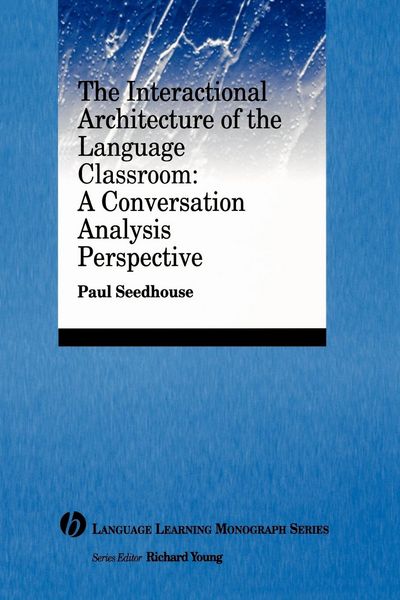
Produktbild: The Interactional Architecture of the Language Classroom

The Interactional Architecture of the Language Classroom A Conversation Analysis Perspective

57,99 €

inkl. gesetzl. MwSt., Versandkostenfrei


Beschreibung

Produktdetails

Einband

Taschenbuch

Erscheinungsdatum

05.01.2005

Verlag

Wiley

Seitenzahl

316

Maße (L/B/H)

22,9/15,2/1,7 cm

Gewicht

426 g

Sprache

Englisch

ISBN

978-1-4051-2009-8

Beschreibung

Produktdetails

Einband

Taschenbuch

Erscheinungsdatum

05.01.2005

Verlag

Wiley

Seitenzahl

316

Maße (L/B/H)

22,9/15,2/1,7 cm

Gewicht

426 g

Sprache

Englisch

ISBN

978-1-4051-2009-8

Herstelleradresse

Libri GmbH
Europaallee 1
36244 Bad Hersfeld
DE

Email: gpsr@libri.de

Kundinnen und Kunden meinen

0 Bewertungen

Informationen zu Bewertungen

Zur Abgabe einer Bewertung ist eine Anmeldung im Konto notwendig. Die Authentizität der Bewertungen wird von uns nicht überprüft. Wir behalten uns vor, Bewertungstexte, die unseren Richtlinien widersprechen, entsprechend zu kürzen oder zu löschen.

Die Bewertungen sind nach Format, Anzahl Sterne und Datum sortiert.

Verfassen Sie die erste Bewertung zu diesem Artikel

Helfen Sie anderen Kund*innen durch Ihre Meinung

Kundinnen und Kunden meinen

0 Bewertungen filtern

  • Produktbild: The Interactional Architecture of the Language Classroom
  • Series Editor's Foreword.

    Acknowledgments.

    Chapter 1 Conversation Analysis Methodology.

    1.1 History and Development of Conversation Analysis.

    1.2 Ethnomethodology.

    1.3 The Principles of Ethnomethodology.

    1.4 Aims of Conversation Analysis.

    1.5 Principles of Conversation Analysis.

    1.6 Types of Interactional Organization.

    1.7 Conversation Analysis Procedures.

    1.8 Attitude Toward Context.

    1.9 Ethnomethodological Conversation.

    1.10 Chapter Summary.

    Notes.

    Chapter 2 Different Perspectives on Language Classroom Interaction.

    2.1 Discourse Analysis Approaches.

    2.2 The Communicative Approach to Second Language Classroom Interaction.

    2.3 Dynamic and Variable Approaches to Classroom Interaction.

    2.4 Database Issues.

    2.5 Adequacy of Database for the Study of Second Language Classroom Interaction.

    2.6 Ethnography.

    2.7 The Pedagogical Landing-Ground Perspective.

    2.8 A Conversation Analysis Institutional-Discourse Perspective.

    2.9 Chapter Summary.

    Notes.

    Chapter 3 The Organization of Turn Taking and Sequence in Language Classrooms.

    3.1 Turn Taking and Sequence in Form-and-Accuracy Contexts.

    3.2 Turn Taking and Sequence in Meaning-and-Fluency Contexts.

    3.3 Turn Taking and Sequence in Task-Oriented Contexts.

    3.4 Turn Taking and Sequence in Procedural Contexts.

    3.5 Methodological Issues.

    3.6 Chapter Summary.

    Notes.

    Chapter 4 The Organization of Repair in Language Classrooms.

    4.1 Repair in Form-and-Accuracy Contexts.

    4.2 Repair in Meaning-and-Fluency Contexts.

    4.3 Repair in Task-Oriented Contexts.

    4.4 Discussion.

    4.5 Practical Applications of a Contextual Approach to Repair.

    4.6 The Preference Organization of Repair: The Case of the Missing "No."

    4.7 Strategies for Conducting Repair Without Using Direct Negative Evaluation.

    4.8 Examples of the Use of Mitigated Negative Evaluation.

    4.9 Why Is There a Dispreference for Direct and Unmitigated Negative Evaluation?

    4.10 A Different Preference Structure in Relation to Procedural Trouble.

    4.11 The Paradox: Pedagogy and Interaction in Opposition.

    4.12 Conclusions.

    4.13 Chapter Summary.

    Notes.

    Chapter 5 The Organization of Language Classroom Interaction.

    5.1 A Sketch of the Interactional Architecture of the Second Language Classroom.

    5.2 The Basic Sequence Organization.

    5.3 A Methodology for the Analysis of Second Language Classroom Interaction.

    5.4 Talking the Institution of the Second Language Classroom In and Out of Being.

    5.5 The Concept of Second Language Classroom Contexts.

    5.6 A Three-Way View of Context.

    5.7 Creating a Second Language Classroom.

    5.8 Managing Context Shift.

    5.9 Chapter Summary.

    Notes.

    Chapter 6 Conversation Analysis, Applied Linguistics, and Second Language Acquisition.

    6.1 Conversation Analysis and Applied Linguistics.

    6.2 Conversation Analysis and Second Language Acquisition.

    6.3 Recasts.

    6.4 Focus-on-Form Instruction.

    6.5 Conversation Analysis as a Social Science Research Methodology.

    6.6 Chapter Summary.

    Notes.

    Chapter 7 Epilogue.

    Appendix 1 Transcription Conventions.

    Appendix 2 Resources for Conversation Analysis Research in Applied Linguistics and Second Language Acquisition.

    References.

    Index.