KI-Beratung Beta

Gutscheinbedingungen

**Gültig am 27.11.2026 auf Spielzeug, Schreibwaren, Filme, Geschenke & Trends, Musik, tolino eReader & Zubehör, Hörbücher und Hörbuch-Downloads, nicht preisgebundene Bücher und Kalender online auf thalia.at und in der Thalia App. Einzelne Artikel können ausgeschlossen sein. Aufgrund der Buchpreisbindung sind deutschsprachige Bücher und eBooks ausgenommen. Zusätzlich ausgenommen sind Abos & Flatrates, Games, Geschenkkarten/-boxen, Shelfies, Software, Zeitschriften sowie einzelne Artikel von tonies®. Pro Einkauf einmal einlösbar. Click & Collect nur bei Onlinevorabzahlung möglich. Keine Barauszahlung. Nicht kombinierbar mit anderen Aktionen und Gutscheinen. Gutschein wird auf max. 500€ Bestellwert angerechnet. Nicht gültig für Versandkosten und Services.

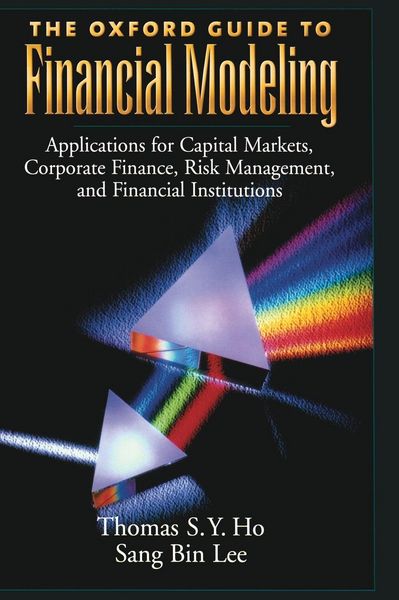
  • Produktbild: The Oxford Guide to Financial Modeling
  • Produktbild: The Oxford Guide to Financial Modeling

The Oxford Guide to Financial Modeling

357,99 €

inkl. gesetzl. MwSt., Versandkostenfrei


Beschreibung

The essential premise of this book is that theory and practice are equally important in describing financial modeling. In it the authors try to strike a balance in their discussions between theories that provide foundations for financial models and the institutional details that provide the context...

Beschreibung

The essential premise of this book is that theory and practice are equally important in describing financial modeling. In it the authors try to strike a balance in their discussions between theories that provide foundations for financial models and the institutional details that provide the context for applications of the models. The book presents the financial models of stock and bond options, exotic options, investment grade and high-yield bonds, convertible bonds, mortgage-backed securities, liabilities of financial institutions -- the business model and the corporate model. It also describes the applications of the models to corporate finance. Furthermore, it relates the models to financial statements, risk management for an enterprise, and asset/liability management with illiquid instruments. The financial models are progressively presented from option pricing in the securities markets to firm valuation in corporate finance, following a format to emphasize the three aspects of a model: the set of assumptions, the model specification, and the model applications. Generally, financial modeling books segment the world of finance as "investments," "financial institutions," "corporate finance," and "securities analysis," and in so doing they rarely emphasize the relationships between the subjects. This unique book successfully ties the thought processes and applications of the financial models together and describes them as one process that provides business solutions. Interested readers can build and test the models described in the book using Excel, and they can submit their models to the site. Readers can also use the site's forum to discuss the models and can browse server based models to gain insights into the applications of the models. For those using the book in meetings or class settings the site provides Power Point descriptions of the chapters. Students can use available question banks on the chapters for studying.

Produktdetails

Einband

Gebundene Ausgabe

Erscheinungsdatum

15.01.2004

Abbildungen

numerous line figures

Verlag Oxford Academic

Produktdetails

Einband

Gebundene Ausgabe

Erscheinungsdatum

15.01.2004

Abbildungen

numerous line figures

Verlag Oxford Academic
Seitenzahl

762

Maße (L/B/H)

26/18,3/4,5 cm

Gewicht

1541 g

Sprache

Englisch

ISBN

978-0-19-516962-1

Herstelleradresse

Libri GmbH
Europaallee 1
36244 Bad Hersfeld
DE

Email: gpsr@libri.de

Noch keine Bewertungen vorhanden

Verfassen Sie die erste Bewertung zu diesem Artikel

Helfen Sie anderen Kundinnen und Kunden durch Ihre Meinung.

Kundinnen und Kunden meinen

Bewertungen (0)

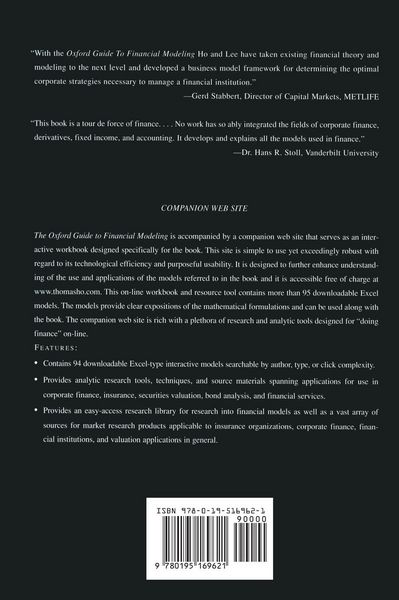
  • Produktbild: The Oxford Guide to Financial Modeling
  • Produktbild: The Oxford Guide to Financial Modeling
    • PART 1. DERIVATIVES VALUATION

    • 1: Introduction: Discounted Cash Flow Method

    • 2: Equity Market: the Capital Asset Pricing Model

    • 3: Bond Markets: the Bond Model

    • 4: Equity Options: the Black-Scholes Model

    • 5: Interest Rate Derivatives: Interest Rate Models

    • 6: Implied Volatility Surface: Calibrating the Models

    • 7: Exotic Options: Bellman's Optimization, Filtration Model and n-Factor Model

    • PART 2. CORPORATE LIABILITIES

    • 8: Investment Grade Corporate Bonds: the Option Adjusted Spread

    • 9: High Yield Corporate Bonds: the Structural Models

    • 10: Convertibles, MBS/CMO, and Other Bonds: the Behavioral Models

    • 11: Financial Institutions' Liabilities: Required Option Adjusted Spread

    • PART 3. CORPORATE FINANCE

    • 12: Valuation of a Firm: the Business Model

    • 13: Strategic Value of a Firm: Real Option

    • 14: Optimal Corporate Financial Decisions: Corporate Model

    • 15: Risk Management

    • 16: Financial Institutions: Applications of Financial Models

    • 17: Equity Options: the Black-Scholes Model

    • 18: Concluding Thoughts

    • 19: Epilogue: Market Model and Binomial Lattices

    • Notation