Gutscheinbedingungen

**Gültig nur für Bestellungen an die Wunsch-Poststation bis 10.06.2026 auf Spielzeug, Schreibwaren, Filme, Geschenke & Trends, Musik, tolino eReader & Zubehör, Hörbücher und Hörbuch-Downloads (außer Abo), nicht preisgebundene Bücher und Kalender online auf thalia.at und in der Thalia App. Einzelne Artikel können ausgeschlossen sein. Aufgrund der Buchpreisbindung sind deutschsprachige Bücher und eBooks ausgenommen. Zusätzlich ausgenommen sind preisgebundene Artikel, Abos & Flatrates, eBooks, Games, Geschenkkarten/-boxen, Shelfies, Software, Zeitschriften sowie einzelne Artikel von tonies®. Pro Einkauf einmal einlösbar. Kein Click & Collect möglich. Keine Barauszahlung. Nicht kombinierbar mit anderen Aktionen und Gutscheinen. Gutschein wird auf max. 500€ Bestellwert angerechnet. Nicht gültig für Versandkosten und Services.

  • Produktbild: Towards a Service-Based Internet
  • Produktbild: Towards a Service-Based Internet

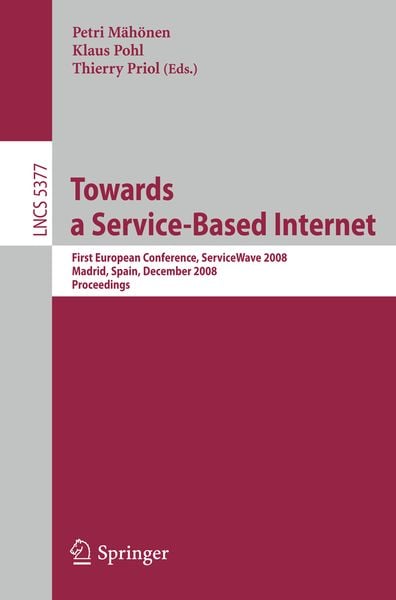
Towards a Service-Based Internet First European Conference, ServiceWave 2008, Madrid, Spain, December 10-13, 2008, Proceedings

49,99 €

inkl. gesetzl. MwSt., Versandkostenfrei


Beschreibung

Produktdetails

Einband

Taschenbuch

Erscheinungsdatum

01.12.2008

Herausgeber

Petri Mähönen + weitere

Verlag

Springer Berlin

Seitenzahl

338

Maße (L/B/H)

23,5/15,5/2 cm

Gewicht

545 g

Auflage

2008

Sprache

Englisch

ISBN

978-3-540-89896-2

Beschreibung

Portrait

Dr. Klaus Pohl is full professor for software systems engineering and director of the Institute for Computer Science and Business Information Systems at the University of Essen, Germany. He holds a degree in computer science (FH Karlsruhe, Germany) and a degree in information systems (Univ. Konstanz, Germany). Klaus Pohl received his PhD and his habilitation in Computer Science from the Technical University of Aachen, Germany. His current research interest include software product lines, requirements management and scenario-based test case derivation. Current research projects include the European ITEA initiative in software product lines (the CAFÉ project) and various industrial uptake projects with leading Germany companies. Klaus Pohl is (co-)author of over 90 referred publications in the area of requirements and software engineering. He as published a book on Process-Centred Requirments Engineering (RSP/Wiley) and is (co-editor) of more than 15 conference and workshop proceedings. Moreover, he is/was co-editor of several special issues of well-established journals, including 'Introduction of Software Product Lines', IEEE Software, 2002. He is a member of the IFIP working-group 2.9 on software requirements engineering, member of the steering committee of the IEEE Intl. Requirements Engineering Conference (RE), member of the editorial board of the Requirements Engineering Journal and founder and member of the advisory board of the Requirements Engineering: Foundation for Software Quality (REFSQ) workshop series. He is/was program chair of various conferences and workshops including the IEEE Joint Intl. Requirements Engineering Conference (RE 02).

Produktdetails

Einband

Taschenbuch

Erscheinungsdatum

01.12.2008

Herausgeber

Verlag

Springer Berlin

Seitenzahl

338

Maße (L/B/H)

23,5/15,5/2 cm

Gewicht

545 g

Auflage

2008

Sprache

Englisch

ISBN

978-3-540-89896-2

Herstelleradresse

Springer-Verlag GmbH
Tiergartenstr. 17
69121 Heidelberg
DE

Email: ProductSafety@springernature.com

Kundinnen und Kunden meinen

0 Bewertungen

Informationen zu Bewertungen

Zur Abgabe einer Bewertung ist eine Anmeldung im Konto notwendig. Die Authentizität der Bewertungen wird von uns nicht überprüft. Wir behalten uns vor, Bewertungstexte, die unseren Richtlinien widersprechen, entsprechend zu kürzen oder zu löschen.

Die Bewertungen sind nach Format, Anzahl Sterne und Datum sortiert.

Verfassen Sie die erste Bewertung zu diesem Artikel

Helfen Sie anderen Kund*innen durch Ihre Meinung

Kundinnen und Kunden meinen

0 Bewertungen filtern

  • Produktbild: Towards a Service-Based Internet
  • Produktbild: Towards a Service-Based Internet
  • Adaptation/Monitoring (1).- An Integrated Approach for the Run-Time Monitoring of BPEL Orchestrations.- Towards Goal-Driven Self Optimisation of Service Based Applications.- Towards Correctness Assurance in Adaptive Service-Based Applications.- Model Driven Architecture.- A Service Based Development Environment on Web 2.0 Platforms.- Using MDE to Build a Schizophrenic Middleware for Home/Building Automation.- Model-Driven Integration and Management of Data Access Objects in Process-Driven SOAs.- Network Services.- WIMS 2.0: Enabling Telecom Networks Assets in the Future Internet of Services.- Describing Next Generation Communication Services: A Usage Perspective.- Adaptation/Monitoring (2).- Monitoring Web Services: A Database Approach.- Milestones: Mythical Signals in UML to Analyze and Monitor Progress.- A Framework for Proactive Self-adaptation of Service-Based Applications Based on Online Testing.- Service Oriented Architecture.- The inContext Pervasive Collaboration Services Architecture.- Leveraging the Upcoming Internet of Services through an Open User-Service Front-End Framework.- Domain-Specific Languages for Service-Oriented Architectures: An Explorative Study.- Business Process Management.- Managing the Alignment between Business and Software Services Requirements from a Capability Model Perspective.- Active Energy-Aware Management of Business-Process Based Applications.- An Architecture for Managing the Lifecycle of Business Goals for Partners in a Service Network.- Deployment/Invocation.- Ad-Hoc Usage of Web Services with Dynvoker.- A Web Services Gateway for the H2O Lightweight Grid Computing Framework.- A Flexible and Extensible Architecture for Device-Level Service Deployment.- Security.- Fine-Grained Continuous Usage Control of Service Based Grids – The GridTrust Approach.- An Approach to Identity Management for Service Centric Systems.- Workflow.- A Dynamic Orchestration Model for Future Internet Applications.- Defining the Behaviour of BPELlight Interaction Activities Using Message Exchange Patterns.- Managing Technical Processes Using Smart Workflows.- SLA/QoS.- Model Driven QoS Analyses of Composed Web Services.- Semantic-Aware Service Quality Negotiation.- Multi-level SLA Management for Service-Oriented Infrastructures.