Gutscheinbedingungen

**Gültig bis 06.07.2026 auf fremdsprachige Bücher online auf thalia.at, in der Thalia App ab einem Mindestbestellwert von 30€ und in allen Thalia Buchhandlungen in Österreich. In den Buchhandlungen nur gültig auf lagernde Ware. Einzelne Artikel können ausgeschlossen sein. Ausgenommen sind preisgebundene Artikel & eBooks. Pro Einkauf einmal einlösbar. Nur gültig gegen Vorlage oder im Onlineshop hinterlegter Bonuscard. Infos zur Einlösung in der Buchhandlung sind auf der Bonuscard-Vorteilspreisseite zu finden. Click & Collect nur bei Onlinevorabzahlung möglich. Keine Einlösung bei Scan & Go-Bezahlung. Keine Barauszahlung. Nicht kombinierbar mit anderen Aktionen und Gutscheinen. Gutschein wird auf max. 500€ Bestellwert angerechnet. Nicht gültig für Versandkosten und Services.

  • Produktbild: The IMF and Its Critics
  • Produktbild: The IMF and Its Critics

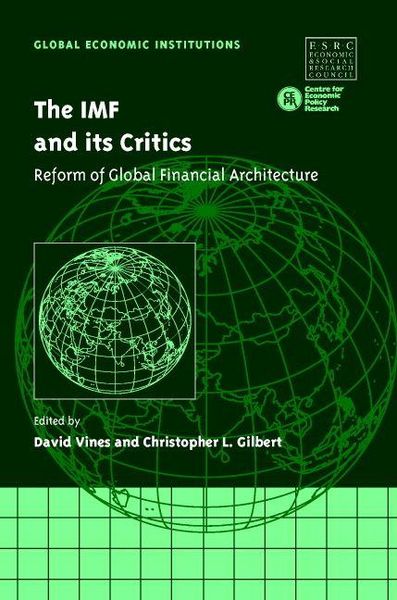
The IMF and Its Critics Reform of Global Financial Architecture

149,99 €

inkl. gesetzl. MwSt., Versandkostenfrei


Beschreibung

Produktdetails

Einband

Gebundene Ausgabe

Erscheinungsdatum

28.02.2007

Herausgeber

Vines David + weitere

Verlag

Cambridge University Press

Seitenzahl

468

Maße (L/B/H)

23,5/15,7/3,2 cm

Gewicht

882 g

Sprache

Englisch

ISBN

978-0-521-82154-4

Beschreibung

Produktdetails

Einband

Gebundene Ausgabe

Erscheinungsdatum

28.02.2007

Herausgeber

Verlag

Cambridge University Press

Seitenzahl

468

Maße (L/B/H)

23,5/15,7/3,2 cm

Gewicht

882 g

Sprache

Englisch

ISBN

978-0-521-82154-4

Herstelleradresse

Libri GmbH
Europaallee 1
36244 Bad Hersfeld
DE

Email: Libri GmbH

Noch keine Bewertungen vorhanden

Verfassen Sie die erste Bewertung zu diesem Artikel

Helfen Sie anderen Kundinnen und Kunden durch Ihre Meinung.

Kundinnen und Kunden meinen

Bewertungen (0)

  • Produktbild: The IMF and Its Critics
  • Produktbild: The IMF and Its Critics
  • Introduction; 1. The IMF and international financial architecture: solvency and liquidity Christopher L. Gilbert, David Vines; 2. Progress towards greater international financial stability Andrew Crockett; 3. International coordination of macroeconomic policies: still alive in the new millennium? Lawrence H. Meyer, Brian M. Doyle, Joseph E. Gagnon, Dale W. Henderson; 4. The Report of the International Financial Institution Advisory Commission: comments on the critics Allan H. Meltzer; 5. Reforming the global financial architecture: just tinkering around the edges? Malcolm Knight, Lawrence Schembri, James Powell; 6. The IMF and capital account liberalisation Dominic Wilson; 7. How should the IMF view capital controls? Gregor Irwin, Christopher L. Gilbert, David Vines; 8. The resolution of international financial crises: an alternative framework Andrew G. Haldane, Mark Kruger; 9. Whose programme is it? Policy ownership and conditional lending James M. Boughton, Alex Mourmouras; 10. The IMF and East Asia: a changing regional financial architecture Gordon de Brouwer; 11. The role of the IMF in developing countries Graham Bird, Paul Mosley; 12. Argentina and the Fund: anatomy of a policy failure Michael Mussa; 13. Countries in payments' difficulties: what can the IMF do? Andrew Powell; 14. Accountability, governance and the reform of the IMF Ngaire Woods; 15. The IMF at the start of the twenty-first century: what has been learned? On which values can we establish a humanised globalisation? Michel Camdessus; Index.