Gutscheinbedingungen

**Gültig bis 02.09.2026 auf fremdsprachige Bücher in der Thalia App. Einzelne Artikel können ausgeschlossen sein. Ausgenommen sind preisgebundene Artikel & eBooks. Pro Einkauf einmal einlösbar. Click & Collect nur bei Onlinevorabzahlung möglich. Keine Barauszahlung. Nicht kombinierbar mit anderen Aktionen und Gutscheinen. Gutschein wird auf max. 500€ Bestellwert angerechnet. Nicht gültig für Geschenkkarten, Versandkosten und Services.

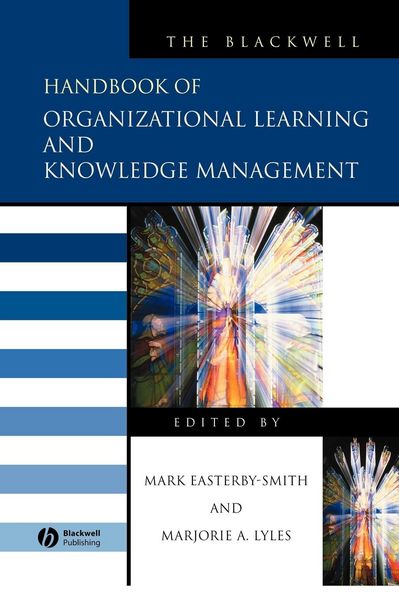
  • Produktbild: The Blackwell Handbook of Organizational Learning and Knowledge Management
  • Produktbild: The Blackwell Handbook of Organizational Learning and Knowledge Management

The Blackwell Handbook of Organizational Learning and Knowledge Management

199,99 €

inkl. gesetzl. MwSt., Versandkostenfrei


Beschreibung

Produktdetails

Einband

Gebundene Ausgabe

Erscheinungsdatum

25.06.2003

Herausgeber

Mark Easterby-Smith + weitere

Verlag

John Wiley & Sons Inc

Seitenzahl

676

Maße (L/B/H)

26/18,3/4,2 cm

Gewicht

1491 g

Sprache

Englisch

ISBN

978-0-631-22672-7

Beschreibung

Rezension

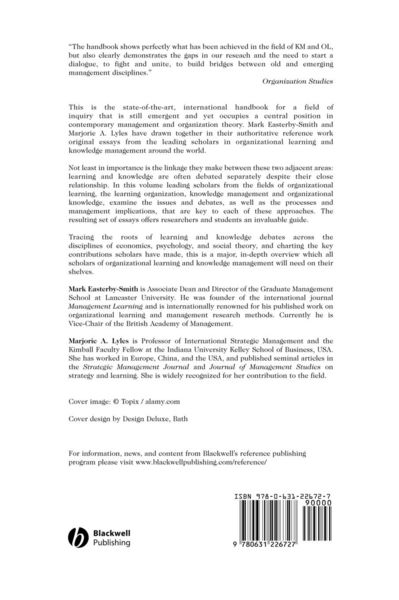
"The handbook shows perfectly what has been achieved in the field of KM and OL, but also clearly demonstrates the gaps in our research and the need to start a dialogue, to fight and unite, to build bridges between old and emerging management disciplines." Organization Studies

Produktdetails

Einband

Gebundene Ausgabe

Erscheinungsdatum

25.06.2003

Herausgeber

Verlag

John Wiley & Sons Inc

Seitenzahl

676

Maße (L/B/H)

26/18,3/4,2 cm

Gewicht

1491 g

Sprache

Englisch

ISBN

978-0-631-22672-7

Herstelleradresse

Libri GmbH
Europaallee 1
36244 Bad Hersfeld
DE

Email: gpsr@libri.de

Noch keine Bewertungen vorhanden

Verfassen Sie die erste Bewertung zu diesem Artikel

Helfen Sie anderen Kundinnen und Kunden durch Ihre Meinung.

Kundinnen und Kunden meinen

Bewertungen (0)

  • Produktbild: The Blackwell Handbook of Organizational Learning and Knowledge Management
  • Produktbild: The Blackwell Handbook of Organizational Learning and Knowledge Management
  • List of Figures.
    List of Tables.

    List of Contributors.

    Foreword: Karl E. Weick.

    Part I: Disciplinary Perspectives: .

    Introduction: Watersheds Of Organizational Learning And Knowledge Management: Mark Easterby-Smith (Lancaster University)and Marjorie A. Lyles (Indiana University).

    1. Psychological Perspectives Underlying Theories of Organizational Learning: Robert Defillippi (Suffolk University) and Suzyn Ornstein (Suffolk University).

    2. Social Learning Theory: Learning As Participation In Social Processes: Bente Elkjaer (Danish University of Education).

    3. The Role of Information and Communication Technologies In Knowledge Management Initiatives: Niall Hayes (Lancaster University) and Geoff Walsham (University of Cambridge).

    4. Knowledge Management: What Can Organizational Economics Contribute? Nicolai J. Foss (Copenhagen Business School) and Volker Mahnke (Copenhagen Business School).

    5. Knowledge Management: The Information Technology Dimension: Maryam Alavi (Emory University) and Amrit Tiwana (Emory University).

    Part II: Learning And Knowledge In Organizations: .

    6. Organizational Learning And Knowledge Management: Toward An Integrative Framework: Dusya Vera (University of Western Ontario) and Mary Crossan (University of Western Ontario).

    7. Organizations As Learning Portfolios: Anthony J. Dibella (East Greenwich and Worcester Polytechnic Institute).

    8. Framework For The Development of Communities Of Practice In A Corporate Environment: Josh Plaskoff (Eli Lilly and Company).

    9. Understanding Outcomes Of Organizational Learning Interventions: Amy C. Edmondson (Harvard Business School) and Anita Williams Woolley (Harvard Business School).

    10. The Impact Of Intercultural Communication On Global Organizational Learning: Sully Taylor (Portland State University), Joyce S. Osland (Portland State University) and Dr Robert B. Pamplin.

    11. Knowledge Seeking FDI And Learning Across Borders: Shige Makino (Chinese University of Hong Kong) and Andrew C. Inkpen (American Graduate School of International Management).

    12. Beyond Alliances: Towards A Meta-Theory Of Collaborative Learning: Jane E. Salk (University of Texas at Dallas)and Bernard L. Simonin (Tufts University).

    13. Knowledge Management And Competitive Advantage: Bala Chakravarthy (IMD), Sue McEvily (University of Pittsburgh), Yves Doz (INSEAD) and Devaki Rau (Northern Illinois University).

    14. Absorptive Capacity: Antecedents, Models, And Outcomes: Frans A. J. Van Den Bosch (Erasmus University Rotterdam), Raymond Van Wijk (Erasmus University Rotterdam), and Henk W. Volberda (Erasmus University Rotterdam),.

    15. Narrative Knowledge In Action: Adaptive Abduction As A Mechanism For Knowledge Creation And Exchange In Organizations: Caroline A. Bartel (New York University) and Raghu Garud (New York University).

    Part III: Organizational Knowledge And KM: .

    16. Dominant Logic, Knowledge Creation, And Managerial Choice: Richard A. Bettis (University of North Carolina at Chapel Hill) and Sze-Sze Wong (Duke University).

    17. Innovation And Knowledge Management: Scanning, Sourcing, And Integration: Paul Almeida (Georgetown University), Anaupama Phene (University of Utah), David Eccles & Rob Grant (Georgetown University).

    18. Knowledge Sharing And The Communal Resource: Georg Von Krogh (University of St Gallen).

    19. Organizational Forgetting: Pablo Martin De Holan (University of Alberta) and Faculté Saint-Jean.

    20. Do We Really Understand Tacit Knowledge? Haridimos Tsoukas.

    21. Knowledge And Networks: Raymond Van Wijk (Erasmus University Rotterdam), Frans A. J. Van Den Bosch (Erasmus University Rotterdam), Henk W. Volberda (Erasmus University Rotterdam).

    22. The Political Economy Of Knowledge Markets In Organizations: Rob Cross (University of Virginia) and Laurence Prusak (IBM Institute for Knowledge-based Organizations).

    23. Barriers To Creating Knowledge: Mikelle A. Calhoun (New York University) and Wi