• Produktbild: Re-Thinking Science
  • Produktbild: Re-Thinking Science

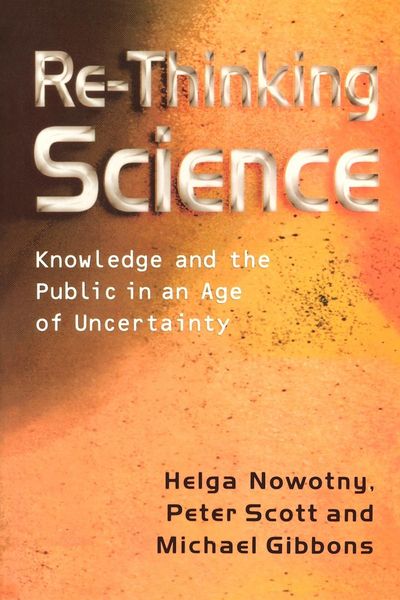
Re-Thinking Science Knowledge and the Public in an Age of Uncertainty

45,99 €

inkl. gesetzl. MwSt., Versandkostenfrei


Beschreibung

Produktdetails

Einband

Taschenbuch

Erscheinungsdatum

24.02.2001

Verlag

John Wiley & Sons

Seitenzahl

290

Maße (L/B/H)

22,9/15,2/2,1 cm

Gewicht

417 g

Sprache

Englisch

ISBN

978-0-7456-2608-6

Beschreibung

Rezension

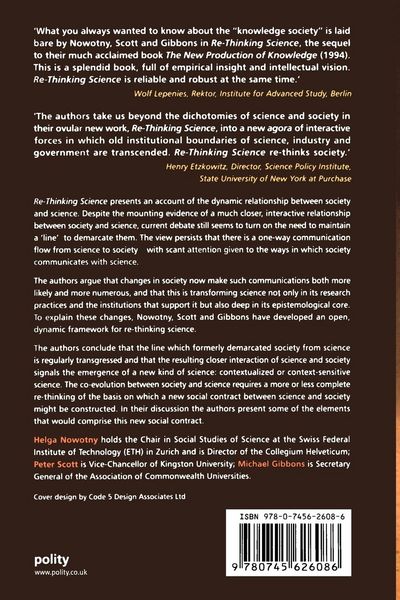
What you always wanted to know about the "knowledge society", Nowotny, Scott and Gibbons are telling it in Re-Thinking Science , the sequel to their much acclaimed book The New Production of Knowledge (1994) . This is a splendid book, full of empirical insight and intellectual vision. Re-Thinking Science is reliable and robust at the same time. Wolf Lepenies, Rektor, Institute for Advanced Study, Berlin

The authors take us beyond the dichotomies of science and society in their ovular new work, Re-Thinking Science , into a new agora of interactive forces in which old institutional boundaries of science, industry and government are transcended. Re-Thinking Science re-thinks society. Henry Etzkowitz, Director, Science Policy Institute, State University of New York at Purchase

This book goes far beyond The New Production of Knowledge (1994), the earlier collection of essays by Michael Gibbons, Helga Nowotny and others. That book launched the debate on the trend towards a new regime for the production of knowledge and the practice of research ... Re-Thinking Science revisits these themes in the form of a single brilliant essay in social theory ... a splendid vision of a probable future world, in which science and society will increasingly overlap and be exposed to the growing expertise and contesting forces of the agora. Nature

This book is packed with novel and quite complicated ideas ... We look forward to a further harvest of sharp observations and deep interpretations in the next product from this outstanding scholarly team. Interdisciplinary Science Review

an enourmously important book, which deserves to be widely read and discussed. Science as Culture

The book could be influential in providing sustenance to higher education managers as they struggle to find new definitions of what it means to be a university. Political leaders too would do well to study it in order to move their policy-making away from dependence on mode 1 ideas. The vision of the science of the future outlined in the book could perhaps have gone further. However, there is a balance to be struck between being influential and being visionary. This book will clearly be influential. The vision will hopefully grow." Studies in Higher Education

Produktdetails

Einband

Taschenbuch

Erscheinungsdatum

24.02.2001

Verlag

John Wiley & Sons

Seitenzahl

290

Maße (L/B/H)

22,9/15,2/2,1 cm

Gewicht

417 g

Sprache

Englisch

ISBN

978-0-7456-2608-6

Herstelleradresse

Libri GmbH
Europaallee 1
36244 Bad Hersfeld
DE

Email: gpsr@libri.de

Noch keine Bewertungen vorhanden

Verfassen Sie die erste Bewertung zu diesem Artikel

Helfen Sie anderen Kundinnen und Kunden durch Ihre Meinung.

Kundinnen und Kunden meinen

Bewertungen (0)

Die Leseprobe wird geladen.
  • Produktbild: Re-Thinking Science
  • Produktbild: Re-Thinking Science
  • Preface.

    Chapter 1: The Transformation of Society.

    Chapter 2: Beyond Modernity - Breaching the Frontiers.

    Chapter 3: The Co-Evolution of Science and Society.

    Chapter 4: The Context Speaks Back.

    Chapter 5: The Transformation of Knowledge Institutions.

    Chapter 6: The Role of Universities in Knowledge Production.

    Chapter 7: How does Contextualization Happen?.

    Chapter 8: Weakly Contextualized Knowledge.

    Chapter 9: Strongly Contextualized Knowledge.

    Chapter 10: Contextualization in the Middle Range.

    Chapter 11: From Reliable Knowledge to Socially Robust Knowledge.

    Chapter 12: The Epistemological Core?.

    Chapter 13: Science Moves to the Agora.

    Chapter 14: Socially Distributed Expertise.

    Chapter 15: Re-Visioning Science.

    Chapter 16: Re-Thinking Science is not Science Re-Thought.

    References.

    Index