KI-Beratung Beta

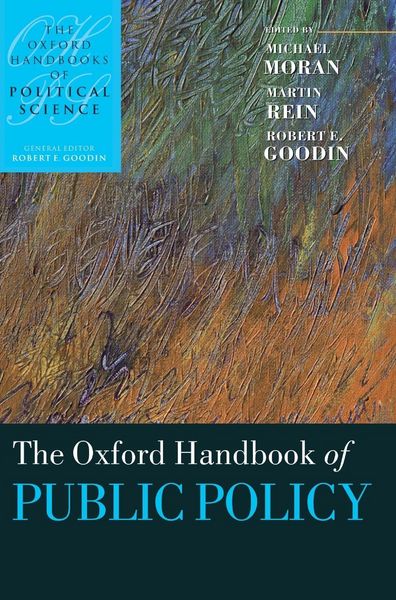
Produktbild: OXF HANDB PUBLIC POLICY OHBK C

OXF HANDB PUBLIC POLICY OHBK C

Aus der Reihe Oxford Handbooks

321,99 €

inkl. gesetzl. MwSt., Versandkostenfrei


Beschreibung

The Oxford Handbooks of Political Science is a ten-volume set of reference books offering authoritative and engaging critical overviews of the state of political science. Each volume focuses on a particular part of the discipline, with volumes on Public Policy, Political Theory, Political Economy, Contextual...

Beschreibung

The Oxford Handbooks of Political Science is a ten-volume set of reference books offering authoritative and engaging critical overviews of the state of political science. Each volume focuses on a particular part of the discipline, with volumes on Public Policy, Political Theory, Political Economy, Contextual Political Analysis, Comparative Politics, International Relations, Law and Politics, Political Behavior, Political Institutions, and Political Methodology. The project as a whole is under the General Editorship of Robert E. Goodin, with each volume being edited by a distinguished international group of specialists in their respective fields. The books set out not just to report on the discipline, but to shape it. The series will be an indispensable point of reference for anyone working in political science and adjacent disciplines.
Public policy is the business end of political science. It is where theory meets practice in the pursuit of the public good. Political scientists approach public policy in myriad ways. Some approach the policy process descriptively, asking how the need for public intervention comes to be perceived, a policy response formulated, enacted, implemented, and, all too often, subverted, perverted, altered, or abandoned. Others approach public policy more prescriptively, offering politically-informed suggestions for how normatively valued goals can and should be pursued, either through particular policies or through alternative processes for making policy. Some offer their advice from the Olympian heights of detached academic observers, others as 'engaged scholars' cum advocates, while still others seek to instil more reflective attitudes among policy practitioners themselves toward their own practices. The Oxford Handbook of Public Policy mines all these traditions, using an innovative structure that responds to the very latest scholarship. Its chapters touch upon institutional and historical sources and analytical methods, how policy is made, how it is evaluated and how it is constrained. In these ways, the Handbook shows how the combined wisdom of political science as a whole can be brought to bear on political attempts to improve the human condition.

Rezension

Spanning all of the major substantive areas and approaches in modern political science, this blockbuster set is a must-have for scholars and students alike. Each volume is crafted by a distinguished set of editors who have assembled critical, comprehensive, essays to survey accumulated knowledge and emerging issues in the study of politics. These volumes will help to shape the discipline for many years to come. Theda Skocpol, Victor S. Thomas Professor of Government and Sociology, and Dean of the Graduate School of Arts and Sciences, Harvard University

Produktdetails

Einband

Gebundene Ausgabe

Erscheinungsdatum

10.08.2006

Abbildungen

figures and tables in text

Herausgeber Michael Moran + weitere

Produktdetails

Einband

Gebundene Ausgabe

Erscheinungsdatum

10.08.2006

Abbildungen

figures and tables in text

Herausgeber
Verlag Oxford University Press
Seitenzahl

996

Maße (L/B/H)

25/17,5/5,7 cm

Gewicht

1860 g

Sprache

Englisch

ISBN

978-0-19-926928-0

Herstelleradresse

Libri GmbH
Europaallee 1
36244 Bad Hersfeld
DE

Email: gpsr@libri.de

Noch keine Bewertungen vorhanden

Verfassen Sie die erste Bewertung zu diesem Artikel

Helfen Sie anderen Kundinnen und Kunden durch Ihre Meinung.

Kundinnen und Kunden meinen

Bewertungen (0)

  • Produktbild: OXF HANDB PUBLIC POLICY OHBK C

    • Part 1. Introduction


    • 1: Robert E. Goodin, Michael Moran, and Martin Rein: The Public and its Policies


    • Part II. Institutional and Historical Background


    • 2: Peter deLeon: The Historical Roots of the Field


    • 3: Graham Allison: Emergence of Schools of Public Policy


    • 4: Yehezkel Dror: Training for Policy-Makers


    • Part III. Modes of Policy Analysis


    • 5: Christopher Winship: Policy Analysis as Puzzle-solving


    • 6: John Forestor: Policy Analysis as Critical Listening


    • 7: Richard Wilson: Policy Analysis as Policy Advice


    • 8: Helen Ingram and Anne L. Schneider: Policy Analysis for Democracy


    • 9: John Dryzek: Policy Analysis as Social Critique


    • Part IV. Producing Public Policy


    • 10: Edward C. Page: The Origins of Policy


    • 11: Giandomenico Majone: Agenda Setting


    • 12: Maarten Hajer and David Laws: Policy Frame and Discourse


    • 13: Lawrence Susskind: Arguing, Bargaining, and Getting Agreement


    • 14: Bea Cantillon and Karel van den Bosch: Policy Impact


    • 15: Mark Bovens, Paul 'tHart and Sanneke Kuipers: The Politics of Policy Evaluation


    • 16: Eugene Bardach: Policy Dynamics


    • 17: Richard Freeman: Learning in Public Policy


    • 18: Martin Rein: Reframing Problematic Policies


    • Part V. Instruments of Policy


    • 19: David Laws and Maarten Hajer: Policy in Practice


    • 20: R.A.W. Rhodes: Policy Networks


    • 21: Tom Christiansen: Smart Policy?


    • 22: Christopher Hood: The Tools of Government in the Information Age


    • 23: Barry L. Friedman: Policy Analysis as Organizational Analysis


    • 24: John D. Donahue and Richard J. Zeckhauser: Public-Private Collaboration


    • Part VI. Constraints on Public Policy


    • 25: John Quiggin: Economic Constraints on Public Policy


    • 26: William A. Galston: Political Feasibility: Interests and Power


    • 27: Ellen M. Immergut: Institutional Constraints on Policy


    • 28: Davis B. Bobrow: Social and Cultural Factors


    • 29: Colin Hay: Globalization and Public Policy


    • Part VII. Policy Intervention: Styles and Rationales


    • 30: Tom Sefton: Distributive and Redistributive Policy


    • 31: Mark Kleiman and Steven N. Teles: Market and Non-Market Failures


    • 32: Colin Scott: Privatization and Regulatory Regimes


    • 33: Archon Fung: Democratizing the Policy Process


    • Part VIII. Commending and Evaluating Public Policies


    • 34: James G. March and Johan P. Olsen: The Logic of Appropriateness


    • 35: Henry Shue: Ethical Dimensions of Public Policy


    • 36: Kevin B. Smith: Economic Techniques


    • 37: Jonathan Wolff and Dirk Haubrich: Economism and its Limits


    • 38: Neta C. Crawford: Policy Modeling


    • 39: Carol Hirschon Weiss and Johanna Birckmayer: Social Experimentation for Public Policy


    • IX. Public Policy, Old and New


    • 40: Amitai Etzioni: The Unique Methodology of Policy Research


    • 41: Oran R. Young: Choosing Governance Systems: A Plea for Comparative Research


    • 42: Frances Fox Piven: The Politics of Retrenchment: the U.S. Case


    • 43: Matthew Holden, Jr.: Reflections on how political scientists (and others) might think about energy and policy


    • 44: Rudolf Klein and Theodore R. Marmor: Reflections on Policy Analysis: Putting it Together Again