KI-Beratung Beta

Gutscheinbedingungen

**Gültig bis 11.11.2026 auf Spielzeug, Schreibwaren, Filme, Geschenke & Trends, Musik, tolino eReader & Zubehör, Hörbücher und Hörbuch-Downloads, nicht preisgebundene Bücher und Kalender online auf thalia.at und in der Thalia App. Einzelne Artikel können ausgeschlossen sein. Aufgrund der Buchpreisbindung sind deutschsprachige Bücher und eBooks ausgenommen. Zusätzlich ausgenommen sind Abos & Flatrates, Games, Geschenkkarten/-boxen, Shelfies, Software, Zeitschriften sowie einzelne Artikel von tonies®. Pro Einkauf einmal einlösbar. Click & Collect nur bei Onlinevorabzahlung möglich. Keine Barauszahlung. Nicht kombinierbar mit anderen Aktionen und Gutscheinen. Gutschein wird auf max. 500€ Bestellwert angerechnet. Nicht gültig für Versandkosten und Services.

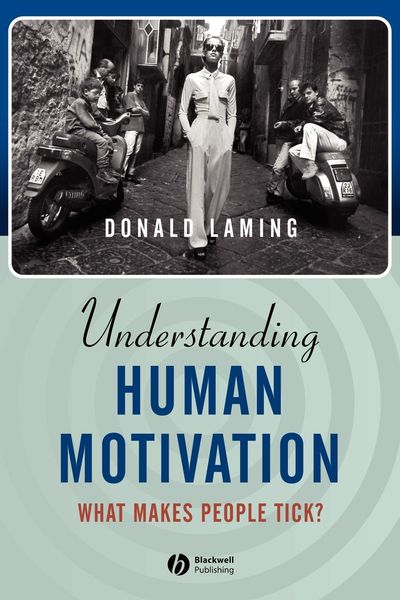
Produktbild: Understanding Human Motivation

Understanding Human Motivation What Makes People Tick?

78,99 €

inkl. gesetzl. MwSt., Versandkostenfrei


Beschreibung

Produktdetails

Einband

Taschenbuch

Erscheinungsdatum

08.09.2003

Verlag

John Wiley & Sons

Seitenzahl

330

Maße (L/B/H)

23,4/15,6/1,8 cm

Gewicht

503 g

Sprache

Englisch

ISBN

978-0-631-21983-5

Beschreibung

Rezension

"This new book on human motivation by Donald Laming represents a fresh look at an important area of psychology. The material is presented in the original idiom of real life stories in newspapers, which serve to illuminate classical controversies in social psychology. Although the book also has some novel theoretical insights, it should be particularly useful for students beginning in psychology." Trevor Robbins, University of Cambridge

Produktdetails

Einband

Taschenbuch

Erscheinungsdatum

08.09.2003

Verlag

John Wiley & Sons

Seitenzahl

330

Maße (L/B/H)

23,4/15,6/1,8 cm

Gewicht

503 g

Sprache

Englisch

ISBN

978-0-631-21983-5

Herstelleradresse

Libri GmbH
Europaallee 1
36244 Bad Hersfeld
DE

Email: gpsr@libri.de

Noch keine Bewertungen vorhanden

Verfassen Sie die erste Bewertung zu diesem Artikel

Helfen Sie anderen Kundinnen und Kunden durch Ihre Meinung.

Kundinnen und Kunden meinen

Bewertungen (0)

  • Produktbild: Understanding Human Motivation
  • Preface and Acknowledgments xii

    INTRODUCTION: THREE FUNDAMENTAL IDEAS 1

    What is "Motivation"? 2

    How Can We Study Human Motivation? 3

    The use of anecdotal material 3

    Three Fundamental Ideas 6

    Quasi-mechanical behavior 6

    Personal view and camera view 6

    Social extrusion 7

    Some omissions 8

    The Plan of this Book 9

    Questions for discussion 10

    1 DETERMINISM AND FREE WILL 11

    Determinism 12

    Psychological theory treats behavior as determinate 13

    Free Will 14

    Questions for discussion 20

    2 TERROR 21

    The Origins of Fear 23

    Components of Fear 25

    Two stages in the genesis of fear 27

    Fear as Instinct 30

    Pathological fear 32

    The Experience of Fear 33

    Companionship 33

    Military combat 34

    Being in control 34

    Training and skill 35

    The Persistence of Fear 35

    The persistence of memory 35

    Recurrence of fear 36

    Questions for discussion 37

    3 SEX 38

    Personal View and Camera View 40

    Which view - personal view or camera view? 42

    Lay psychology 43

    Sexual Behavior is Quasi-Mechanical 45

    "Mechanical" 45

    "Substantially mechanical" 46

    Acquisition of patterns of sexual behavior 47

    The pleasure principle 49

    Some Questions about Sexual Behavior 51

    1 What are the extraneous signals which trigger sexual behavior? 51

    2 What other signals or social constraints act to modify sexual behavior? 52

    3 What about the intense feelings that accompany sexual activity? 53

    4 What has this to do with the survival of the species? 54

    5 What about the variation in sexual behavior from one adult to another? 56

    6 Does sexual behavior have to match between male and female? 56

    7 How much of our sexual behavior is innate and how much acquired?

    4 CONSCIOUSNESS 60

    Two Views of What People Do 61

    The Meaning of "Consciousness" 62

    Philosophical inquiry into consciousness 64

    The neural signature of consciousness 65

    Personal view and camera view 67

    The Relationship of Subjective Experience to Objective Observation 69

    The split brain 75

    Why is consciousness important to the study of motivation? 79

    Questions for discussion 80

    5 BOREDOM 81

    The Political Background 82

    "Brainwashing" 83

    Sensory Deprivation 84

    Hallucinations 85

    Disturbances of perception 92

    Cognitive deficits 94

    What does it all signify? 96

    Boredom 96

    Boredom at work 97

    Leisure activities 97

    Questions for discussion 102

    6 SOCIAL CONVENTIONS 103

    Milgram's Experiments 104

    Proximity of teacher and pupil 104

    What is going on? 106

    Relaxation of the conflict 108

    The importance of social structure 109

    Social Conventions 111

    Social conventions are different in different societies 113

    Social conventions also differ between subgroups within the one society 116

    Understanding Milgram's Results 117

    Military obedience 119

    The Stanford County Prison Experiment 120

    Questions for discussion 123

    7 THE RATE FOR THE JOB 124

    How Much Do Different People Earn? 124

    1 People doing the same job get paid the same (irrespective of how well they do it), unless, sometimes, they happen to be women 125

    2 Those people closest to the money are paid the most 125

    3 If someone can earn more by negotiating a private deal, well, good luck to her or him 128

    Boardroom pay 130

    MPs' financial interests 134

    What has this chapter really been about? 137

    Questions for discussion 139

    8 LONELINESS 140

    The Experience of Being Alone 140

    Applications of research into social isolation 143

    "Brainwashing" 144

    Feral Children 147

    What may we conclude from the attempted rehabilitation of these three children? 151

    Conclusions on Social Isolation 153

    Questions for discussion 155

    9 THE MORAL SANCTION 156

    The Moral Sanction 157

    An experimental study of extrusion 157

    Whistleblowers 159

    Examples from the wider society 162

    Some Interim Conclusions on Extrusion 167

    1 Extrusion is sp