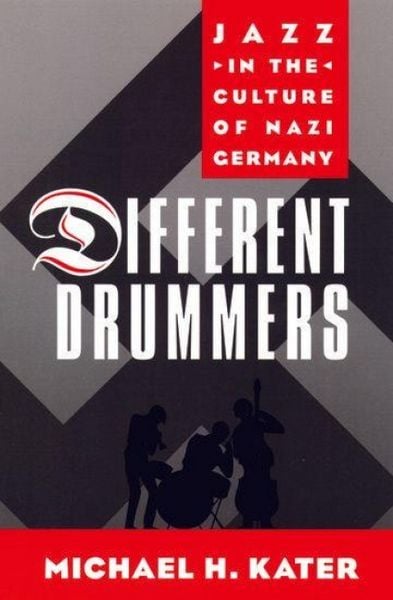
Different Drummers Jazz in the Culture of Nazi Germany
-
- Englisch ausgewählt
75,99 €
inkl. gesetzl. MwSt.,
Beschreibung
Produktdetails
Einband
Taschenbuch
Erscheinungsdatum
13.03.2003
Abbildungen
numerous halftones
Verlag
Oxford University PressSeitenzahl
320
Maße (L/B/H)
23,8/15,3/2,1 cm
Gewicht
449 g
Sprache
Englisch
ISBN
978-0-19-516553-1
In Different Drummers, Michael Kater--a distinguished historian and himself a jazz musician--explores the underground history of jazz in Hitler's Germany. He offers a frightening and fascinating look at life and popular culture during the Third Reich, showing that for the Nazis, jazz was an especially threatening form of expression. Not only were its creators at the very bottom of the Nazi racial hierarchy, but the very essence of jazz--spontaneity, improvisation, and, above all, individuality--represented a direct challenge to the repetitive, simple, uniform pulse of German march music and indeed everyday life. The fact that many of the most talented European jazz artists were Jewish only made the music more objectionable.
In tracing the growth of what would become a bold and eloquent form of social protest, Kater mines a trove of previously untapped archival records and assembles interviews with surviving witnesses as he brings to life a little-known aspect of wartime Germany. He introduces us to groups such as the Weintraub Syncopators, Germany's best indigenous jazz band; the Harlem Club of Frankfurt, whose male members wore their hair long in defiance of Nazi conventions; and the Hamburg Swings--the most daring radicals of all--who openly challenged the Gestapo with a series of mass dance rallies. More than once these demonstrations turned violent, with the Swings and the Hitler Youth fighting it out in the streets. In the end we come to realize that jazz not only survived persecution, but became a powerful symbol of political disobedience--and even resistance--in wartime Germany. And as we witness the vacillations of the Nazi regime (while they worked toward its ultimate extinction, they used jazz for their own propaganda purposes), we see that the myth of Nazi social control was, to a large degree, just that--Hitler's dictatorship never became as pure and effective a form of totalitarianism as we are sometimes led to believe.
With its vivid portraits of all the key figures, Different Drummers provides a unique glimpse of a counter-culture virtually unexamined until now. It is a provocative account that reminds us that, even in the face of the most unspeakable oppression, the human spirit endures.
Noch keine Bewertungen vorhanden
Verfassen Sie die erste Bewertung zu diesem Artikel
Helfen Sie anderen Kundinnen und Kunden durch Ihre Meinung.
Kurze Frage zu unserer Seite
Vielen Dank für Ihr Feedback
Wir nutzen Ihr Feedback, um unsere Produktseiten zu verbessern. Bitte haben Sie Verständnis, dass wir Ihnen keine Rückmeldung geben können. Falls Sie Kontakt mit uns aufnehmen möchten, können Sie sich aber gerne an unseren Kund*innenservice wenden.
zum Kundenservice