Gutscheinbedingungen

**Gültig bis 14.09.2026 auf Spielzeug, Schreibwaren, Filme, Geschenke & Trends, Musik, tolino eReader & Zubehör, Hörbücher, nicht preisgebundene Bücher und Kalender in der Thalia App. Einzelne Artikel können ausgeschlossen sein. Aufgrund der Buchpreisbindung sind deutschsprachige Bücher und eBooks ausgenommen. Zusätzlich ausgenommen sind Abos & Flatrates, Games, Geschenkkarten/-boxen, Shelfies, Software, Zeitschriften sowie einzelne Artikel von tonies®. Pro Einkauf einmal einlösbar. Nur gültig mit im Onlineshop hinterlegter Bonuscard. Click & Collect nur bei Onlinevorabzahlung möglich. Keine Barauszahlung. Nicht kombinierbar mit anderen Aktionen und Gutscheinen. Gutschein wird auf max. 500€ Bestellwert angerechnet. Nicht gültig für Versandkosten und Services.

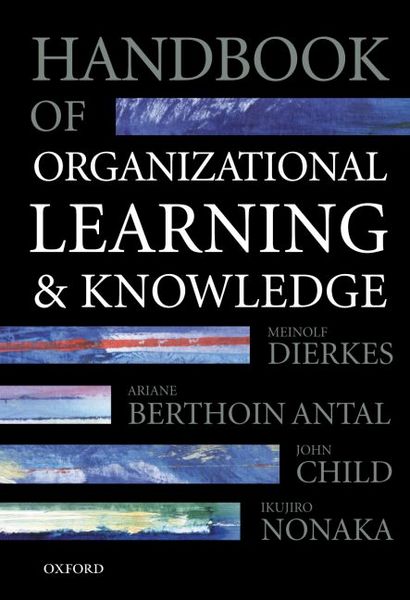
Produktbild: Handbook of Organizational Learning and Knowledge

Handbook of Organizational Learning and Knowledge

85,99 €

inkl. gesetzl. MwSt., Versandkostenfrei


Beschreibung

Produktdetails

Einband

Taschenbuch

Erscheinungsdatum

22.05.2003

Herausgeber

Dierkes Meinolf + weitere

Verlag

Oxford University Press

Seitenzahl

1008

Maße (L/B/H)

24,9/17,2/6 cm

Gewicht

1727 g

Sprache

Englisch

ISBN

978-0-19-829582-2

Beschreibung

Rezension

Finalist for the 2002 Terry Book Award, Academy of Management." An excellent and monumental volume edited by a distinguished group of scholars" Professor Walter Nord, Chairman, Terry Book Award Committee

Produktdetails

Einband

Taschenbuch

Erscheinungsdatum

22.05.2003

Herausgeber

Verlag

Oxford University Press

Seitenzahl

1008

Maße (L/B/H)

24,9/17,2/6 cm

Gewicht

1727 g

Sprache

Englisch

ISBN

978-0-19-829582-2

Herstelleradresse

Libri GmbH
Europaallee 1
36244 Bad Hersfeld
DE

Email: gpsr@libri.de

Noch keine Bewertungen vorhanden

Verfassen Sie die erste Bewertung zu diesem Artikel

Helfen Sie anderen Kundinnen und Kunden durch Ihre Meinung.

Kundinnen und Kunden meinen

Bewertungen (0)

  • Produktbild: Handbook of Organizational Learning and Knowledge
    • Introduction: Finding Paths through the Handbook

    • Part I: Insights from Major Social Science Disciplines

    • 1: G. W. Maier, C. Prange, and L. von Rosenstiel: Psychological Perspectives of Organizational Learning

    • 2: S. Gherardi and D. Nicolini: The Sociological Foundations of Organizational Learning

    • 3: P. Pawlowsky: The Treatment of Organizational Learning in Management Science

    • 4: C. Boerner, J. T. Macher and D. J. Teece: A Review and Assessment of Organizational Learning in Economic Theories

    • 5: B. Czarniawska: Anthropology and Organizational Learning

    • 6: J. LaPalombara: The Underestimated Contributions of Political Science to Organizational Learning

    • 7: J. Fear: Thinking Historically about Organizational Learning

    • Part II: External Triggers for Learning

    • 8: L. von Rosenstiel and S. Koch: Change in Socioeconomic Values as a Trigger of Organizational Learning

    • 9: J. Kÿdtler: Social Movements and Interest Groups as Triggers for Organizational Learning

    • 10: H. Merkens, M. Geppert, and D. Antal: Triggers of Organizational Learning during the Transformation Process in Central European Countries

    • 11: J. Stopford: Organizational Learning as Guided Responses to Market Signals

    • 12: M. Dierkes, L. Marz, and C. Teele: Technological Visions, Technological Development, and Organizational Learning

    • Part III: Factors and Conditions Shaping Organizational Learning

    • 13: J. Child and S. Heavens: The Social Constitution of Organizations and its Implications for Organizational Learning

    • 14: W. Starbuck and B. Hedberg: How Organizations Learn from Success and Failure

    • 15: C. Weber and A. Berthoin Antal: The Role of Time in Organizational Learning

    • 16: K. Scherer and V. Tran: Effects of Emotions on the Process of Organizational Learning

    • Part IV: Agents of Organizational Learning

    • 17: V. Friedman: The Individual as Agent of Organizational Learning

    • 18: P. Sadler: Leadership and Organizational Learning

    • 19: R. Tainio, K. Lilja, and T. Santalainen: The Role of Boards in Facilitating or Limiting Learning in Organizations

    • 20: A. Drinkuth, C. Riegler, and R. Wolff: Labor Unions as Learning Organizations and Learning Facilitators

    • 21: A. Berthoin Antal and C. Krebsbach-Gnath: Consultants as Agents of Organizational Learning: The importance of marginality

    • Part V: Processes of Organizational Learning and Knowledge Creation

    • 22: I. Nonaka, R. Toyama, and P. Byosiÿre: A Theory of Organizational Knowledge Creation: Understanding the dynamic process of creating knowledge

    • 23: B. Bÿchel and S. Raub: Media Choice and Organizational Learning

    • 24: B. Hedberg and R. Wolff: Organizing, Learning, and Strategizing: From construction to delivery

    • 25: J. LaPalombara: Power and Politics in Organizations: Public and private sector comparisons

    • 26: J. Rothman and V. Friedman: Identity, Conflict, and Organizational Learning

    • 27: A. Kieser, N. Beck, and R. Tainio: Rules and Organizational Learning: The behavioural theory approach

    • Part VI: Interorganizational Learning and Knowledge in a Global Context

    • 28: K. Macharzina, M. J. Oesterle, and D. Brodel: Learning in Multinationals

    • 29: J. Child: Learning Through Strategic Alliances

    • 30: M. Lyles: Organizational Learning in International Joint Ventures: The case of Hungary

    • 31: C. Lane: Organizational Learning in Supplier Networks

    • 32: L. S. Tsui-Auch: Learning in Global and Local Networks: Experience of Chinese firms in Hong Kong, Singapore, and Taiwan

    • 33: B. Hedberg and M. Holmqvist: Learning in Imaginary Organizations

    • Part VII: Developing Learning Practices

    • 34: V. Friedman, R. Lipshitz, and W. Overmeer: Creating Conditions for Organizational Learning

    • 35: P. Pawlowsky, J. Forslin, and R. Reinhardt: Practices and Tools of Organizational Learning

    • 36: R. Reinhardt, M. Bornemann, P. Pawlowsky, and U. Schneider: Intellectual Capital and Knowledge Management: Perspectives on measuring knowledge

    • Part VIII: Putting Learning into Practice

    • 37: I. Nonaka, P. Reinmöller, and R. Toyama: Integrated Information Technology Systems for Knowledge Creation

    • 38: G. Galer and K. van der Heijden: Scenarios and Their Contribution to Organizational Learning: From practice to theory

    • 39: A. Berthoin Antal, U. Lenhardt, and R. Rosenbrock: Barriers to Organizational Learning

    • 40: C. Krebsbach-Gnath: Applying Theory to Organizational Transformation

    • 41: C. de HaÃ'n, L. S. Tsui-Auch, and M. Alexis: Multimodal Organizational Learning: From misbehaviour to good laboratory practice in the pharmaceutical industry

    • Part IX: Conclusion

    • 42: A. Berthoin Antal, M. Dierkes, J. Child, and I. Nonaka: Organizational Learning and Knowledge: Reflections on the dynamics of the field and challenges for the future