Produktbild: The Symmetries of Things

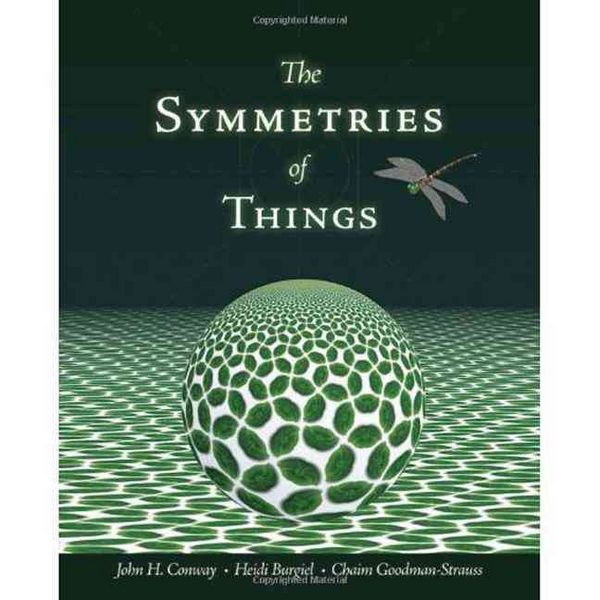
The Symmetries of Things

119,99 €

inkl. gesetzl. MwSt., Versandkostenfrei


Beschreibung

Produktdetails

Einband

Gebundene Ausgabe

Erscheinungsdatum

18.04.2008

Verlag

Peters, A K

Seitenzahl

448

Maße (L/B/H)

24,1/19,2/3 cm

Gewicht

1066 g

Sprache

Englisch

ISBN

978-1-56881-220-5

Beschreibung

Rezension

The book contains many new results. ... [and] is printed on glossy pages with a large number of beautiful full-colour illustrations, which can be enjoyed even by non-mathematicians. -- EMS Newsletter, June 2009 One of the most base concepts of art [is] symmetry. The Symmetries of Things is a guide to this most basic concept showing that even the most basic of things can be beautiful-and addresses why the simplest of patterns mesmerizes humankind and the psychological and mathematical importance of symmetry in ones every day life. The Symmetries of Things is an intriguing book from first page to last, highly recommended to the many collections that should welcome it. -- The Midwest Book Review, June 2008 Conway, Burgiel, and Goodman-Strauss have written a wonderful book which can be appreciated on many levels. ... [M]athematicians and math-enthusiasts at a wide variety of levels will be able to learn some new mathematics. Even better, the exposition is lively and engaging, and the authors find interesting ways of telling you the things you already know in addition to the things you don't. -- Darren Glass, MAA Reviews, July 2008 This rich study of symmetrical things . . . prepares the mind for abstract group theory. It gets somewhere, it justifies the time invested with striking results, and it develops . . . phenomena that demand abstraction to yield their fuller meaning. . . . the fullest available exposition with many new results. -- D. V. Feldman, CHOICE Magazine , January 2009 This book is a plaything, an inexhaustible exercise in brain expansion for the reader, a work of art and a bold statement of what the culture of math can be like, all rolled into one. Like any masterpiece, The Symmetries of Things functions on a number of levels simultaneously. . . . It is imperative to get this book into the hands of as many young mathematicians as possible. And then to get it into everyone else's hands. -- Jaron Lanier, American Scientist, January 2009 You accompany the authors as they learn about the structures they so beautifully illustrate on over 400 hundred glossy and full-colour pages. Tacitly, you are given an education in the ways of thought and skills of way-finding in mathematics. . . . The style of writing is relaxed and playful . . . we see the fusing of the best aspects of textbooks-conciseness, flow, reader-independence-with the best bit of popular writing-accessibility, fun, beauty. -- Phil Wilson, Plus Magazine, February 2009 This book gives a refreshing and comprehensive account of the subject of symmetry-a subject that has fascinated humankind for centuries. . . . Overall, the book is a treasure trove, full of delights both old and new. Much of it should be accessible for anyone with an undergraduate-level background in mathematics, and is likely to stimulate further interest. -- Marston Conder, Mathematical Reviews, March 2009 Inspired by the geometric intuition of Bill Thurston and empowered by his own analytical skills, John Conway, together with his coauthors, has developed a comprehensive mathematical theory of symmetry that allows the description and classification of symmetries in numerous geometric environments. This richly and compellingly illustrated book addresses the phenomenological, analytical, and mathematical aspects of symmetry on three levels that build on one another and will speak to interested lay people, artists, working mathematicians, and researchers. -- L'Enseignement Mathematique, December 2009
Produktdetails

Einband

Gebundene Ausgabe

Erscheinungsdatum

18.04.2008

Verlag

Peters, A K

Seitenzahl

448

Maße (L/B/H)

24,1/19,2/3 cm

Gewicht

1066 g

Sprache

Englisch

ISBN

978-1-56881-220-5

Herstelleradresse

Libri GmbH
Europaallee 1
36244 Bad Hersfeld
DE

Email: gpsr@libri.de

Noch keine Bewertungen vorhanden

Verfassen Sie die erste Bewertung zu diesem Artikel

Helfen Sie anderen Kundinnen und Kunden durch Ihre Meinung.

Kundinnen und Kunden meinen

Bewertungen (0)

Die Leseprobe wird geladen.
  • Produktbild: The Symmetries of Things
  • I Symmetries of Finite Objects and Plane Repeating Patterns
    1. Symmetries
    Kaleidoscopes
    Gyrations
    Rosette Patterns
    Frieze Patterns
    Repeating Patterns on the Plane and Sphere
    Where Are We?
    2. Planar Patterns
    Mirror Lines
    Describing Kaleidoscopes
    Gyrations
    More Mirrors and Miracles
    Wanderings and Wonder-Rings
    The Four Fundamental Features!
    Where Are We?
    3. The Magic Theorem
    Everything Has Its Cost!
    Finding the Signature of a Pattern
    Just Symmetry Types
    How the Signature Determines the Symmetry Type
    Interlude: About Kaleidoscopes
    Where Are We?
    Exercises
    4. The Spherical Patterns
    The 14 Varieties of Spherical Pattern
    The Existence Problem: Proving the Proviso
    Group Theory and All the Spherical Symmetry Types
    All the Spherical Types
    Where Are We?
    Examples
    5. Frieze Patterns
    Where Are We?
    Exercises
    6. Why the Magic Theorems Work
    Folding Up Our Surface
    Maps on the Sphere: Euler's Theorem
    Why char = ch
    The Magic Theorem for Frieze Patterns
    The Magic Theorem for Plane Patterns
    Where Are We?
    7. Euler's Map Theorem
    Proof of Euler's Theorem
    The Euler Characteristic of a Surface
    The Euler Characteristics of Familiar Surfaces
    Where Are We?
    8. Classification of Surfaces
    Caps, Crosscaps, Handles, and Cross-Handles
    We Don't Need Cross-Handles
    Two crosscaps make one handle
    That's All, Folks!
    Where Are We?
    Examples
    9. Orbifolds
    II Color Symmetry, Group Theory, and Tilings
    10. Presenting Presentations
    Generators Corresponding to Features
    The Geometry of the Generators
    Where Are We?
    11. Twofold Colorations
    Describing Twofold Symmetries
    Classifying Twofold Plane Colorings
    Complete List of Twofold Color Types
    Duality Groups
    Where Are We?
    13. Threefold Colorings of Plane Patterns
    A Look at Threefold Colorings
    Complete List for Plane Patterns
    Where Are We?
    Other Primefold Colorings
    Plane Patterns
    The Remaining Primefold Types for Plane Patterns
    The "Gaussian" Cases
    The "Eisensteinian" Cases
    Spherical Patterns and Frieze Patterns
    Where Are We?
    14. Searching for Relations
    On Left and Right
    Justifying the Presentations
    The Sufficiency of the Relations
    The General Case
    Simplifications
    Alias and Alibi
    Where Are We?
    Exercises
    Answers to Exercises
    15. Types of Tilings
    Heesch Types
    Isohedral Types
    Where Are We?
    16. Abstract Groups
    Cyclic Groups, Direct Products, and Abelian Groups
    Split and Non-split Extensions
    Dihedral, Quaternionic, and QuasiDihedral Groups
    Extraspecial and Special Groups
    Groups of the Simplest Orders
    The Group Number Function gnu(n)
    The gnu-Hunting Conjecture: Hunting moas
    Appendix: The Number of Groups to Order 2009
    III Repeating Patterns in Other Spaces
    17. Introducing Hyperbolic Groups
    No Projection Is Perfect!
    Analyzing Hyperbolic Patterns
    What Do Negative Characteristics Mean?
    Types of Coloring, Tiling, and Group Presentations
    Where Are We?
    18. More on Hyperbolic Groups
    Which Signatures Are Really the Same?
    Inequivalence and Equivalence Theorems
    Existence and Construction
    Enumerating Hyperbolic Groups
    Thurston's Geometrization Program
    Appendix: Proof of the Inequivalence Theorem
    Interlude: Two Drums That Sound the Same
    19. Archimedean Tilings
    The Permutation Symbol
    Existence
    Relative versus Absolute
    Enumerating the Tessellations
    Archimedes Was Right!
    The Hyperbolic Archimedean Tessellations
    Examples and Exercises
    20. Generalized Schläfli Symbols
    Flags and Flagstones
    More Precise Definitions
    More General Definitions
    Interlude: Polygons and Polytopes
    21. Naming Archimedean and Catalan Polyhedra and Tilings
    Truncation and "Kis"ing
    Marriage and Children
    Coxeter's Semi-Snub Operation
    Euclidean Plane Tessellations
    Additional Data
    Architectonic and Catoptric Tessellations
    22. The 35 "Prime" Space Groups
    The Three Lattices
    Displaying the Groups
    Translation Lattices and Point Groups
    Catalogue of Plenary Groups
    The Quarter Groups
    Catalogue of Quarter Groups
    Why This List Is Complete
    Appendix: Generators