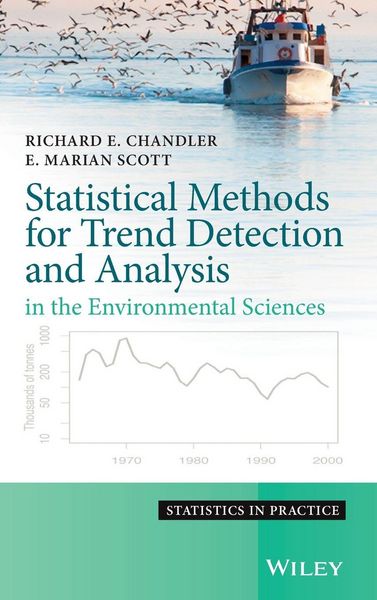
Statistical Methods for Trend Detection and Analysis in the Environmental Sciences
-
- Englisch ausgewählt
162,99 €
inkl. gesetzl. MwSt.,
Beschreibung
Produktdetails
Einband
Gebundene Ausgabe
Erscheinungsdatum
10.05.2011
Verlag
John Wiley & SonsSeitenzahl
400
Maße (L/B/H)
23,6/16,1/2,7 cm
Gewicht
706 g
Auflage
1. Auflage
Sprache
Englisch
ISBN
978-0-470-01543-8
Practitioners studying environmental change will be familiar with many classical statistical procedures for the detection and estimation of trends. However, the ever increasing capacity to collect and process vast amounts of environmental information has led to growing awareness that such procedures are limited in the insights that they can deliver. At the same time, significant developments in statistical methodology have often been widely dispersed in the statistical literature and have therefore received limited exposure in the environmental science community. This book aims to provide a thorough but accessible review of these developments. It is split into two parts: the first provides an introduction to this area and the second part presents a collection of case studies illustrating the practical application of modern statistical approaches to the analysis of trends in real studies.
Key Features:
* Presents a thorough introduction to the practical application and methodology of trend analysis in environmental science.
* Explores non-parametric estimation and testing as well as parametric techniques.
* Methods are illustrated using case studies from a variety of environmental application areas.
* Looks at trends in all aspects of a process including mean, percentiles and extremes.
* Supported by an accompanying website featuring datasets and R code.
The book is designed to be accessible to readers with some basic statistical training, but also contains sufficient detail to serve as a reference for practising statisticians. It will therefore be of use to postgraduate students and researchers both in the environmental sciences and in statistics.
Noch keine Bewertungen vorhanden
Verfassen Sie die erste Bewertung zu diesem Artikel
Helfen Sie anderen Kundinnen und Kunden durch Ihre Meinung.
Kurze Frage zu unserer Seite
Vielen Dank für Ihr Feedback
Wir nutzen Ihr Feedback, um unsere Produktseiten zu verbessern. Bitte haben Sie Verständnis, dass wir Ihnen keine Rückmeldung geben können. Falls Sie Kontakt mit uns aufnehmen möchten, können Sie sich aber gerne an unseren Kund*innenservice wenden.
zum Kundenservice