KI-Beratung Beta

Gutscheinbedingungen

**Gültig bis 30.11.2026 auf Spielzeug, Schreibwaren, Filme, Geschenke & Trends, Musik, tolino eReader & Zubehör, Hörbücher und Hörbuch-Downloads, nicht preisgebundene Bücher und Kalender online auf thalia.at und in der Thalia App. Einzelne Artikel können ausgeschlossen sein. Aufgrund der Buchpreisbindung sind deutschsprachige Bücher und eBooks ausgenommen. Zusätzlich ausgenommen sind Abos & Flatrates, Games, Geschenkkarten/-boxen, Shelfies, Software, Zeitschriften sowie einzelne Artikel von tonies®. Pro Einkauf einmal einlösbar. Nur gültig mit im Onlineshop hinterlegter Bonuscard. Click & Collect nur bei Onlinevorabzahlung möglich. Keine Barauszahlung. Nicht kombinierbar mit anderen Aktionen und Gutscheinen. Gutschein wird auf max. 500€ Bestellwert angerechnet. Nicht gültig für Versandkosten und Services.

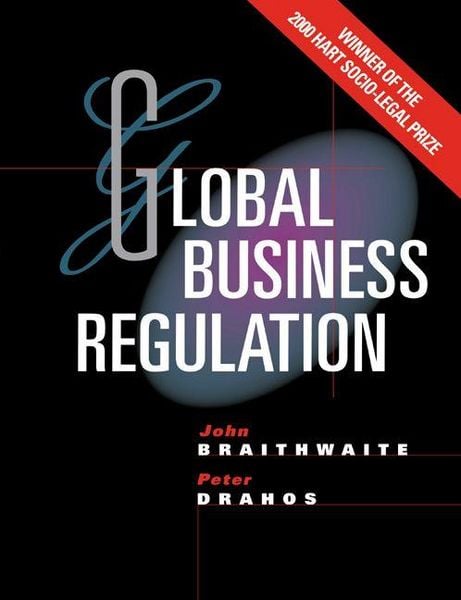
  • Produktbild: Global Business Regulation
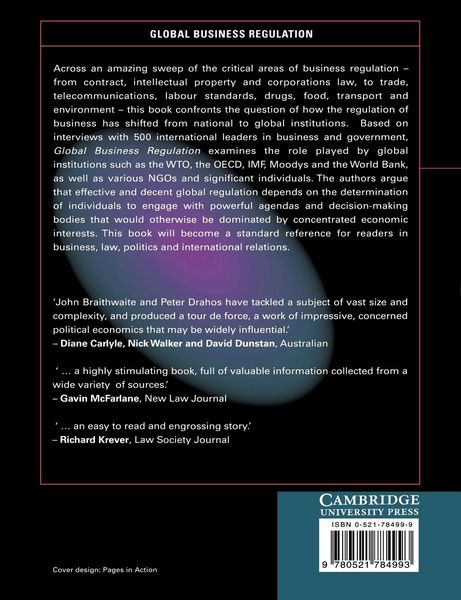
  • Produktbild: Global Business Regulation

Global Business Regulation

98,99 €

inkl. gesetzl. MwSt., Versandkostenfrei


Beschreibung

Across an amazing sweep of the critical areas of business regulation - from contract, intellectual property and corporations law, to trade, telecommunications, labour standards, drugs, food, transport and environment - this book confronts the question of how the regulation of business has shifted from...

Beschreibung

Across an amazing sweep of the critical areas of business regulation - from contract, intellectual property and corporations law, to trade, telecommunications, labour standards, drugs, food, transport and environment - this book confronts the question of how the regulation of business has shifted from national to global institutions. Based on interviews with 500 international leaders in business and government, this book examines the role played by global institutions such as the WTO, the OECD, IMF, Moody's and the World Bank, as well as various NGOs and significant individuals. The authors argue that effective and decent global regulation depends on the determination of individuals to engage with powerful agendas and decision-making bodies that would otherwise be dominated by concentrated economic interests. This book will become a standard reference for readers in business, law, politics and international relations.

Rezension

'The authors [of this book] argue that global business regulations emerge from various 'epistemic' communities - communities of experts that meet regularly all over the world. They have a shared understanding of regulation in any particular sphere that leads them not merely to advise but to direct as well ... In effect, the book suggests that the world is run from a few important cities - in particular New York, Washington, Brussels, Geneva - where these communities are important and congregate. The authors interviewed 500 international leaders in business and government to produce the 700-page book ... which contains 13 case studies - ranging from property and contract, financial regulation, corporations and securities to the environment, food, telecommunications, drugs, sea, road and air transport. These are sandwiched between a broad-ranging introduction and analytical conclusion dealing with the core issues of globalisation.' Financial Times

Produktdetails

Einband

Taschenbuch

Erscheinungsdatum

28.09.2004

Abbildungen

9 b/w illus. 3 tables

Verlag Cambridge University Press

Produktdetails

Einband

Taschenbuch

Erscheinungsdatum

28.09.2004

Abbildungen

9 b/w illus. 3 tables

Verlag Cambridge University Press
Seitenzahl

724

Maße (L/B/H)

24,6/18,9/3,9 cm

Gewicht

1375 g

Sprache

Englisch

ISBN

978-0-521-78499-3

Herstelleradresse

Libri GmbH
Europaallee 1
36244 Bad Hersfeld
DE

Email: gpsr@libri.de

Noch keine Bewertungen vorhanden

Verfassen Sie die erste Bewertung zu diesem Artikel

Helfen Sie anderen Kundinnen und Kunden durch Ihre Meinung.

Kundinnen und Kunden meinen

Bewertungen (0)

Die Leseprobe wird geladen.
  • Produktbild: Global Business Regulation
  • Produktbild: Global Business Regulation
  • Part I. Introduction: 1. The historical canvas; 2. Globalization and regulation; 3. Method; 4. Concepts: mechanisms, principles and actors; 5. Conclusions; 6. The struggle for a sovereignty of the people; Part II. Cases: 7. Property and contract; 8. Financial regulation; 9. Corporations and securities; 10. Trade and competition; 11. Labour standards; 12. The environment; 13. Nuclear energy; 14. Telecommunications; 15. Drugs; 16. Food; 17. Sea transport; 18. Road transport; 19. Air transport; Part III. Analysis: 20. Contests of actors; 21. Contests of principles; 22. Mechanisms of globalization; 23. Regulatory webs and globalization sequences; 24. Forum-shifting and contests of principles; 25. Modelling, globalization and the politics of empowerment; 26. A political program for sovereignty over global regulation.