KI-Beratung Beta

Gutscheinbedingungen

**Gültig am 20.11.2026 ab einem Mindestbestellwert von 30€ auf Spielzeug, Schreibwaren, Filme, Geschenke & Trends, Musik, tolino eReader & Zubehör, Hörbücher und Hörbuch-Downloads, nicht preisgebundene Bücher und Kalender online auf thalia.at und in der Thalia App. Einzelne Artikel können ausgeschlossen sein. Aufgrund der Buchpreisbindung sind deutschsprachige Bücher und eBooks ausgenommen. Zusätzlich ausgenommen sind Abos & Flatrates, Games, Geschenkkarten/-boxen, Shelfies, Software, Zeitschriften sowie einzelne Artikel von tonies®. Pro Einkauf einmal einlösbar. Click & Collect nur bei Onlinevorabzahlung möglich. Keine Barauszahlung. Nicht kombinierbar mit anderen Aktionen und Gutscheinen. Gutschein wird auf max. 500€ Bestellwert angerechnet. Nicht gültig für Versandkosten und Services. Preisgebundene Artikel sind vom Mindestbestellwert ausgeschlossen.

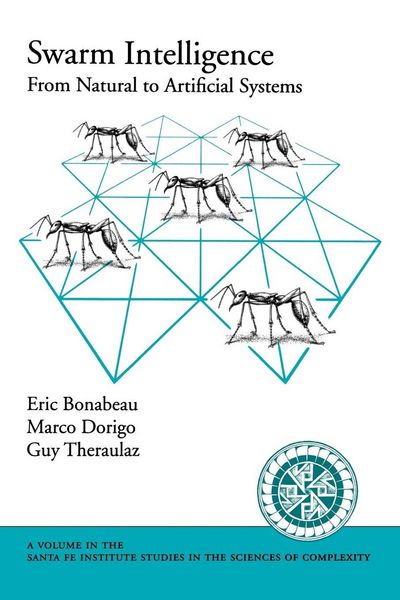
Produktbild: Swarm Intelligence

Swarm Intelligence From Natural to Artificial Systems

115,99 €

inkl. gesetzl. MwSt., Versandkostenfrei


Beschreibung

Social insects--ants, bees, termites, and wasps--can be viewed as powerful problem-solving systems with sophisticated collective intelligence. Composed of simple interacting agents, this intelligence lies in the networks of interactions among individuals and between individuals and the environment. A...

Beschreibung

Social insects--ants, bees, termites, and wasps--can be viewed as powerful problem-solving systems with sophisticated collective intelligence. Composed of simple interacting agents, this intelligence lies in the networks of interactions among individuals and between individuals and the environment. A fascinating subject, social insects are also a powerful metaphor for artificial intelligence, and the problems they solve--finding food, dividing labor among nestmates, building nests, responding to external challenges--have important counterparts in engineering and computer science.
This book provides a detailed look at models of social insect behaviour and how to apply these models in the design of complex systems. The book shows how these models replace an emphasis on control, preprogramming, and centralization with designs featuring autonomy, emergence, and distributed functioning. These designs are proving immensely flexible and robust, able to adapt quickly to changing environments and to continue functioning even when individual elements fail. In particular, these designs are an exciting approach to the tremendous growth of complexity in software and information. Swarm Intelligence draws on up-to-date research from biology, neuroscience, artificial intelligence, robotics, operations research, and computer graphics, and each chapter is organized around a particular biological example, which is then used to develop an algorithm, a multiagent system, or a group of robots. The book will be an invaluable resource for a broad range of disciplines.

Produktdetails

Einband

Taschenbuch

Erscheinungsdatum

01.01.1999

Abbildungen

numerous halftone and line illustrations

Verlag Oxford University Press

Produktdetails

Einband

Taschenbuch

Erscheinungsdatum

01.01.1999

Abbildungen

numerous halftone and line illustrations

Verlag Oxford University Press
Seitenzahl

320

Maße (L/B/H)

23,4/15,6/1,7 cm

Gewicht

488 g

Sprache

Englisch

ISBN

978-0-19-513159-8

Herstelleradresse

Libri GmbH
Europaallee 1
36244 Bad Hersfeld
DE

Email: gpsr@libri.de

Noch keine Bewertungen vorhanden

Verfassen Sie die erste Bewertung zu diesem Artikel

Helfen Sie anderen Kundinnen und Kunden durch Ihre Meinung.

Kundinnen und Kunden meinen

Bewertungen (0)

  • Produktbild: Swarm Intelligence
    • 1: Introduction

    • 2: Ant Foraging Behavior, Combinatorial Optimization, and Routing in Communications Networks

    • 3: Division of Labor and Task Allocation

    • 4: Cemetery Organization, Brood Sorting, Data Analysis, and Graph Partitioning

    • 5: Self-Organization and Templates: Application to Data Analysis and Graph Partitioning

    • 6: Nest Building and Self-Assembling

    • 7: Cooperative Transport by Insects and Robots

    • 8: Epilogue