KI-Beratung Beta

Gutscheinbedingungen

**Gültig bis 18.11.2026 auf englischsprachige Klassiker (klassiker-32728) online auf thalia.at und in der Thalia App. Einzelne Artikel können ausgeschlossen sein. Ausgenommen sind preisgebundene Artikel & eBooks. Pro Einkauf einmal einlösbar. Click & Collect nur bei Onlinevorabzahlung möglich. Keine Barauszahlung. Nicht kombinierbar mit anderen Aktionen und Gutscheinen. Gutschein wird auf max. 500€ Bestellwert angerechnet. Nicht gültig für Geschenkkarten, Versandkosten und Services.

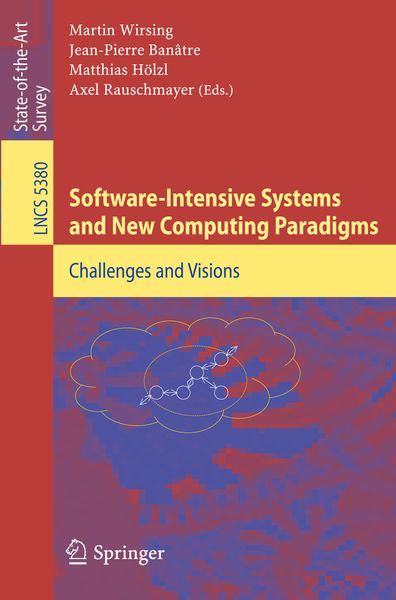
  • Produktbild: Software-Intensive Systems and New Computing Paradigms
  • Produktbild: Software-Intensive Systems and New Computing Paradigms
Band 5380

Software-Intensive Systems and New Computing Paradigms Challenges and Visions

51,99 €

inkl. gesetzl. MwSt., Versandkostenfrei


Beschreibung

To identify the emergent trends in software-intensive and distributed and decentralized computer systems and their impact on the Information Society in the next 10--15 years, the European Commission has established two Coordinated Actions: Initially the project `Beyond the Horizon' and then, starting...

Beschreibung

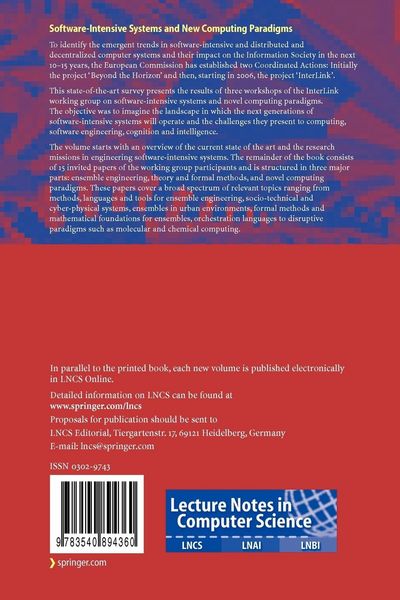
To identify the emergent trends in software-intensive and distributed and decentralized computer systems and their impact on the Information Society in the next 10--15 years, the European Commission has established two Coordinated Actions: Initially the project `Beyond the Horizon' and then, starting in 2006, the project `InterLink'.

This state-of-the-art survey presents the results of three workshops of the InterLink working group on software-intensive systems and novel computing paradigms. The objective was to imagine the landscape in which next generations of software-intensive systems will operate and the challenges they present to computing, software engineering, cognition and intelligence.

The volume starts with an overview of the current state of the art and the research missions in engineering software-intensive systems. The remainder of the book consists of 15 invited papers of the working group participants and is structured in three major parts: ensemble engineering, theory and formal methods, and novel computing paradigms. These papers cover a broad spectrum of relevant topics ranging from methods, languages and tools for ensemble engineering, socio-technical and cyber-physical systems, ensembles in urban environments, formal methods and mathematical foundations for ensembles, orchestration languages to disruptive paradigms such as molecular and chemical computing.

Produktdetails

Einband

Taschenbuch

Erscheinungsdatum

06.11.2008

Abbildungen

X, 267 p.

Herausgeber Martin Wirsing + weitere

Produktdetails

Einband

Taschenbuch

Erscheinungsdatum

06.11.2008

Abbildungen

X, 267 p.

Herausgeber
Verlag Springer Berlin
Seitenzahl

267

Maße (L/B/H)

23,5/15,5/1,6 cm

Gewicht

429 g

Auflage

2008

Sprache

Englisch

ISBN

978-3-540-89436-0

Herstelleradresse

Springer-Verlag KG
Sachsenplatz 4-6
1201 Wien
AT

Email: ProductSafety@springernature.com

Noch keine Bewertungen vorhanden

Verfassen Sie die erste Bewertung zu diesem Artikel

Helfen Sie anderen Kundinnen und Kunden durch Ihre Meinung.

Kundinnen und Kunden meinen

Bewertungen (0)

  • Produktbild: Software-Intensive Systems and New Computing Paradigms
  • Produktbild: Software-Intensive Systems and New Computing Paradigms
  • Engineering of Software-Intensive Systems: State of the Art and Research Challenges.- Engineering of Software-Intensive Systems: State of the Art and Research Challenges.- I Ensemble Engineering.- Software Engineering for Ensembles.- Change-Enabled Software Systems.- On the Challenge of Engineering Socio-technical Systems.- Design of Complex Cyber Physical Systems with Formalized Architectural Patterns.- Cyber-Physical Systems and Events.- Design and Deployment of Large-Scale Software-Intensive Systems in Urban Districts.- II Theory and Formal Methods.- Formal Ensemble Engineering.- Structured Interacting Computations.- Extending Formal Methods for Software-Intensive Systems.- Ensemble Engineering and Emergence.- Mathematical Support for Ensemble Engineering.- Behaviour Equivalences in Timed Distributed ?-Calculus.- III Novel Computing Paradigms.- The Chemical Reaction Model Recent Developments and Prospects.- Spatial Organization of the Chemical Paradigm and the Specification of Autonomic Systems.- Emerging Models of Computation: Directions in Molecular Computing.