KI-Beratung Beta

  • Produktbild: Theory and Practice of Model Transformations
  • Produktbild: Theory and Practice of Model Transformations
Band 5063

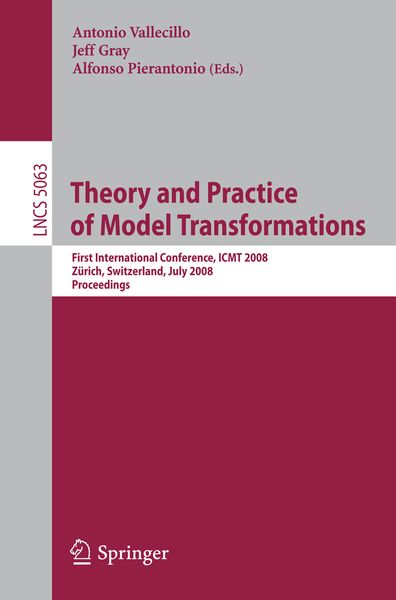
Theory and Practice of Model Transformations First International Conference, ICMT 2008, ETH Zürich, Switzerland, July 1-2, 2008, Proceedings

51,99 €

inkl. gesetzl. MwSt., Versandkostenfrei


Beschreibung

Models have become essential for dealing with the numerous aspects involved in developing and maintaining complex IT systems. Models allow capturing of the relevant aspects of a system from a given perspective, and at a precise level of abstraction. In addition to models, the transformations between...

Beschreibung

Models have become essential for dealing with the numerous aspects involved in developing and maintaining complex IT systems. Models allow capturing of the relevant aspects of a system from a given perspective, and at a precise level of abstraction. In addition to models, the transformations between them are other key elements in model-driven engineering. Model transformations allow the de?nition and implementation of the operations on models, and also provide achainthatenablestheautomateddevelopmentofasystemfromitscorrespo- ing models. Furthermore, model transformations may be realized using models, and are, therefore, an integral part of any model-driven approach. There are already several proposals for model transformation speci?cation, implementation and execution, which are beginning to be used by modeling practitioners. However, model transformations need specialized support in s- eral aspects in order to realize their full potential. The problem goes beyond having speci?c languages to represent model transformations; we also need to understandtheirfoundations,suchasthekeyconceptsandoperatorssupporting those languages, their semantics, and their structuring mechanisms and pr- erties (e. g. , modularity, composability and parametrization). In addition, model transformations can be stored in repositories as reusable assets, where they can be managed, discovered and reused. There is also a need to chain and combine model transformations in order to produce new and more powerful transfor- tions, and to be able to implement new operations on models. Finally, model transformations need methodology support, i. e. , they need to be integrated into software development methodologies supported by appropriate tools and en- ronments. These issues and concerns de?nethe focus of these proceedings.

Produktdetails

Einband

Taschenbuch

Erscheinungsdatum

17.06.2008

Abbildungen

XII, 261 p.

Herausgeber Antonio Vallecillo + weitere

Produktdetails

Einband

Taschenbuch

Erscheinungsdatum

17.06.2008

Abbildungen

XII, 261 p.

Herausgeber
Verlag Springer Berlin
Seitenzahl

261

Maße (L/B/H)

23,5/15,5/1,6 cm

Gewicht

429 g

Auflage

2008

Sprache

Englisch

ISBN

978-3-540-69926-2

Herstelleradresse

Springer-Verlag KG
Sachsenplatz 4-6
1201 Wien
AT

Email: ProductSafety@springernature.com

Noch keine Bewertungen vorhanden

Verfassen Sie die erste Bewertung zu diesem Artikel

Helfen Sie anderen Kundinnen und Kunden durch Ihre Meinung.

Kundinnen und Kunden meinen

Bewertungen (0)

  • Produktbild: Theory and Practice of Model Transformations
  • Produktbild: Theory and Practice of Model Transformations
  • Process and Engineering of Model Transformations.- Transformations Have to be Developed ReST Assured.- Lifting Transformational Models of Product Lines: A Case Study.- Model Synchronisation: Definitions for Round-Trip Engineering.- The Epsilon Transformation Language.- Model Transformations Supporting Concurrency and Time.- Transforming Process Algebra Models into UML State Machines: Bridging a Semantic Gap?.- On Specifying and Visualising Long-Running Empirical Studies.- Programmed Graph Rewriting with Time for Simulation-Based Design.- Matching and Mapping within Model Transformation Rules.- Live Model Transformations Driven by Incremental Pattern Matching.- Semantics-Based Weaving of UML Sequence Diagrams.- Translation of QVT Relations into QVT Operational Mappings.- Language Support for Model Transformation Reuse and Modularity.- Composition Techniques for Rule-Based Model Transformation Languages.- Approaches for Model Transformation Reuse: Factorization and Composition.- Code Generation by Model Transformation.- Application of Reflection in Model Transformation Languages.- Correctness and Analysis of Model Transformations.- Proofs-as-Model-Transformations.- Analysing Graph Transformation Rules through OCL.- Extracting Object Interactions Out of Software Contracts Using Model Transformations.