KI-Beratung Beta

Gutscheinbedingungen

**Gültig bis 30.11.2026 auf Spielzeug, Schreibwaren, Filme, Geschenke & Trends, Musik, tolino eReader & Zubehör, Hörbücher und Hörbuch-Downloads, nicht preisgebundene Bücher und Kalender online auf thalia.at und in der Thalia App. Einzelne Artikel können ausgeschlossen sein. Aufgrund der Buchpreisbindung sind deutschsprachige Bücher und eBooks ausgenommen. Zusätzlich ausgenommen sind Abos & Flatrates, Games, Geschenkkarten/-boxen, Shelfies, Software, Zeitschriften sowie einzelne Artikel von tonies®. Pro Einkauf einmal einlösbar. Nur gültig mit im Onlineshop hinterlegter Bonuscard. Click & Collect nur bei Onlinevorabzahlung möglich. Keine Barauszahlung. Nicht kombinierbar mit anderen Aktionen und Gutscheinen. Gutschein wird auf max. 500€ Bestellwert angerechnet. Nicht gültig für Versandkosten und Services.

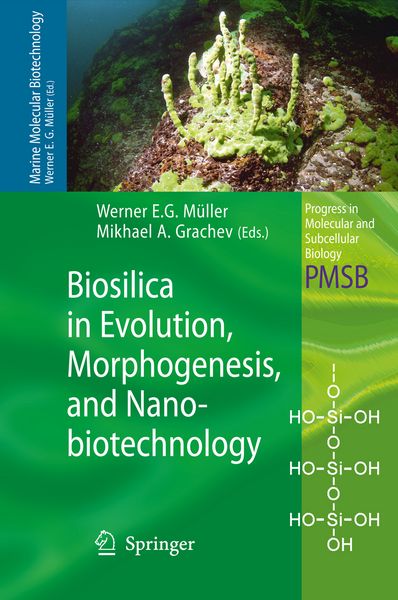
Produktbild: Biosilica in Evolution, Morphogenesis, and Nanobiotechnology
Band 47

Biosilica in Evolution, Morphogenesis, and Nanobiotechnology Case Study Lake Baikal

199,99 €

inkl. gesetzl. MwSt., Versandkostenfrei


Beschreibung

Lake Baikal is the oldest, deepest and most voluminous lake on Earth, comprising one fifth of the World’s unfrozen fresh water. It hosts the highest number of endemic animals recorded in any freshwater lake. Until recently it remained enigmatic why such a high diversity evolved in the isolated Lake Baikal....

Beschreibung

Lake Baikal is the oldest, deepest and most voluminous lake on Earth, comprising one fifth of the World’s unfrozen fresh water. It hosts the highest number of endemic animals recorded in any freshwater lake. Until recently it remained enigmatic why such a high diversity evolved in the isolated Lake Baikal. Focusing on the sponges (phylum Porifera) as an example, some answers are provided to fundamental questions on evolutionary forces. The characteristic feature of these animals is that they form their polymeric silicic acid skeleton enzymatically. This process is explored using modern molecular biological and cellular biological techniques to outline strategies to fabricate novel materials applicable in biomedicine and nanooptics.

Produktdetails

Einband

Gebundene Ausgabe

Erscheinungsdatum

23.02.2009

Abbildungen

XXII, 421 p.

Herausgeber Werner E. G. Müller + weitere

Produktdetails

Einband

Gebundene Ausgabe

Erscheinungsdatum

23.02.2009

Abbildungen

XXII, 421 p.

Herausgeber
Verlag Springer Berlin
Seitenzahl

421

Maße (B/H)

15,5/23,5 cm

Gewicht

772 g

Sprache

Englisch

ISBN

978-3-540-88551-1

Herstelleradresse

Springer Nature Customer Service Center GmbH
Europaplatz 3
69115 Heidelberg
DE
ProductSafety@springernature.com

Noch keine Bewertungen vorhanden

Verfassen Sie die erste Bewertung zu diesem Artikel

Helfen Sie anderen Kundinnen und Kunden durch Ihre Meinung.

Kundinnen und Kunden meinen

Bewertungen (0)

  • Produktbild: Biosilica in Evolution, Morphogenesis, and Nanobiotechnology
  • Geology – Paleontology – Paleoclimate.- Overview of Geology and Tectonic Evolution of the Baikal-Tuva Area.- Tectonics of the Baikal Rift Deduced from Volcanism and Sedimentation: A Review Oriented to the Baikal and Hovsgol Lake Systems.- Paleoclimate and Evolution: Emergence of Sponges During the Neoproterozoic.- Organisms: Sponges.- Studies on the Taxonomy and Distribution of Freshwater Sponges in Lake Baikal.- Towards a Molecular Systematics of the Lake Baikal/Lake Tuva Sponges.- Symbiotic Interaction Between Dinoflagellates and the Demosponge Lubomirskia baicalensis: Aquaporin-Mediated Glycerol Transport.- Evolution.- Silicon in Life: Whither Biological Silicification?.- Fossil Sponge Fauna in Lake Baikal Region.- Identification and Isolation of a Retrotransposon from the Freshwater Sponge Lubomirskia baicalensis: Implication in Rapid Evolution of Endemic Sponges.- Role of Biosilica in Morphogenesis.- Modelling the Skeletal Architecture in a Sponge with Radiate Accretive Growth.- Biosilica Formation.- Silicatein: Nanobiotechnological and Biomedical Applications.- Role of Biosilica in Materials Science.- Role of Biosilica in Materials Science: Lessons from Siliceous Biological Systems for Structural Composites.- An Overview of Silica in Biology: Its Chemistry and Recent Technological Advances.- Optical and Nonlinear Optical Properties of Sea Glass Sponge Spicules.- Nanobiotechnology: Soft Lithography.- The Application of Silicon and Silicates in Dentistry: A Review.- Role of Biosilica in Nanobiotechnology.- Sustainable Exploitation and Conservation of the Endemic Lake Baikal Sponge (Lubomirskia baicalensis) for Application in Nanobiotechnology.