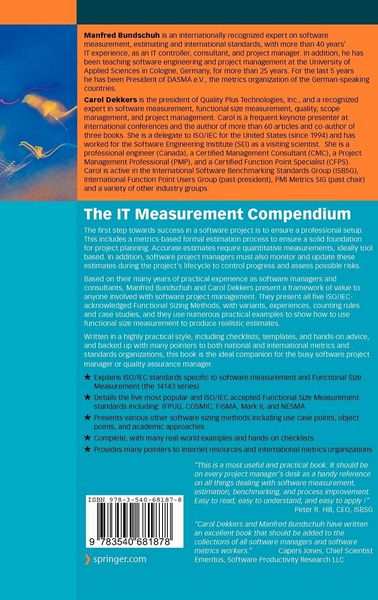
"This is a most useful and practical book. It should be on every project manager's desk as a handy reference on all things dealing with software measurement, estimation, benchmarking, and process improvement. Easy to read, easy to understand, and easy to apply !"
Peter R. Hill, CEO, International Software Benchmarking Standards Group
"Carol Dekkers and Manfred Bundschuh have written an excellent book that should be added to the collections of all software managers and software metrics workers throughout the world.
Measurement and estimation of software projects has been extremely difficult for both technical and sociological reasons. The technical reasons include scores of poorly defined and incompatible metrics, gaps or "leakage" from historical data, and a rather sparse collection of accurate benchmarks that were available to the general software community.
The sociological reasons center around the adversarial relationships between followers of rival metrics and measurement practices. For many years the "lines of code" metrics users have been at odds with the "function point" metrics users. Several other forms of measurement such as Earned Value, Balanced Scorecards, and Goal-Question metrics also have supporters, and tend to ignore other forms of metrics.
In recent years the situation has become even more complex. As of 2008 there are at least 24 function point variants, five methods for counting lines of code, and perhaps 15 other forms of measurement such as Use Case Points, Story Points, object-oriented metrics, and others too numerous to cite.
Dekkers and Bundschuh navigate this tricky area with clarity and objectiveness. All of the major metrics variants are discussed and explained, and their pros and cons are noted.
The book also discusses the organizations that are trying to eliminate competition among the rival metrics camps, and achieve some kind of consensus on what needs to be measured and how to go about it. Although there is still antagonism among the various rivals, this new book by Dekkers and Bundschuh is likely to be useful in leading to common goals and mutual understanding of what the various metrics were trying to accomplish.
Prior to the publication of this book, there was no easy way for followers of various metrics to learn about the other possibilities. While there are many books that discuss IFPUG function points, COSMIC function points, Goal-Question metrics, Balanced Scorecards, and all the others, this is the first book to try and show all of the major metrics in one volume.
This new book is a worthy companion to older books such as Barry Boehm's Software Engineering Economics, Steve McConnell's Software Estimation, Richard Stutzke's Estimating Software-Intensive Systems, Roger Pressman's Software Engineering - A Practitioner's Approach, Steve Kan's Metrics and Models in Software Engineering, and my own books Estimating Software Costs and Applied Software Measurement. All of these books attempt to show the synergistic relationships among wide-ranging topics, as does this new book by Dekkers and Bundschuh."
Capers Jones, Chief Scientist Emeritus, Software Productivity Research LLC