KI-Beratung Beta

Gutscheinbedingungen

**Gültig bis 18.11.2026 auf englischsprachige Klassiker (klassiker-32728) online auf thalia.at und in der Thalia App. Einzelne Artikel können ausgeschlossen sein. Ausgenommen sind preisgebundene Artikel & eBooks. Pro Einkauf einmal einlösbar. Click & Collect nur bei Onlinevorabzahlung möglich. Keine Barauszahlung. Nicht kombinierbar mit anderen Aktionen und Gutscheinen. Gutschein wird auf max. 500€ Bestellwert angerechnet. Nicht gültig für Geschenkkarten, Versandkosten und Services.

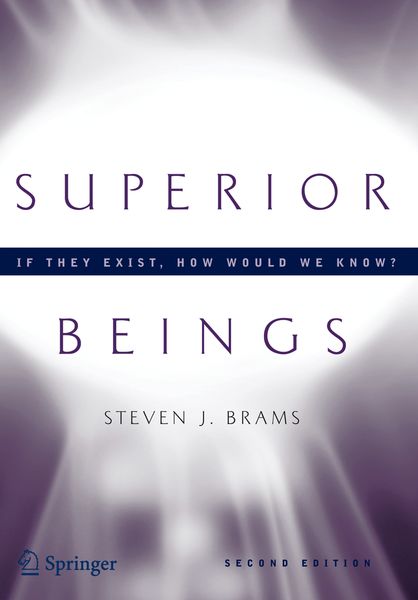
  • Produktbild: Superior Beings. If They Exist, How Would We Know?
  • Produktbild: Superior Beings. If They Exist, How Would We Know?

Superior Beings. If They Exist, How Would We Know? Game-Theoretic Implications of Omnipotence, Omniscience, Immortality, and Incomprehensibility

38,99 €

inkl. gesetzl. MwSt., Versandkostenfrei


Beschreibung

The same is true of applications of game theory to history, philosophy religion, and the other humanities. In particular, I know of no attempts to apply game theory to the kinds of p- losophy-of-religion and theology questions that I explored in Superior Beings, By contrast; the nexus between science...

Beschreibung

The same is true of applications of game theory to history, philosophy religion, and the other humanities. In particular, I know of no attempts to apply game theory to the kinds of p- losophy-of-religion and theology questions that I explored in Superior Beings, By contrast; the nexus between science and religion has been thoroughly analyzed using other methods of inquiry as evidenced by Charles L. Harper Jr (ed. ), Spiritual Information: 100 Perspectives on Science and Religion (West Conshohocken, PA: Templeton Foundation Press, 2006), a huge collection put together in honor of Sir John Templeton's ninetieth birthday Sir John, through the Templeton Foundation, is the primary propo nent and the major benefactor of studies in science and religion today How science and religion are (or are not) connected is, of course, an old subject. It is also a controversial one, extending at least from Galileo's trial in 1633 to the teaching of evolution today. While game theory is a mathematical theory, Superior Beings is emphatically not a scientific work, wherein a theory is tested. Rather, it is an attempt to interpret and explain important philo sophical, religious, and theological questions in terms of the rational choices of ordinary human beings, who are assumed to play games with a superior being. The game theory I use is nonstandard.

Rezension

From the reviews:


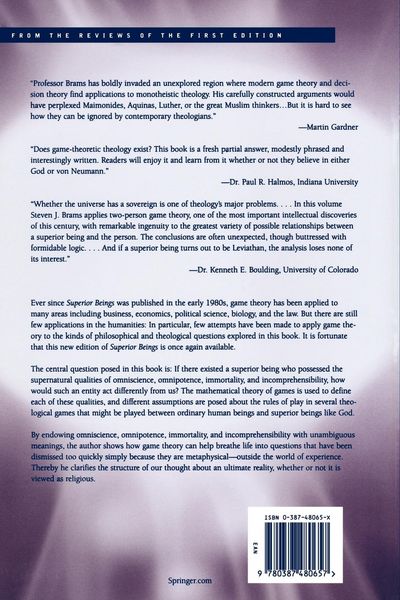
"[Brams’s] arguments, some of them quite complicated, are presented clearly and enough background information is given to enable the non-expert in game theory to follow what is going on.” —H.N.V. Temperley,
Nature
(March, 1984)


"
Superior Beings
is an extraordinary book... He [Brams] uses strikingly simple models and generally transparent logic to make some surprising inferences about superiority.  His inquiry is carried out with great inventiveness and care, and his book is highly recommended to those interested in religion, philosophy, and the contribution of logical analysis." - D. Marc Kilgur, American Scientist (1984)


"Brams has performed a service in deominstrating that rational analysis need not stop where issues involving faith and emotion begin." - Peter Bennett, New Scientist (1 March, 1984)


"Does game-theoretic theory exist?  This book is a fresh partial answer, modestly phrased and interestingly written.  Readers will enjoy it and learn from it whether or not the believe in either God or von Neumann." - Dr. Paul R. Halmos, Indiana University


"Professor Brams has boldly invaded an unexplored region where modern game theory and decision theory find applications to monotheistic theology.  His carefully constructed arguments would have perplexed Maimonides, Aquinas, Luther, or the great Muslim thinkers... But it is hard to see how they can be ignored by contemporary theologians." - Martin Gardener


"[Brams's] work can be highly recommended as collateral reading for introdcutory courses on mathematical modeling in the social, managerial and decision science-now perhaps even in theology." - William F. Lucas, American Mathematical Monthly (January, 1987)


From the reviews of the second edition:


"Brams analyses human interactions with the divine in order to effectively cast light on some of the toughestquestions in philosophy and theology. … Superior Beings represents a first step in applying game-theoretic analysis to religious issues and reading it brings up many questions and directions for future work. … Overall, Superior Beings is an excellent book that tackles a challenging series of topics with grace and depth." (Angela Vierling-Claassen, MathDL, February, 2008)

Produktdetails

Einband

Taschenbuch

Erscheinungsdatum

14.11.2006

Abbildungen

XXIV, 202 p. 32 illus.

Verlag Springer Us

Produktdetails

Einband

Taschenbuch

Erscheinungsdatum

14.11.2006

Abbildungen

XXIV, 202 p. 32 illus.

Verlag Springer Us
Seitenzahl

202

Maße (L/B/H)

23,4/15,7/1,4 cm

Gewicht

335 g

Auflage

Second Edition 2007

Sprache

Englisch

ISBN

978-0-387-48065-7

Herstelleradresse

Libri GmbH
Europaallee 1
36244 Bad Hersfeld
DE

Email: gpsr@libri.de

Noch keine Bewertungen vorhanden

Verfassen Sie die erste Bewertung zu diesem Artikel

Helfen Sie anderen Kundinnen und Kunden durch Ihre Meinung.

Kundinnen und Kunden meinen

Bewertungen (0)

  • Produktbild: Superior Beings. If They Exist, How Would We Know?
  • Produktbild: Superior Beings. If They Exist, How Would We Know?
  • The Rationality of Belief in a Superior Being.- Omniscience and Partial Omniscience.- The Paradox of Omniscience and the Theory of Moves.- Omnipotence: Moving and Staying Power.- Immortality and Incomprehensibility.- Superior Beings: They May Be Undecidable.