Gutscheinbedingungen

**Gültig bis 14.09.2026 auf Spielzeug, Schreibwaren, Filme, Geschenke & Trends, Musik, tolino eReader & Zubehör, Hörbücher, nicht preisgebundene Bücher und Kalender in der Thalia App. Einzelne Artikel können ausgeschlossen sein. Aufgrund der Buchpreisbindung sind deutschsprachige Bücher und eBooks ausgenommen. Zusätzlich ausgenommen sind Abos & Flatrates, Games, Geschenkkarten/-boxen, Shelfies, Software, Zeitschriften sowie einzelne Artikel von tonies®. Pro Einkauf einmal einlösbar. Nur gültig mit im Onlineshop hinterlegter Bonuscard. Click & Collect nur bei Onlinevorabzahlung möglich. Keine Barauszahlung. Nicht kombinierbar mit anderen Aktionen und Gutscheinen. Gutschein wird auf max. 500€ Bestellwert angerechnet. Nicht gültig für Versandkosten und Services.

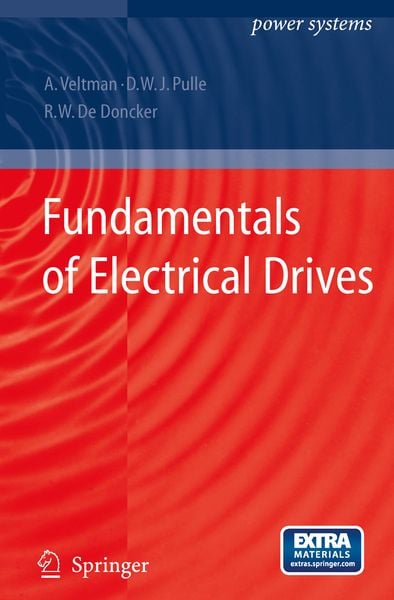
Produktbild: Fundamentals of Electrical Drives
- 12%

Fundamentals of Electrical Drives With Downloadable Files

Aus der Reihe Power Systems
12% sparen

144,99 € UVP 164,99 €

inkl. gesetzl. MwSt., Versandkostenfrei


Beschreibung

Produktdetails

Einband

Gebundene Ausgabe

Erscheinungsdatum

11.07.2007

Verlag

Springer Netherland

Seitenzahl

345

Maße (L/B/H)

24,1/16/2,8 cm

Gewicht

660 g

Auflage

2007

Sprache

Englisch

ISBN

978-1-4020-5503-4

Beschreibung

Rezension

From the reviews:


"This book on fundamentals of electrical drives provides the background of modern electrical drives. … The uniqueness of this book is that the authors use generic models to represent drive components. … This would be a great book for electrical engineers learning about electric drives and could also be used for a course in electrical drives … ." (Electrical Insulation Magazine, Vol. 24 (5), September/October, 2008)

Produktdetails

Einband

Gebundene Ausgabe

Erscheinungsdatum

11.07.2007

Verlag

Springer Netherland

Seitenzahl

345

Maße (L/B/H)

24,1/16/2,8 cm

Gewicht

660 g

Auflage

2007

Sprache

Englisch

ISBN

978-1-4020-5503-4

Herstelleradresse

Springer-Verlag GmbH
Tiergartenstr. 17
69121 Heidelberg
DE

Email: ProductSafety@springernature.com

Noch keine Bewertungen vorhanden

Verfassen Sie die erste Bewertung zu diesem Artikel

Helfen Sie anderen Kundinnen und Kunden durch Ihre Meinung.

Kundinnen und Kunden meinen

Bewertungen (0)

  • Produktbild: Fundamentals of Electrical Drives
  • Dedication. Foreword. Preface. Acknowledgments. Symbol conventions.
    1. INTRODUCTION. 1.1 Why use electro-mechanical energy conversion? 1.2 Key components of an Electrical drive system. 1.3 What characterizes high performance drives? 1.4 Notational conventions. 1.5 Use of building blocks to represent equations. 1.6 Magnetic principles. 1.7 Machine sizing principles. 1.8 Tutorials for Chapter 1.
    2. SIMPLE ELECTRO-MAGNETIC CIRCUITS. 2.1 Introduction. 2.2 Linear inductance. 2.3 Coil resistance. 2.4 Magnetic saturation. 2.5 Use of phasors for analyzing linear circuits. 2.6 Tutorials for Chapter 2.
    3. THE TRANSFORMER. 3.1 Introduction. 3.2 Ideal transformer (ITF) concept. 3.3 Basic transformer. 3.4 Transformer with magnetizing inductance. 3.5 Steady-state analysis. 3.6 Three inductance model. 3.7 Two inductance models. 3.8 Mutual and self inductance based model. 3.9 Two inductance model with coil resistance. 3.10 Tutorials for Chapter 3.
    4. THREE-PHASE CIRCUITS. 4.1 Introduction. 4.2 Star/Whye connected circuit. 4.3 Delta connected circuit. 4.4 Space vectors. 4.5 Amplitude and power invariant space vectors. 4.6 Application of space vectors for three-phase circuit analysis. 4.7 Relationship between space vectors and phasors. 4.8 Tutorials for Chapter 4.
    5. CONCEPT OF REAL AND REACTIVE POWER. 5.1 Introduction. 5.2 Power in single phase systems. 5.3 Power in three phase systems. 5.4 Phasor representation of real and reactive power. 5.5 Tutorials for Chapter 5.
    6. SPACE VECTOR BASED TRANSFORMER MODELS. 6.1 Introduction. 6.2 Development of a space vector based ITF model. 6.3 Two-phase ITF based generalized transformer model. 6.4 Tutorials for Chapter 6.
    7. INTRODUCTION TO ELECTRICAL MACHINES. 7.1 Introduction. 7.2 Ideal Rotating Transformer (IRTF) concept. 7.3 Conditions required to realize constant torque. 7.4 General machine model. 7.5 Tutorials for Chapter 7.
    8. VOLTAGESOURCECONNECTEDSYNCHRONOUS MACHINES. 8.1 Introduction. 8.2 Machine configuration. 8.3 Operating principles. 8.4 Symbolic model. 8.5 Generalized symbolic model. 8.6 Steady-state characteristics. 8.7 Tutorials for Chapter 8.
    9. VOLTAGESOURCECONNECTEDASYNCHRONOUS MACHINES. 9.1 Introduction. 9.2 Machine configuration. 9.3 Operating principles. 9.4 Symbolic model, simplified version. 9.5 Generalized symbolic model. 9.6 Steady-state analysis. 9.7 Tutorials for Chapter 9.
    10. DIRECT CURRENT MACHINES. 10.1 Introduction. 10.2 Machine configuration. 10.3 Operating principles. 10.4 Symbolic model, simplified form. 10.5 General symbolic DC machine model. 10.6 Steady-state characteristics. 10.7 Tutorials for Chapter 10.
    11. ANALYSIS OF A SIMPLE DRIVE SYSTEM. 11.1 Introduction. 11.2 Basic single phase uni-polar ‘drive’ circuit. 11.3 Basic single phase bipolar ‘drive’ circuit. 11.4 Control algorithm. 11.5 Tutorials for Chapter 11.
    Appendices. A Concept of sinusoidal distributed windings. B Generic module library.
    References. Index.