
KI-Beratung Beta

Gutscheinbedingungen

**Gültig bis 18.11.2026 auf englischsprachige Klassiker (klassiker-32728) online auf thalia.at und in der Thalia App. Einzelne Artikel können ausgeschlossen sein. Ausgenommen sind preisgebundene Artikel & eBooks. Pro Einkauf einmal einlösbar. Click & Collect nur bei Onlinevorabzahlung möglich. Keine Barauszahlung. Nicht kombinierbar mit anderen Aktionen und Gutscheinen. Gutschein wird auf max. 500€ Bestellwert angerechnet. Nicht gültig für Geschenkkarten, Versandkosten und Services.

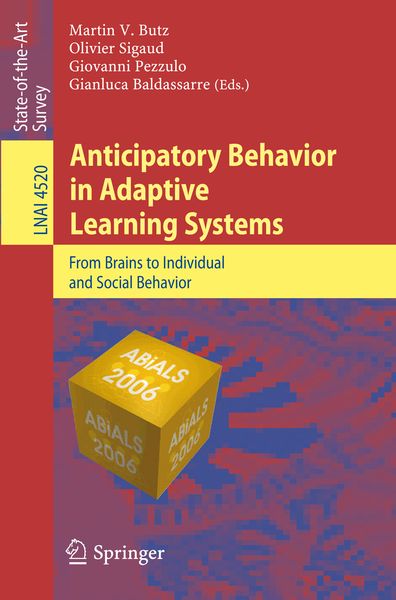
  • Produktbild: Anticipatory Behavior in Adaptive Learning Systems
  • Produktbild: Anticipatory Behavior in Adaptive Learning Systems
Band 4520

Anticipatory Behavior in Adaptive Learning Systems From Brains to Individual and Social Behavior

51,99 €

inkl. gesetzl. MwSt., Versandkostenfrei


Beschreibung

Anticipatory behavior in adaptive learning systems is steadily gaining the - terest of scientists, although many researchers still do not explicitly consider the actual anticipatory capabilities of their systems. Similarly to the previous two workshops, the third workshop on anticipatory behavior in...

Beschreibung

Anticipatory behavior in adaptive learning systems is steadily gaining the - terest of scientists, although many researchers still do not explicitly consider the actual anticipatory capabilities of their systems. Similarly to the previous two workshops, the third workshop on anticipatory behavior in adaptive lea- ing systems (ABiALS 2006) has shown yet again that the similarities between di?erent anticipatory mechanisms in diverse cognitive systems are striking. The discussions and presentations on the workshop day of September 30th, 2006, during the Simulation of Adaptive Behavior Conference (SAB 2006), con?rmed that the investigations into anticipatory cognitive mechanisms for behavior and learning strongly overlap among researchers from various disciplines, including the whole interdisciplinary cognitive science area. Thus, further conceptualizations of anticipatory mechanisms seem man- tory. The introductory chapter of this volume therefore does not only provide an overview of the contributions included in this volume but also proposes a taxonomy of how anticipatory mechanisms can improve adaptive behavior and learning in cognitive systems. During the workshop it became clear that ant- ipations are involved in various cognitive processes that range from individual anticipatory mechanisms to social anticipatory behavior. This book re?ects this structure by ?rst providing neuroscienti?c as well as psychological evidence for anticipatorymechanismsinvolvedinbehavior,learning,language,andcognition. Next,individualpredictivecapabilitiesandanticipatorybehaviorcapabilitiesare investigated. Finally, anticipation relevant in social interaction is studied.

Produktdetails

Einband

Taschenbuch

Erscheinungsdatum

22.08.2007

Abbildungen

X, 382 p.

Herausgeber Martin V. Butz + weitere

Produktdetails

Einband

Taschenbuch

Erscheinungsdatum

22.08.2007

Abbildungen

X, 382 p.

Herausgeber
Verlag Springer Berlin
Seitenzahl

382

Maße (L/B/H)

23,5/15,5/2,2 cm

Gewicht

598 g

Auflage

2007

Sprache

Englisch

ISBN

978-3-540-74261-6

Herstelleradresse

Springer-Verlag GmbH
Tiergartenstr. 17
69121 Heidelberg
DE

Email: ProductSafety@springernature.com

Noch keine Bewertungen vorhanden

Verfassen Sie die erste Bewertung zu diesem Artikel

Helfen Sie anderen Kundinnen und Kunden durch Ihre Meinung.

Kundinnen und Kunden meinen

Bewertungen (0)

  • Produktbild: Anticipatory Behavior in Adaptive Learning Systems
  • Produktbild: Anticipatory Behavior in Adaptive Learning Systems
  • Anticipations, Brains, Individual and Social Behavior: An Introduction to Anticipatory Systems.- Anticipatory Aspects in Brains, Language, and Cognition.- Neural Correlates of Anticipation in Cerebellum, Basal Ganglia, and Hippocampus.- The Role of Anticipation in the Emergence of Language.- Superstition in the Machine.- Individual Anticipatory Frameworks.- From Actions to Goals and Vice-Versa: Theoretical Analysis and Models of the Ideomotor Principle and TOTE.- Project “Animat Brain”: Designing the Animat Control System on the Basis of the Functional Systems Theory.- Cognitively Inspired Anticipatory Adaptation and Associated Learning Mechanisms for Autonomous Agents.- Schema-Based Design and the AKIRA Schema Language: An Overview.- Learning Predictions and Anticipations.- Training and Application of a Visual Forward Model for a Robot Camera Head.- A Distributed Computational Model of Spatial Memory Anticipation During a Visual Search Task.- A Testbed for Neural-Network Models Capable of Integrating Information in Time.- Construction of an Internal Predictive Model by Event Anticipation.- Anticipatory Individual Behavior.- The Interplay of Analogy-Making with Active Vision and Motor Control in Anticipatory Robots.- An Intrinsic Neuromodulation Model for Realizing Anticipatory Behavior in Reaching Movement under Unexperienced Force Fields.- Anticipating Rewards in Continuous Time and Space: A Case Study in Developmental Robotics.- Anticipatory Model of Musical Style Imitation Using Collaborative and Competitive Reinforcement Learning.- Anticipatory Social Behavior.- An Anticipatory Trust Model for Open Distributed Systems.- Anticipatory Alignment Mechanisms for Behavioral Learning in Multi Agent Systems.- Backward vs. Forward-Oriented Decision Making in theIterated Prisoner’s Dilemma: A Comparison Between Two Connectionist Models.- An Experimental Study of Anticipation in Simple Robot Navigation.