
Gutscheinbedingungen

**Gültig nur für Bestellungen an die Wunsch-Poststation bis 10.06.2026 auf Spielzeug, Schreibwaren, Filme, Geschenke & Trends, Musik, tolino eReader & Zubehör, Hörbücher und Hörbuch-Downloads (außer Abo), nicht preisgebundene Bücher und Kalender online auf thalia.at und in der Thalia App. Einzelne Artikel können ausgeschlossen sein. Aufgrund der Buchpreisbindung sind deutschsprachige Bücher und eBooks ausgenommen. Zusätzlich ausgenommen sind preisgebundene Artikel, Abos & Flatrates, eBooks, Games, Geschenkkarten/-boxen, Shelfies, Software, Zeitschriften sowie einzelne Artikel von tonies®. Pro Einkauf einmal einlösbar. Kein Click & Collect möglich. Keine Barauszahlung. Nicht kombinierbar mit anderen Aktionen und Gutscheinen. Gutschein wird auf max. 500€ Bestellwert angerechnet. Nicht gültig für Versandkosten und Services.

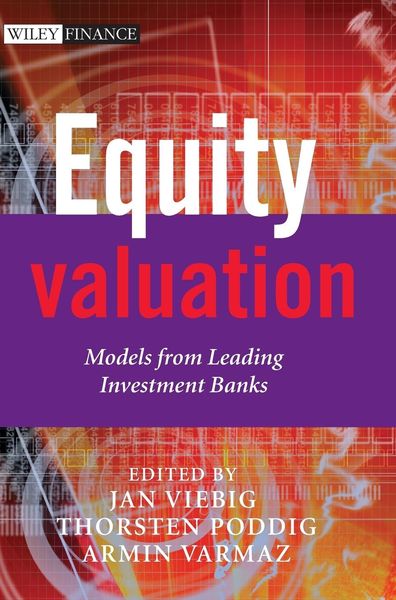
  • Produktbild: Equity Valuation
  • Produktbild: Equity Valuation

Equity Valuation Models from Leading Investment Banks

Aus der Reihe Wiley Finance Series

159,99 €

inkl. gesetzl. MwSt., Versandkostenfrei


Beschreibung

Produktdetails

Einband

Gebundene Ausgabe

Erscheinungsdatum

01.05.2008

Herausgeber

Jan Viebig + weitere

Verlag

John Wiley & Sons Inc

Seitenzahl

409

Maße (L/B/H)

25/17,5/2,8 cm

Gewicht

903 g

Auflage

1. Auflage

Sprache

Englisch

ISBN

978-0-470-03149-0

Beschreibung

Produktdetails

Einband

Gebundene Ausgabe

Erscheinungsdatum

01.05.2008

Herausgeber

Verlag

John Wiley & Sons Inc

Seitenzahl

409

Maße (L/B/H)

25/17,5/2,8 cm

Gewicht

903 g

Auflage

1. Auflage

Sprache

Englisch

ISBN

978-0-470-03149-0

Herstelleradresse

Produktsicherheitsverantwortliche/r
Europaallee 1
36244 Bad Hersfeld
DE

Email: gpsr@libri.de

Kundinnen und Kunden meinen

0 Bewertungen

Informationen zu Bewertungen

Zur Abgabe einer Bewertung ist eine Anmeldung im Konto notwendig. Die Authentizität der Bewertungen wird von uns nicht überprüft. Wir behalten uns vor, Bewertungstexte, die unseren Richtlinien widersprechen, entsprechend zu kürzen oder zu löschen.

Die Bewertungen sind nach Format, Anzahl Sterne und Datum sortiert.

Verfassen Sie die erste Bewertung zu diesem Artikel

Helfen Sie anderen Kund*innen durch Ihre Meinung

Kundinnen und Kunden meinen

0 Bewertungen filtern

Die Leseprobe wird geladen.
  • Produktbild: Equity Valuation
  • Produktbild: Equity Valuation
  • Foreword xiii

    Preface xvii

    Acknowledgments xxiii

    Abbreviations xxv

    Part I Discounted Cash Flow (DCF) Models 1
    Jan Viebig and Thorsten Poddig

    1 Introduction 3

    2 The Fundamental Value of Stocks and Bonds 5

    3 Discounted Cash Flow Models: The Main Input Factors 11

    3.1 Analytical balance sheets and free cash flow discount models 11

    3.2 The dividend discount model 14

    3.3 The free cash flow to the firm (FCFF) model 21

    3.3.1 Stirling Homex: why cash is king! 21

    3.3.2 FCFF during the competitive advantage period 27

    3.3.3 Weighted average cost of capital (WACC) 35

    3.3.4 Terminal value calculation 45

    References 49

    Part II Monte Carlo Free Cash Flow to the Firm (MC-FCFF) Models (Deutsche Bank/DWS) 53
    Jan Viebig and Thorsten Poddig

    4 Introduction 55

    5 Standard FCFF Model 57

    5.1 Net revenues 59

    5.2 Cost structure and operating income 63

    5.3 Reconciling operating income to FCFF 66

    5.4 The financial value driver approach 71

    5.5 Fundamental enterprise value and market value 76

    5.6 Baidu's share price performance 2005-2007 79

    6 Monte Carlo FCFF Models 85

    6.1 Monte Carlo simulation: the idea 85

    6.2 Monte Carlo simulation with @Risk 88

    6.2.1 Monte Carlo simulation with one stochastic variable 88

    6.2.2 Monte Carlo simulation with several stochastic variables 98

    6.3 Disclaimer 103

    References 105

    Part III Beyond Earnings: A User's Guide to Excess Return Models and the HOLT CFROI® Framework 107
    Tom Larsen and David Holland

    7 Introduction 109

    8 From Accounting to Economics - Part I 113

    9 From Economics to Valuation - Part I 115

    10 Where Does Accounting Go Wrong? 117

    11 From Accounting to Economics: CFROI 119

    11.1 The basics 119

    11.1.1 Return on net assets (RONA) or return on invested capital (ROIC) 120

    11.1.2 Return on gross investment (ROGI) 121

    11.1.3 Cash flow return on investment (CFROI) 121

    11.2 CFROI adjustments using Vodafone's March 2005 annual report 123

    11.2.1 Gross investment 123

    11.2.2 Non-depreciating assets 131

    11.2.3 Project life 135

    11.2.4 Gross cash flow 137

    11.3 CFROI calculation for Vodafone 140

    11.4 A comment on goodwill 141

    12 From Accounting to Economics: Economic Profit 145

    12.1 The basics 145

    12.2 Caveats 147

    12.3 EP adjustments using Vodafone March 2005 annual report 148

    12.3.1 Balance Sheet 148

    12.3.2 Net operating profit after tax (NOPAT) 153

    12.3.3 Economic profit 153

    12.3.4 EP or CFROI? 154

    13 From Economics to Valuation - Part II 157

    13.1 General rules 157

    13.2 Market value added 157

    13.3 CFROI 157

    13.4 A word on debt 158

    13.5 Valuation 159

    13.5.1 CFROI valuation: general framework 159

    13.5.2 Understanding project returns 159

    13.5.3 The residual period 161

    13.5.4 CFROI residual period approach 164

    13.5.5 Economic profit valuation: general framework 165

    13.6 Valuation of Vodafone 167

    13.7 EP or CFROI? 171

    13.8 A final word 173

    Appendix 1: Vodafone Financial Statements and Relevant Notes for CFROI Calculation 175

    Appendix 2: Additional Notes from Vodafone Annual Report for EP Calculation 185

    References 191

    Part IV Morgan Stanley ModelWare's Approach to Intrinsic Value: Focusing on Risk-Reward Trade-offs 193
    Trevor S. Harris, Juliet Estridge and Doron Nissim

    14 Introduction 195

    15 Linking Fundamental Analysis to the Inputs of the Valuation Model 199

    16 Our Valuation Framework 203

    17 Linking Business Activity to Intrinsic Value: The ModelWare Profitability Tree 211

    18 ModelWare's Intrinsic Value Approach 219

    19 Treatment of Key Inputs 231

    20 The Cost of Capital 233

    20.1 Risk-free rate 233

    20.2 Equity risk premium 234

    20.3 Beta-estimation 234

    21 Summary and Conclusions 237

    Appendix 239

    References 251

    Part V UBS VCAM and EGQ Regression-based Valuation 253
    David Bianco

    22 Introducing "EGQ" - Where Intrinsic Methods and Empirical Techniques Meet 255

    23 A Quick Guide to DCF and Economic Profit Analysis 257

    23.1 Powerful analytical frameworks, but not a complete solution 257

    23.2 Dynamics of economic profit analysis 257

    23.3 "Unadulterated EVA" 258

    23.4 Value dynamic 1: ROIC 258

    23.5 Value dynamic 2: invested capital 259

    23.6 Value dynamic 3: WACC 260

    23.7 Value dynamic 4: the value creation horizon 261

    23.8 Combining all four value dynamics: EGQ 261

    23.8.1 EGQ vs. PVGO 261

    23.8.2 The search for the ultimate valuation methodology 262

    24 Regression-based Valuation 263

    25 UBS Economic Growth Quotient 265

    25.1 The EGQ calculation 265

    25.2 EGQ special attributes 265

    25.2.1 A complete metric 265

    25.2.2 Not influenced by the current capital base 265

    25.2.3 Limited sensitivity to the assumed cost of capital 266

    25.2.4 Comparable across companies of different size 266

    25.2.5 Explains observed multiples on flows like earnings or cash flow 267

    26 UBS EGQ Regression Valuation 269

    26.1 Intrinsic meets relative valuation 269

    26.2 EGQ regressions: relative valuation theater 270

    26.3 EGQ regressions: a layered alpha framework 271

    26.4 Y-intercept indicates cost of capital 271

    26.5 Slope vs. Y-intercept indicates style 271

    26.6 Emergent valuation 272

    26.7 Why regress EGQ vs. EV/NOPAT? 272

    26.8 Think opposite when under the X-axis 273

    27 Understanding Regressions 275

    27.1 Key takeaways 275

    27.2 The line - what is the relationship? 276

    27.2.1 Slope (beta) 276

    27.2.2 y-intercept (alpha) 277

    27.3 The explanatory power or strength of the relationship 277

    27.3.1 Correlation coefficient (R) 277

    27.3.2 Coefficient of determination (R-squared) 277

    27.4 Reliability or confidence in the quantified relationship 278

    27.4.1 Standard error (of beta) 278

    27.4.2 t-Statistic 278

    27.5 Regression outliers 278

    27.5.1 Influence outliers 278

    27.5.2 Leverage outliers 278

    27.6 Beware of outliers in EGQ regressions 279

    28 Appendix Discussions 281

    28.1 EGQ's muted sensitivity to assumed WACC 281

    28.2 EV/IC vs. ROIC/WACC regressions 282

    28.3 PE vs. EPS growth regressions or PEG ratios 284

    28.4 Return metrics: ROIC vs. CFROI 285

    28.5 Accrual vs. cash flow return measures 286

    28.6 ROIC vs. CFROI 286

    28.7 Adjusting invested capital important, but not for EGQ 288

    References 291

    Part VI Leverage Buyout (LBO) Models 293
    Jan Viebig, Daniel Stillit and Thorsten Poddig

    29 Introduction 295

    30 Leveraged Buyouts 297

    31 IRRs and the Structure of LBO Models 301

    32 Assumptions of LBO Models 307

    33 Example: Continental AG 317

    33.1 Background 317

    33.2 LBO modeling approach - appropriate level of detail 318

    33.3 Key LBO parameters 318

    33.4 Step-by-step walk through the model 320

    34 A Word of Caution 329

    References 333

    Part VII Valuation 101: Approaches and Alternatives 335
    Aswath Damodaran

    35 Introduction 337

    36 Overview of Valuation 339

    37 Discounted Cash Flow Valuation 341

    37.1 Essence of discounted cashflow valuation 341

    37.2 Discount rate adjustment models 341

    37.2.1 Equity DCF models 343

    37.2.2 Firm DCF models 344

    37.3 Certainty equivalent models 345

    37.4 Excess return models 346

    37.5 Adjusted present value models 346

    37.6 Value enhancement in the DCF world 347

    37.6.1 Determinants of value 347

    37.6.2 Ways of increasing value 349

    38 Liquidation and Accounting Valuation 355

    38.1 Book value-based valuation 355

    38.1.1 Book value 356

    38.1.2 Book value plus earnings 356

    38.1.3 Fair value accounting 357

    38.2 Liquidation valuation 358

    38.3 Value enhancement in the accounting world 358

    39 Relative Valuation 361

    39.1 Steps in relative valuation 361

    39.2 Basis for approach 361

    39.3 Standardized values and multiples 362

    39.4 Determinants of multiples 363

    39.5 Comparable firms 365

    39.6 Controlling for differences across firms 365

    39.7 Value enhancement in the relative valuation world 366

    40 Real Option Valuation 369

    40.1 Basis for approach 369

    40.2 The essence of real options 370

    40.3 Examples of real options 371

    40.4 Value enhancement in the real options world 372

    41 Closing Thoughts on Value Enhancement 375

    References 377

    Part VIII Final Thoughts on Valuation 379
    Armin Varmaz, Thorsten Poddig and Jan Viebig

    42 Introduction 381

    43 Valuation in Theory: The Valuation of a Single Asset 383

    43.1 Certain cash flows 383

    43.2 Uncertain cash flows 384

    43.3 Risk premia 386

    43.4 Certainty equivalents and utility-based valuation 388

    43.5 Risk neutral probabilities 391

    44 Outlook: The Multi-asset Valuation and Allocation Case 395

    45 Summary 399

    References 401

    Index 403