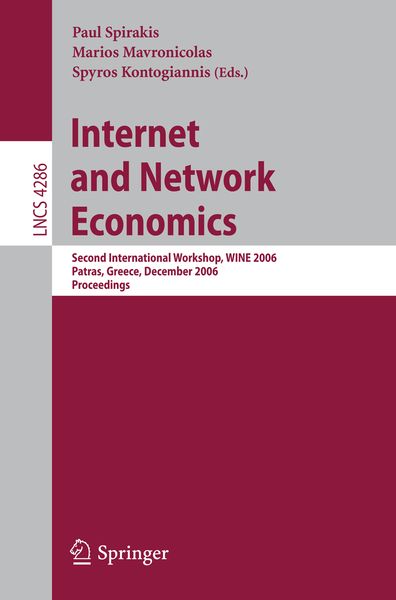

Internet and Network Economics Second International Workshop, WINE 2006, Patras, Greece, December 15-17, 2006, Proceedings
-
- Englisch ausgewählt
51,99 €
inkl. gesetzl. MwSt.,
Beschreibung
Produktdetails
Einband
Taschenbuch
Erscheinungsdatum
27.11.2006
Abbildungen
XI, 404 p.
Herausgeber
Paul Spirakis + weitereVerlag
Springer BerlinSeitenzahl
404
Maße (L/B/H)
23,5/15,5/2,3 cm
Gewicht
628 g
Auflage
2006
Sprache
Englisch
ISBN
978-3-540-68138-0
Recent Developments in Learning and Competition with Finite Automata (Extended Abstract).- Dynamic Mechanism Design.- Unconditional Competitive Auctions with Copy and Budget Constraints.- Truthful Auctions with Optimal Profit.- Mechanisms with Verification for Any Finite Domain.- Pure Nash Equilibria in Player-Specific and Weighted Congestion Games.- On the Complexity of Pure-Strategy Nash Equilibria in Congestion and Local-Effect Games.- Strong and Correlated Strong Equilibria in Monotone Congestion Games.- The Equilibrium Existence Problem in Finite Network Congestion Games.- First-Passage Percolation on a Width-2 Strip and the Path Cost in a VCG Auction.- Optimal Cost-Sharing Mechanisms for Steiner Forest Problems.- Mechanisms to Induce Random Choice.- Bayesian Optimal No-Deficit Mechanism Design.- Succinct Approximation of Trade-Off Curves.- Game-Theoretic Aspects of Designing Hyperlink Structures.- Competing for Customers in a Social Network: The Quasi-linear Case.- Selfish Service Installation in Networks.- Games of Connectivity.- Assignment Problems in Rental Markets.- On Portfolio's Default-Risk-Adjusted Duration and Value: Model and Algorithm Based on Copulas.- Price Roll-Backs and Path Auctions: An Approximation Scheme for Computing the Market Equilibrium.- New Results on Rationality and Strongly Polynomial Time Solvability in Eisenberg-Gale Markets.- Making Economic Theory Operational.- Sparse Games Are Hard.- Market Equilibria with Hybrid Linear-Leontief Utilities.- Polynomial Algorithms for Approximating Nash Equilibria of Bimatrix Games.- A Note on Approximate Nash Equilibria.- Ranking Sports Teams and the Inverse Equal Paths Problem.- Price of Anarchy for Polynomial Wardrop Games.- Wardrop Equilibria and Price of Stability for Bottleneck Games withSplittable Traffic.- A Worm Propagation Model Based on People's Email Acquaintance Profiles.- Mixed Strategies in Combinatorial Agency.- The Sound of Silence: Mining Implicit Feedbacks to Compute Reputation.- Strongly Polynomial-Time Truthful Mechanisms in One Shot.- Secretary Problems with Competing Employers.
Noch keine Bewertungen vorhanden
Verfassen Sie die erste Bewertung zu diesem Artikel
Helfen Sie anderen Kundinnen und Kunden durch Ihre Meinung.
Kurze Frage zu unserer Seite
Vielen Dank für Ihr Feedback
Wir nutzen Ihr Feedback, um unsere Produktseiten zu verbessern. Bitte haben Sie Verständnis, dass wir Ihnen keine Rückmeldung geben können. Falls Sie Kontakt mit uns aufnehmen möchten, können Sie sich aber gerne an unseren Kund*innenservice wenden.
zum Kundenservice