Gutscheinbedingungen

**Gültig bis 06.07.2026 auf fremdsprachige Bücher online auf thalia.at, in der Thalia App ab einem Mindestbestellwert von 30€ und in allen Thalia Buchhandlungen in Österreich. In den Buchhandlungen nur gültig auf lagernde Ware. Einzelne Artikel können ausgeschlossen sein. Ausgenommen sind preisgebundene Artikel & eBooks. Pro Einkauf einmal einlösbar. Nur gültig gegen Vorlage oder im Onlineshop hinterlegter Bonuscard. Infos zur Einlösung in der Buchhandlung sind auf der Bonuscard-Vorteilspreisseite zu finden. Click & Collect nur bei Onlinevorabzahlung möglich. Keine Einlösung bei Scan & Go-Bezahlung. Keine Barauszahlung. Nicht kombinierbar mit anderen Aktionen und Gutscheinen. Gutschein wird auf max. 500€ Bestellwert angerechnet. Nicht gültig für Versandkosten und Services.

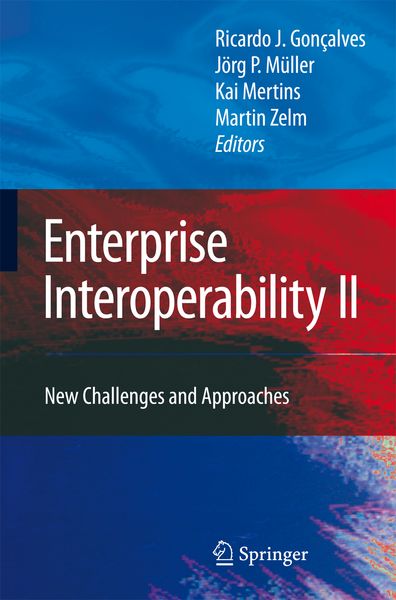
  • Produktbild: Enterprise Interoperability II
  • Produktbild: Enterprise Interoperability II
Band 3 - 10%

Enterprise Interoperability II New Challenges and Approaches

10% sparen

294,99 € UVP 329,99 €

inkl. gesetzl. MwSt., Versandkostenfrei


Beschreibung

Produktdetails

Einband

Gebundene Ausgabe

Erscheinungsdatum

16.03.2007

Abbildungen

XVIII, 322 schwarzweisse Abbildungen, 58 Tabellen, 322 schwarzweisse Zeichnungen 235 mm

Herausgeber

Ricardo Jardim-Gonçalves + weitere

Verlag

Springer London

Seitenzahl

894

Maße (L/B/H)

24,1/16/5,5 cm

Gewicht

1519 g

Auflage

2007

Sprache

Englisch

ISBN

978-1-84628-857-9

Beschreibung

Produktdetails

Einband

Gebundene Ausgabe

Erscheinungsdatum

16.03.2007

Abbildungen

XVIII, 322 schwarzweisse Abbildungen, 58 Tabellen, 322 schwarzweisse Zeichnungen 235 mm

Herausgeber

Verlag

Springer London

Seitenzahl

894

Maße (L/B/H)

24,1/16/5,5 cm

Gewicht

1519 g

Auflage

2007

Sprache

Englisch

ISBN

978-1-84628-857-9

Herstelleradresse

Springer-Verlag KG
Sachsenplatz 4-6
1201 Wien
AT

Email: GPSR Kontakt

Noch keine Bewertungen vorhanden

Verfassen Sie die erste Bewertung zu diesem Artikel

Helfen Sie anderen Kundinnen und Kunden durch Ihre Meinung.

Kundinnen und Kunden meinen

Bewertungen (0)

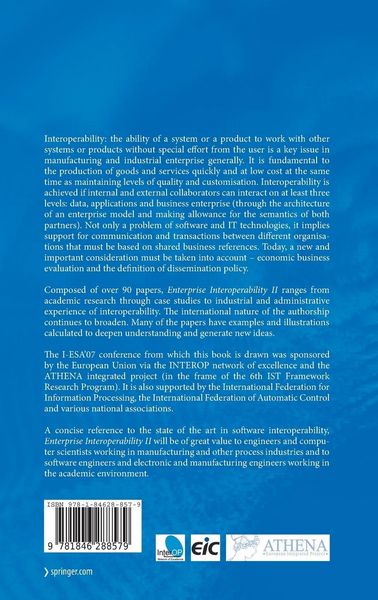
  • Produktbild: Enterprise Interoperability II
  • Produktbild: Enterprise Interoperability II
  • Enterprise Modelling and Interoperability Engineering.- Requirements for Implementing Business Process Models through Composition of Semantic Web Services.- Requirements Engineering for Improving Business/IT Alignment in Security Risk Management Methods.- An Ontology for Requirements Analysis of Managers’ Policies in Financial Institutions.- Interoperability Requirements derived from Interoperability Dimensions.- Peer-to-Peer Supported Design Infrastructure for Collaborative Business Processing.- Model Transformations with Reference Models.- Comparing GRL and KAOS using the UEML Approach.- Integrated solution to support enterprise interoperability at the business process level on e-Procurement.- Access and Semantic Level Integration of Building Models for Cooperative Fire Protection Planning.- Business Process Modelling and Flexibility.- Analysing CIM2PIM Approaches to Improve Interoperability.- Using IIAM to Assess Interoperability Investments: a Case Study.- Distributed, Decentralized and Adaptable Interoperability Architecture.- The EIC - A consensus-centric approach for cross-organizational e-Business standards diffusion.- Improving Interoperability in Collaborative Modelling.- Designing a Service Oriented Domain Architecture.- Decomposition of Supply Networks - Business Modelling and Interoperability.- An Ontology of Interoperability in Inter-Enterprise Communities.- ICT interoperability challenges in decentral, cross-enterprise product engineering.- A Security Framework for Smart Ubiquitous Industrial Resources.- Interoperability through a Platform-Independent Model for Agents.- Architecture for the Design and Agent-Based Implementation of Cross-Organizational Business Processes.- The Data Grid for the Collaboration Development in the Virtual Enterprise.- Conformance Test of Federated Choreographies.- Tools and Methodologies for Enterprise Interoperability.- Evaluating Quality of Enterprise Modelling Languages: The UEML solution.- Towards a common repository for governmental data: A modelling framework and real world application.- Improving the collaboration ability among SMEs by developing an open source based collaboration tool.- Cartography for designing collaborative processes.- Building and validating a Manufacturing Ontology to achieve Interoperability.- A Graph based approach for interoperability evaluation.- Product Ontology Supporting Information Exchanging in Global Furniture Industry.- Living Labs — a new multi-stakeholder approach to user integration.- TermExtractor: a Web Application to Learn the Shared Terminology of Emergent Web Communities.- SMDA: A Service Model Driven Architecture.- Enterprise Interoperability enabling Enterprise Collaboration.- Classifying Interoperability Problems for a Method Chunk Repository.- Semantics and Knowledge Aspects in Enterprise Interoperability.- Towards an Ontology using a Concern-Oriented Approach for Information Systems Analysis.- Integrating HAD Organizational Data Assets using Semantic Web Technologies.- Formalizing the OPAL eBusiness ontology design patterns with OWL.- An Approach for Building an OWL Ontology for Workflow Interoperability.- Enabling Cross-Border Interoperability: Modelling Legal Rules for Electronic Transactions in the European Union.- On capturing information requirements in process specifications.- OntoMas: a Tutoring System dedicated to Ontology Matching.- Combined SOA Maturity Model (CSOAMM): Towards a Guide for SOA Adoption.- Integration of Job Portals by Meta-search.- Model-driven and Service-oriented Integration and Development.- ABILITIES to Support a Federated Architecture Based Interoperability Bus with Groupware and Multimedia.- Context-Aware Service Compositions: A Way to Facilitate Interoperability.- External Integration of an e-Services Hub.- Transforming GRAI Extended Actigrams into UML Activity Diagrams: a First Step to Model Driven Interoperability.- Interoperability Oriented Business Object Model.- An Integrated Approach to Model-Driven Design, Execution, Analysis and Monitoring.- CCTS-based Business Information Modelling for Increasing Cross-Organizational Interoperability.- Applying TTCN to enhance B2B Conformance testing frameworks.- Enabling Semantic Mediation for Business Applications: XML-RDF, RDF-XML and XSD-RDFS transformations.- Towards a service-oriented enterprise based on business components identification.- Business Level Service-Oriented Enterprise Application Integration.- Interoperability for transport companies.- Collaborative Architecture and Formal Interoperability Approaches.- Enabling Cross-Organizational Interoperability: A Hybrid e-Business Architecture.- Challenges in Collaboration: Tool Chain Enables Transparency Beyond Partner Borders.- A Case Study in Enterprise Modelling for Interoperable Cross-Enterprise Data Exchange.- An Interoperable E-business platform towards better integration of New Member States SME’s.- Interoperability in Collaborative Networks: An Innovative Approach for the Shoe Up-Stream Business Segment.- The ATHENA Interoperability Framework.- Towards precise descriptions for programming language interoperability: a general approach based on operational semantics.- Organising Manufacturing Information for Engineering Interoperability.- Extended Influence Diagram Generation.- Managing, Measuring and Validating Interoperability.- Assessing Interoperability in the Retail Industry: The Case of Metro Group.- An ontology for the Environmental and Safety integration in the construction sector.- The value of interoperability in networked enterprises: the case of health care management companies.- The Interoperability of Information and its Representation in New Media: A Case Study of a Global Content Provider.- Building B2B middleware — Interoperability knowledge management issues.- Introducing the Common Non-Functional Ontology.- An Iterative Procedure for Efficient Testing of B2B: A Case in Messaging Service Tests.- Towards Interoperable Healthcare Information Systems: The HL7 Conformance Profile Approach.- Cross-sector Interoperability Solutions.- An Intelligent Test Methodology to Achieve Interoperability between Business-to-Business (B2B) Applications.- Testing and Monitoring E-Business using the Event-driven Test Scripting Language.- UN/CEFACT Core Components as the basis for structured business communication by SMEs, employing auto-generated, user adjustable forms.- Interoperability Challenges and Solutions in Automotive Collaborative Product Development.- A Case Study in Business Application Development Using Open Source and Semantic Web Technologies.- Interoperability Impact Assessment Model: An Overview.- A primitive ontology model for product lifecycle meta data in the closed-loop PLM.- SAMBA — An Agent architecture for Ambient Intelligence Elements Interoperability.- Determining Runtime Properties of Mobile Software Architectures.- Applications, Case Studies, Best Practice and Standards.- Enabling Interoperability in the Area of Multi-Brand Vehicle Configuration.- Model-Generated Workplaces: An Interoperability Approach.- Parsing Effort in a B2B Integration Scenario — An Industrial Case Study.- Towards automatic semantic integration.- Integration of an Acoustic Simulation Tool with CAAD Environments using ifcXML.- On Web Service Evolution Monitoring.- Enhancing STEP-based Interoperabity Using Model Morphisms.- Schema description for arbitrary data formats with the Data Format Description Language.- Web services to resolve concept identifiers for an effective product data exchange.- Application Development with Virtual Teams: Models and Metrics.- Business Interoperability Profiles: Relating Business Interoperability Issues To Technical Interoperability Solutions.- An Approach for Service-Oriented Urbanism.