Gutscheinbedingungen

**Gültig nur für Bestellungen an die Wunsch-Poststation bis 10.06.2026 auf Spielzeug, Schreibwaren, Filme, Geschenke & Trends, Musik, tolino eReader & Zubehör, Hörbücher und Hörbuch-Downloads (außer Abo), nicht preisgebundene Bücher und Kalender online auf thalia.at und in der Thalia App. Einzelne Artikel können ausgeschlossen sein. Aufgrund der Buchpreisbindung sind deutschsprachige Bücher und eBooks ausgenommen. Zusätzlich ausgenommen sind preisgebundene Artikel, Abos & Flatrates, eBooks, Games, Geschenkkarten/-boxen, Shelfies, Software, Zeitschriften sowie einzelne Artikel von tonies®. Pro Einkauf einmal einlösbar. Kein Click & Collect möglich. Keine Barauszahlung. Nicht kombinierbar mit anderen Aktionen und Gutscheinen. Gutschein wird auf max. 500€ Bestellwert angerechnet. Nicht gültig für Versandkosten und Services.

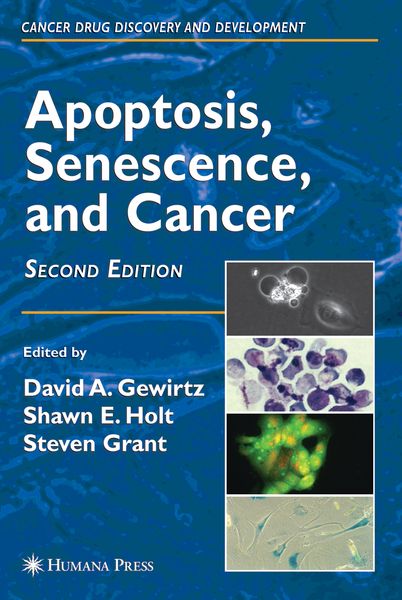
Produktbild: Apoptosis, Senescence and Cancer
- 12%

Apoptosis, Senescence and Cancer

12% sparen

192,99 € UVP 219,99 €

inkl. gesetzl. MwSt., Versandkostenfrei


Beschreibung

Produktdetails

Einband

Gebundene Ausgabe

Erscheinungsdatum

17.12.2007

Abbildungen

XVII, 69 illus., 5 illus. in color., schwarz-weiss Illustrationen, farbige Illustrationen

Herausgeber

David A. Gewirtz + weitere

Verlag

Humana Press

Seitenzahl

599

Maße (L/B/H)

26/18,3/3,8 cm

Gewicht

1275 g

Auflage

2nd ed. 2007

Sprache

Englisch

ISBN

978-1-58829-527-9

Beschreibung

Rezension

From the reviews of the second edition:"The book provides a comprehensive view in the field of apoptosis, senescence, and cancer therapies. I recommend this book to PhD students in clinical and experimental oncology, pharmacology as well as to lecturers in biological disciplines." (J. Sedlák, Neoplasma, September, 2008)"This book aims to explain basic biological processes and signalling pathways and to link that knowledge to the anticancer drugs associated with those pathways. … The book is generally well written and extremely informative. The information within is as up to date … . I have certainly learnt a lot from reading this book. … recommending it to a laboratory/clinical group or library for purchase." (A Young, British Journal of Cancer, Vol. 100 (5), 2009)“The purpose of the book is to contribute to an understanding of the growth arrest and cell death pathways mediating the response to chemotherapy in tumour cells. … provides basic scientists and clinicians with a deeper and more thorough understanding of the cellular responses of malignant cells to common therapeutic modalities, which may determine the effectiveness of the anti-cancer treatment. This work is an interesting overview of the topics described above and it is well written by experts in the field.” (Sylvie Rottey, Acta Clinica Belgica, Vol. 65 (2), 2010)

Produktdetails

Einband

Gebundene Ausgabe

Erscheinungsdatum

17.12.2007

Abbildungen

XVII, 69 illus., 5 illus. in color., schwarz-weiss Illustrationen, farbige Illustrationen

Herausgeber

Verlag

Humana Press

Seitenzahl

599

Maße (L/B/H)

26/18,3/3,8 cm

Gewicht

1275 g

Auflage

2nd ed. 2007

Sprache

Englisch

ISBN

978-1-58829-527-9

Herstelleradresse

Springer-Verlag GmbH
Tiergartenstr. 17
69121 Heidelberg
DE

Email: ProductSafety@springernature.com

Kundinnen und Kunden meinen

0 Bewertungen

Informationen zu Bewertungen

Zur Abgabe einer Bewertung ist eine Anmeldung im Konto notwendig. Die Authentizität der Bewertungen wird von uns nicht überprüft. Wir behalten uns vor, Bewertungstexte, die unseren Richtlinien widersprechen, entsprechend zu kürzen oder zu löschen.

Die Bewertungen sind nach Format, Anzahl Sterne und Datum sortiert.

Verfassen Sie die erste Bewertung zu diesem Artikel

Helfen Sie anderen Kund*innen durch Ihre Meinung

Kundinnen und Kunden meinen

0 Bewertungen filtern

  • Produktbild: Apoptosis, Senescence and Cancer
  • Apoptosis, Senescence and Cancer

    Section I: Apoptosis and Alternative Models of Cell Death
    Chapter 1. The intrinsic pathway of apoptosis. Scott H. Kaufman
    Chapter 2. The extrinsic pathway of apoptosis. M. Stacey Ricci and Wafik S. El-Deiry
    Chapter 3. Evaluating the importance of apoptosis and other determinants of cell death and survival. Bradley G. Wouters and Roland K. Chiu
    Chapter 4. Mitotic catastrophe. Fiorenza Ianzini and Michael A. Mackey
    Chapter 5. Autophagy and autophagic cell death. Mojgan Djavaheri-Mergny, Joelle Botti and Patrice Codogno
    Chapter 6. Regulation and function of detachment-induced cell death (anoikis) in cancer progression and metastasis. David J. McConkey and Victor Bondar

    Section II. Telomeres and Telomerase, Senescence, Genomic Instability and Tumorigenesis
    Chapter 7. Structure and function of the telomere. Jay E. Johnson and Dominique Broccoli
    Chapter 8. Overview of Senescence. Ruben D. Ramirez
    Chapter 9. Contributions of telomerase to tumorigenesis. Richard Possemato and William C. Hahn
    Chapter 10. The role of telomeres in genomic instability. John P. Murnane

    Section III. DNA Damage Response, Signaling Pathways and Tumorigenesis
    Chapter 11. Overview of the DNA damage checkpoint -- ATM and ATR. Aude Dupre and Jean Gautier
    Chapter 12. Interactions between myc and cyclin dependent kinase inhibitors in cancer. Kirsteen H. Maclean and John L. Cleveland
    Chapter 13. Interplay between H2AX and 53BP1 pathways in DNA double strand break repair response. Fatouros Chronis and Emmy P. Rogakou
    Chapter 14. DNA-dependent protein kinase in repair, apoptosis, telomere maintenance and chemotherapy. Lawrence F. Povirk

    Section IV. Resistance and Sensitization
    Chapter 15. Resistance/signaling pathways. Paul Dent
    Chapter 16. Ceramide and multi-drug resistance. Myles C. Cabot
    Chapter 17. Chemo and radio-sensitization through inhibition of PI3/Akt signaling. Debra L. Smith, Laura K. Nolden, Gordon B. Mills and Yiling Lu
    Chapter 18. The advancement of epidermal growth factor receptor inhibitors in cancer therapy. Gregory W. Allen and Paul M. Harari

    Section V. Established Cancer Therapies
    Chapter 19. Antimetabolites. Janet A. Houghton
    Chapter 20. Topoiseomerase I poisons and apoptotic topoisomerase I-DNA complexes. Olivier Sordet, Yves Pommier and Eric Solary
    Chapter 21. Perturbations of cellular functions by topoisomerase II inhibitors: all roads lead to cell death? Annette K. Larsen and Andrzej Skladanowski
    Chapter 22. The significance of poly-targeting in apoptosis induction by alkylating agents and platinum drugs. Jan M. Woynarowski and Barbara A. Woynarowska
    Chapter 23. Contributions of apoptosis and senescence to cytotoxicity produced by microtubule stabilizing agents. Laura E. Klein and Susan B. Horwitz

    Section VI. Recent and Developing Cancer Therapies
    Chapter 24. Tyrosine kinase inhibitors. Michael Deininger
    Chapter 25. Humanized antibodies. Morton Coleman and Richard Furman
    Chapter 26. Role of apoptosis in anti-angiogenic cancer therapies. Jennifer A. Doll, Jennifer E. Hobbs and Gerald A. Soff
    Chapter 27. Photodynamic therapy-induced apoptosis. Nancy L. Oleinick, Rachel L. Morris and Anna Lisa Nieminen
    Chapter 28. Modulation of TRAIL signaling for cancer therapy. Simone Fulda and Klaus-Michael Debatin