Gutscheinbedingungen

**Gültig nur für Bestellungen an die Wunsch-Poststation bis 10.06.2026 auf Spielzeug, Schreibwaren, Filme, Geschenke & Trends, Musik, tolino eReader & Zubehör, Hörbücher und Hörbuch-Downloads (außer Abo), nicht preisgebundene Bücher und Kalender online auf thalia.at und in der Thalia App. Einzelne Artikel können ausgeschlossen sein. Aufgrund der Buchpreisbindung sind deutschsprachige Bücher und eBooks ausgenommen. Zusätzlich ausgenommen sind preisgebundene Artikel, Abos & Flatrates, eBooks, Games, Geschenkkarten/-boxen, Shelfies, Software, Zeitschriften sowie einzelne Artikel von tonies®. Pro Einkauf einmal einlösbar. Kein Click & Collect möglich. Keine Barauszahlung. Nicht kombinierbar mit anderen Aktionen und Gutscheinen. Gutschein wird auf max. 500€ Bestellwert angerechnet. Nicht gültig für Versandkosten und Services.

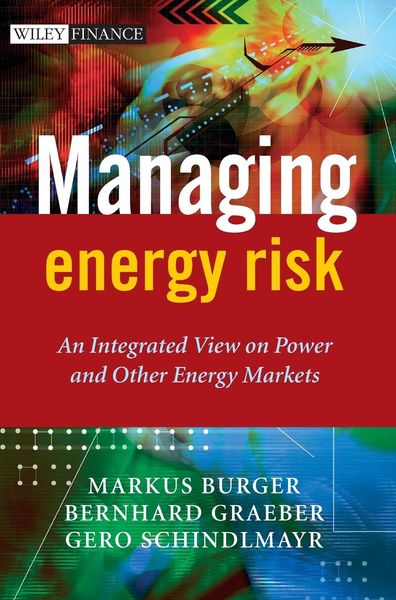
  • Produktbild: Managing Energy Risk
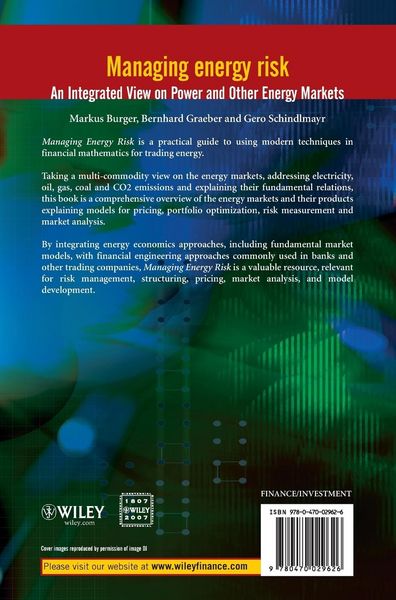
  • Produktbild: Managing Energy Risk

Managing Energy Risk An Integrated View on Power and Other Energy Markets

Aus der Reihe Wiley Finance Series

184,99 €

inkl. gesetzl. MwSt., Versandkostenfrei


Beschreibung

Produktdetails

Einband

Gebundene Ausgabe

Erscheinungsdatum

01.01.2008

Verlag

John Wiley & Sons Inc

Seitenzahl

312

Maße (L/B/H)

25/17,5/2,2 cm

Gewicht

714 g

Auflage

1. Auflage

Sprache

Englisch

ISBN

978-0-470-02962-6

Beschreibung

Produktdetails

Einband

Gebundene Ausgabe

Erscheinungsdatum

01.01.2008

Verlag

John Wiley & Sons Inc

Seitenzahl

312

Maße (L/B/H)

25/17,5/2,2 cm

Gewicht

714 g

Auflage

1. Auflage

Sprache

Englisch

ISBN

978-0-470-02962-6

Herstelleradresse

Produktsicherheitsverantwortliche/r
Europaallee 1
36244 Bad Hersfeld
DE

Email: gpsr@libri.de

Kundinnen und Kunden meinen

0 Bewertungen

Informationen zu Bewertungen

Zur Abgabe einer Bewertung ist eine Anmeldung im Konto notwendig. Die Authentizität der Bewertungen wird von uns nicht überprüft. Wir behalten uns vor, Bewertungstexte, die unseren Richtlinien widersprechen, entsprechend zu kürzen oder zu löschen.

Die Bewertungen sind nach Format, Anzahl Sterne und Datum sortiert.

Verfassen Sie die erste Bewertung zu diesem Artikel

Helfen Sie anderen Kund*innen durch Ihre Meinung

Kundinnen und Kunden meinen

0 Bewertungen filtern

Die Leseprobe wird geladen.
  • Produktbild: Managing Energy Risk
  • Produktbild: Managing Energy Risk
  • Foreword.

    Preface.

    1 Energy Markets.

    1.1 The oil market.

    1.1.1 Consumption, production and reserves.

    1.1.2 Crude oil trading.

    1.1.3 Refined oil products.

    1.2 The natural gas market.

    1.2.1 Consumption, production and reserves.

    1.2.2 Natural gas trading.

    1.2.3 Price formulas with oil indexation.

    1.2.4 Liquefied natural gas.

    1.3 The coal market.

    1.3.1 Consumption, production and reserves.

    1.3.2 Coal trading.

    1.3.3 Freight.

    1.3.4 Coal subsidies in Germany: BAFA-indexed prices.

    1.4 The electricity market.

    1.4.1 Consumption and production.

    1.4.2 Electricity trading.

    1.4.3 Products in the electricity markets.

    1.4.4 Energy exchanges.

    1.5 The emissions market.

    1.5.1 Kyoto Protocol.

    1.5.2 EU emissions trading scheme.

    1.5.3 Flexible mechanisms.

    1.5.4 Products and market places.

    1.5.5 Emissions trading in North America.

    2 Energy Derivatives.

    2.1 Forwards, futures and swaps.

    2.1.1 Forward contracts.

    2.1.2 Futures contracts.

    2.1.3 Swaps.

    2.2 "Plain vanilla" options.

    2.2.1 The put-call parity and option strategies.

    2.2.2 Black's futures price model.

    2.2.3 Option pricing formulas.

    2.2.4 Hedging options: the "Greeks".

    2.2.5 Implied volatilities and the "volatility smile".

    2.2.6 Swaptions.

    2.3 American and Asian options.

    2.3.1 American options.

    2.3.2 Asian options.

    2.4 Commodity bonds and loans.

    2.5 Multi-underlying options.

    2.5.1 Basket options.

    2.5.2 Spread options.

    2.5.3 Quanto and composite options.

    2.6 Spot price options.

    2.6.1 Pricing spot price options.

    2.6.2 Caps and floors.

    2.6.3 Swing options.

    2.6.4 Virtual storage.

    3 Commodity Price Models.

    3.1 Forward curves and the market price of risk.

    3.1.1 Investment assets.

    3.1.2 Consumption assets and convenience yield.

    3.1.3 Contango, backwardation and seasonality.

    3.1.4 The market price of risk.

    3.1.5 Derivatives pricing and the risk-neutral measure.

    3.2 Commodity spot price models.

    3.2.1 Geometric Brownian motion.

    3.2.2 The one-factor Schwartz model.

    3.2.3 The Schwartz-Smith model.

    3.3 Stochastic forward curve models.

    3.3.1 One-factor forward curve models.

    3.3.2 A two-factor forward curve model.

    3.3.3 A multi-factor exponential model.

    3.4 Electricity price models.

    3.4.1 The hourly forward curve.

    3.4.2 The SMaPS model.

    3.4.3 Regime-switching model.

    3.5 Multi-commodity models.

    3.5.1 Regression analysis.

    3.5.2 Correlation analysis.

    3.5.3 Cointegration.

    3.5.4 Model building.

    4 Fundamental Market Models.

    4.1 Fundamental price drivers in electricity markets.

    4.1.1 Demand side.

    4.1.2 Supply side.

    4.1.3 Interconnections.

    4.2 Economic power plant dispatch.

    4.2.1 Thermal power plants.

    4.2.2 Hydro power plants.

    4.2.3 Optimisation methods.

    4.3 Methodological approaches.

    4.3.1 Merit order curve.

    4.3.2 Optimisation models.

    4.3.3 System dynamics.

    4.3.4 Game theory.

    4.4 Relevant system information for electricity market modelling.

    4.4.1 Demand side.

    4.4.2 Supply side.

    4.4.3 Transmission system.

    4.4.4 Historical data for backtesting.

    4.4.5 Information sources.

    4.5 Application of electricity market models.

    4.6 Gas market models.

    4.6.1 Demand side.

    4.6.2 Supply side.

    4.6.3 Transport.

    4.6.4 Storage.

    4.6.5 Portfolio optimisation.

    4.6.6 Formulation of the market model.

    4.6.7 Application of gas market models.

    4.7 Market models for oil, coal, and CO2 markets.

    5 Electricity Retail Products.

    5.1 Interaction of wholesale and retail markets.

    5.2 Retail products.

    5.2.1 Common full service contracts.

    5.2.2 Indexed contracts.

    5.2.3 Partial delivery contracts.

    5.2.4 Portfolio management.

    5.2.5 Supplementary products.

    5.3 Sourcing.

    5.3.1 Business-to-business (B2B).

    5.3.2 Business-to-consumer (B2C).

    5.3.3 Small accounts.

    5.3.4 Municipalities and reseller.

    5.4 Load forecasting.

    5.5 Risk premium.

    5.5.1 Price validity period.

    5.5.2 Balancing power.

    5.5.3 Credit risk.

    5.5.4 Price-volume correlation.

    5.5.5 Strict risk premiums.

    5.5.6 Hourly price profile risk.

    5.5.7 Volume risk.

    5.5.8 Operational risk.

    5.5.9 Risk premium summary.

    6 Risk Management.

    6.1 Market price exposure.

    6.1.1 Delta position.

    6.1.2 Variance minimising hedging.

    6.2 Value-at-Risk and further risk measures.

    6.2.1 Definition of Value-at-Risk.

    6.2.2 Parameters of the Value-at-Risk measure.

    6.2.3 Computation methods.

    6.2.4 Liquidity-adjusted Value-at-Risk.

    6.2.5 Estimating volatilities and correlations.

    6.2.6 Backtesting.

    6.2.7 Further risk measures.

    6.3 Credit risk.

    6.3.1 Legal risk.

    6.3.2 Quantifying credit risk.

    6.3.3 Credit rating.

    Appendices.

    A Mathematical background.

    A.1 Econometric methods.

    A.1.1 Linear regression.

    A.1.2 Stationary time series and unit root tests.

    A.1.3 Principal component analysis.

    A.1.4 Kalman filtering method.

    A.1.5 Regime-switching models.

    A.2 Stochastic processes.

    A.2.1 Conditional expectation and martingales.

    A.2.2 Brownian motion.

    A.2.3 Stochastic integration and Itô's lemma.

    A.2.4 The Feynman-Kac theorem.

    A.2.5 Monte Carlo simulation.

    Bibliography.

    Index.