KI-Beratung Beta

Gutscheinbedingungen

**Gültig bis 18.11.2026 auf englischsprachige Klassiker (klassiker-32728) online auf thalia.at und in der Thalia App. Einzelne Artikel können ausgeschlossen sein. Ausgenommen sind preisgebundene Artikel & eBooks. Pro Einkauf einmal einlösbar. Click & Collect nur bei Onlinevorabzahlung möglich. Keine Barauszahlung. Nicht kombinierbar mit anderen Aktionen und Gutscheinen. Gutschein wird auf max. 500€ Bestellwert angerechnet. Nicht gültig für Geschenkkarten, Versandkosten und Services.

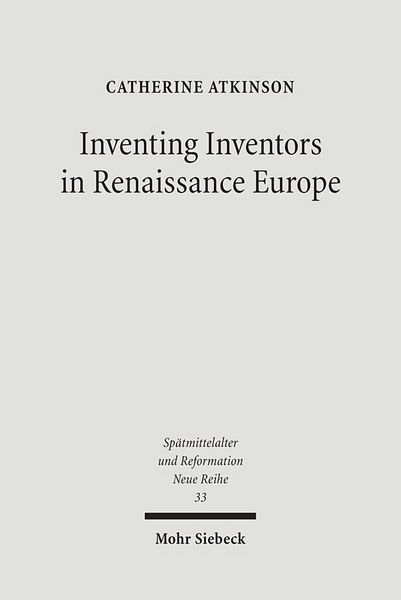
Produktbild: Inventing Inventors in Renaissance Europe
Band 33

Inventing Inventors in Renaissance Europe Polydore Vergil's 'De inventoribus rerum'

112,99 €

inkl. gesetzl. MwSt., Versandkostenfrei


Beschreibung

Polydore Vergil of Urbino (ca.1470-1555) fired his readers' imagination with his encyclopaedic book "On the inventors of all things" ( De inventoribus rerum 1499). His account of the manifold origins of sciences, crafts and social institutions is a praise of man's inventive genius and a prototypical...

Beschreibung

Polydore Vergil of Urbino (ca.1470-1555) fired his readers' imagination with his encyclopaedic book "On the inventors of all things" ( De inventoribus rerum 1499). His account of the manifold origins of sciences, crafts and social institutions is a praise of man's inventive genius and a prototypical cultural history. "Polydorus" was a household name for several centuries. Erasmus envied his friend the book's success, Rabelais heaped scorn on it, Catholic censors put it on the index, while Protestants were fascinated with "that papist" work. In this first in-depth study of the Renaissance 'bestseller', Catherine Atkinson examines not only the Italian humanist's bona fide (mostly ancient) inventors, in books I-III, she enquires into the neglected and misunderstood, yet equally important, books IV-VIII (1521). This early modern text, written on the eve of the Reformation, is devoted to the highly controversial topic of the 'invention' of ecclesiastical institutions. The priest and humanist Vergil, who during his 50 years in England rose in the church hierarchy, is shown to be an acute observer of contemporary religious practice. He employs the inventor question ("who was the first to do this?") as an instrument of historiography and by comparing medieval church rites and institutions with religious practice of antiquity, implicitly questions the singularity of the Christian church.

Produktdetails

Einband

Gebundene Ausgabe

Erscheinungsdatum

01.02.2007

Abbildungen

XI, w. Illustrationen 24 cm

Verlag Mohr Siebeck

Produktdetails

Einband

Gebundene Ausgabe

Erscheinungsdatum

01.02.2007

Abbildungen

XI, w. Illustrationen 24 cm

Verlag Mohr Siebeck
Seitenzahl

325

Maße (L/B/H)

23,6/16,5/2,4 cm

Gewicht

655 g

Auflage

1. Auflage

Sprache

Englisch

ISBN

978-3-16-149187-0

Herstelleradresse

Mohr Siebeck GmbH & Co. KG
Wilhelmstr. 18
72074 Tübingen
Deutschland
Email: sales@mohrsiebeck.com
Url: www.mohrsiebeck.com
Telephone: +49 7071 92317
Fax: +49 7071 51104

Noch keine Bewertungen vorhanden

Verfassen Sie die erste Bewertung zu diesem Artikel

Helfen Sie anderen Kundinnen und Kunden durch Ihre Meinung.

Kundinnen und Kunden meinen

Bewertungen (0)

  • Produktbild: Inventing Inventors in Renaissance Europe