KI-Beratung Beta

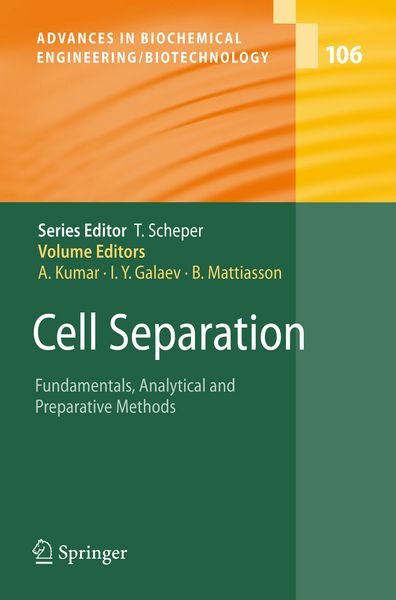
  • Produktbild: Cell Separation
  • Produktbild: Cell Separation
Band 106

Cell Separation Fundamentals, Analytical and Preparative Methods

199,99 €

inkl. gesetzl. MwSt., Versandkostenfrei


Beschreibung

Cell separation, which was once limited to merely being a basic technique for fractionating different cell populations, has come a long way in the last two decades. New, advanced and more speci?c and selective techniques have emerged as the demand for isolating a speci?c cell type for various biological...

Beschreibung

Cell separation, which was once limited to merely being a basic technique for fractionating different cell populations, has come a long way in the last two decades. New, advanced and more speci?c and selective techniques have emerged as the demand for isolating a speci?c cell type for various biological applications has increased. Ef?cient and cost-effective techniques for fr- tionation and isolation of target cell types are necessary to provide pure cell populations for diagnostics, biotechnological and biomedical applications. One can see a considerable need, both in biomedical research and in di- nostic medicine, for the speci?c separation of a discrete population of cells from a mixture. For example, in the ?eld of tissue engineering, isolation of stemcellsfromtissuesororgansisofparticularlygreatimportance.Moreover, understanding cell developmental pathways becomes increasingly signi?cant as diagnosis and treatment of diseases turns more to the molecular level. The diagnosis of cell-related diseases requires methods of detection, isolation and theanalysisofindividualcells,regardlessoftheirrelativecontentinthetissue. Since cell-based therapies now turn towards more realistic medical options, developing an effective separation system for large-scale cell separation has becomechallengingresearchgoalforcellbiologistsandbiotechnologists.The ideal technique should provide in a short time a good yield of cells with high puritywhile maintaining cellfunction.Despite the growingneed formethods to separate cells into cell subpopulations, the existing cell-separation te- niques stillhave somelimitations when the desired degree ofperformance on apreparativescaleisrequired.Wewillseemoreresearchfocusinthisdirection in the future. The traditional techniques of micro?ltration, ultra?ltration and ultrac- trifugation, which exploit differences in cell size, shape and density, have remainedtheworkhorsesdespitelowspeci?cityandproblemswithscalingup.

Produktdetails

Einband

Gebundene Ausgabe

Erscheinungsdatum

08.11.2007

Abbildungen

XIII, 203 p.

Herausgeber Ashok Kumar + weitere

Produktdetails

Einband

Gebundene Ausgabe

Erscheinungsdatum

08.11.2007

Abbildungen

XIII, 203 p.

Herausgeber
Verlag Springer Berlin
Seitenzahl

203

Maße (L/B/H)

24,1/16/1,8 cm

Gewicht

448 g

Auflage

2007

Sprache

Englisch

ISBN

978-3-540-75262-2

Herstelleradresse

Springer-Verlag KG
Sachsenplatz 4-6
1201 Wien
AT

Email: ProductSafety@springernature.com

Noch keine Bewertungen vorhanden

Verfassen Sie die erste Bewertung zu diesem Artikel

Helfen Sie anderen Kundinnen und Kunden durch Ihre Meinung.

Kundinnen und Kunden meinen

Bewertungen (0)

  • Produktbild: Cell Separation
  • Produktbild: Cell Separation
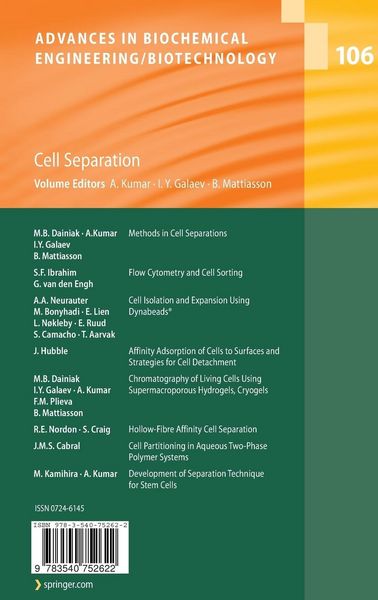
  • Methods in Cell Separations.- Flow Cytometry and Cell Sorting.- Cell Isolation and Expansion Using Dynabeads ®.- Affinity Adsorption of Cells to Surfaces and Strategies for Cell Detachment.- Chromatography of Living Cells Using Supermacroporous Hydrogels, Cryogels.- Hollow-Fibre Affinity Cell Separation.- Cell Partitioning in Aqueous Two-Phase Polymer Systems.- Development of Separation Technique for Stem Cells.