Gutscheinbedingungen

**Gültig am 28.06.2026 auf Spielzeug, Schreibwaren, Filme, Geschenke & Trends, Musik, tolino eReader & Zubehör, Hörbücher und Hörbuch-Downloads (außer Abo), nicht preisgebundene Bücher und Kalender online auf thalia.at und in der Thalia App. Einzelne Artikel können ausgeschlossen sein. Aufgrund der Buchpreisbindung sind deutschsprachige Bücher und eBooks ausgenommen. Zusätzlich ausgenommen sind preisgebundene Artikel, Abos & Flatrates, eBooks, Games, Geschenkkarten/-boxen, Shelfies, Software, Zeitschriften sowie einzelne Artikel von tonies®. Pro Einkauf einmal einlösbar. Click & Collect nur bei Onlinevorabzahlung möglich. Keine Barauszahlung. Nicht kombinierbar mit anderen Aktionen und Gutscheinen. Gutschein wird auf max. 500€ Bestellwert angerechnet. Nicht gültig für Versandkosten und Services.

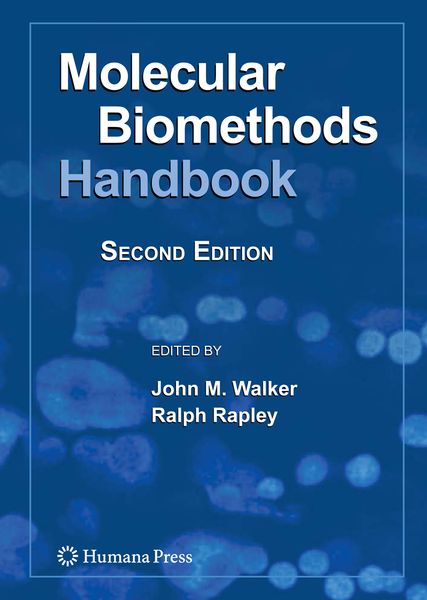
  • Produktbild: Molecular Biomethods Handbook
  • Produktbild: Molecular Biomethods Handbook
- 11%

Molecular Biomethods Handbook

11% sparen

193,99 € UVP 219,99 €

inkl. gesetzl. MwSt., Versandkostenfrei


Beschreibung

Produktdetails

Einband

Taschenbuch

Erscheinungsdatum

04.09.2008

Herausgeber

John M. Walker + weitere

Verlag

Humana Press

Seitenzahl

1124

Maße (L/B/H)

25,4/17,8/6,1 cm

Gewicht

2105 g

Auflage

2nd ed. 2008

Sprache

Englisch

ISBN

978-1-60327-374-9

Beschreibung

Rezension

From the reviews of the second edition:


"If you want to know the theoretical basis of how a technique works, how it might be applied, or what techniques are available to allow you to ask a particular question, then this book could prove very useful. … this book will be of interest to young (and not so young) scientists who want to better understand the techniques they use, or may wish to use, and would be a useful addition to a library or PhD room." (Bob Dalziel, Microbiology Today, February, 2009)


"The book is a second edition and this includes several new sections which deal with new areas e.g. microarray technology and nanotechnology … . These deal with the physical concepts behind the techniques in an accessible way and will be useful to a large number of researchers. … In summary, I found the book to be generally comprehensive, clearly written and logically organised. … it would be a useful addition to any molecular biology laboratory bookshelf." (Nicola J Stonehouse, British Toxicology Society Newsletter, June-August, 2009)

“Written by experts in their fields, the book gives a wide scope of molecular biology experimentation really living out only the most specialized uncommon techniques while at the same time giving reference to each chapter and sharing full information with readers. This handbook is suitable for research scientists, technicians, and graduate research students in molecular and cell biology, proteomics, and related branches of science.” (G. Ya. Wiederschain, Biochemistry, Vol. 74 (9), 2009)

Produktdetails

Einband

Taschenbuch

Erscheinungsdatum

04.09.2008

Herausgeber

Verlag

Humana Press

Seitenzahl

1124

Maße (L/B/H)

25,4/17,8/6,1 cm

Gewicht

2105 g

Auflage

2nd ed. 2008

Sprache

Englisch

ISBN

978-1-60327-374-9

Herstelleradresse

Springer-Verlag GmbH
Tiergartenstr. 17
69121 Heidelberg
DE

Email: ProductSafety@springernature.com

Kundinnen und Kunden meinen

0 Bewertungen

Informationen zu Bewertungen

Zur Abgabe einer Bewertung ist eine Anmeldung im Konto notwendig. Die Authentizität der Bewertungen wird von uns nicht überprüft. Wir behalten uns vor, Bewertungstexte, die unseren Richtlinien widersprechen, entsprechend zu kürzen oder zu löschen.

Die Bewertungen sind nach Format, Anzahl Sterne und Datum sortiert.

Verfassen Sie die erste Bewertung zu diesem Artikel

Helfen Sie anderen Kund*innen durch Ihre Meinung

Kundinnen und Kunden meinen

0 Bewertungen filtern

  • Produktbild: Molecular Biomethods Handbook
  • Produktbild: Molecular Biomethods Handbook
  • Molecular Biomethods Handbook 2nd Ed

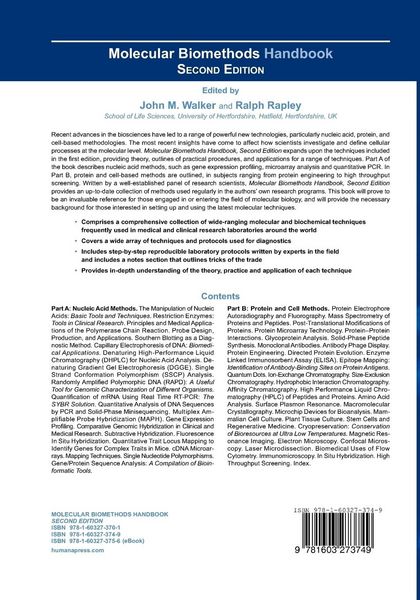
    Contents

    PART A: NUCLEIC ACID BIOMETHODS

    1 The manipulation of nucleic acids: basic tools and techniques – Gayle Corkill and
    Ralph Rapley

    2 Restriction Enzymes – Gareth J.S. Jenkins

    3 Principles and Medical Applications of the Polymerase Chain Reaction – Birmal D.M.
    Theophilus

    4 Probe Design, Production, and Applications – Marilena Aquino de Muro

    5 Southern Blotting as a Diagnostic Method – Bronwen Harvey and Pirkko Soundy

    6 Introduction to Capillary Electrophoresis of DNA - Beatriz Sanchez-Vega

    7 Denaturing High-Performance Liquid Chromatography (DHPLC) for nucleic acid
    analysis - Kim Hung Leung and Shea Ping Yip

    8 Denaturing Gradient Gel Electrophoresis (DGGE) – Jeroen H. Roelfsema and Dorien
    J.M. Peters

    9 Single Strand Conformation Polymorphism (SSCP) Analysis - Kim Hung Leung and
    Shea Ping Yip

    10 Randomly amplified polymorphic DNA (RAPD); a useful tool for genomic
    characterization of different organisms - Lúcia Maria da Cunha Galvão and Eliane
    Lages-Silva

    11 Quantification of mRNA using Real Time RT-PCR – the SYBR solution - David
    Sugden and Patricia de Winter

    12 Quantitative Analysis of DNA Sequences by PCR and Solid Phase Sequencing – Anu
    Suomalainen and Ann-Christine Syvanen

    13 MAPH (Multiplex Amplifiable Probe Hybridization) - Carolina Sismani, Ludmila
    Kousoulidou and Philippos C. Patsalis

    14 Gene Expression Profiling - Arnis Druka, Robbie Waugh and Pete Hedley

    15 Comparative Genomic Hybridization in Clinical and Medical Research – Peng-Hui
    Wang, Yann-Jang Chen and Chi-Hung Lin

    16Subtractive Hybridization – Craig Winstanley

    17 Fluorescence in situ Hybridization - Jane Bayani and Jeremy A. Squire

    18 Quantitative Trait Locus Mapping to Identify Genes for Complex Traits in Mice -
    Jonathan D. Smith

    19 cDNA Microarrays – Phillip G. Febbo

    20 Mapping Techniques – Simon G. Gregory

    21 Single Nucleotide Polymorphisms Overview – Nameeta Shah

    22 Bioinformatics Tools for Gene and Protein Sequence Analysis– Bernd H.A. Rehm and
    Frank Reinecke

    PART B: PROTEIN AND CELL METHODS

    23. Protein Electrophoresis - David Sheehan and Siobhan O’Sullivan
    24. Protein blotting - Patricia Gravel
    25. Capillary electrophoresis of proteins - Mark Strege
    26. Autoradiography and fluorography - Bronwen Harvey
    27. Mass spectrometry of proteins & peptides - Kenneth G. Standing
    28. Post-translational modifications - Christoph Kannicht and Birte Fuchs
    29. Protein microarray technology - Charlotte H. Clarke and Eric T. Fung
    30. Protein-protein interactions - Hae Ryoun Park, Lisa Montoya Cockrell, Yuhong Du, Andrea Kasinski, Jonathan Havel, Jing Zhao, Francisca Reyes-Turcu, Keith Wilkinson and Haian Fu
    31. Glycoprotein analysis - Terry Butters and David C.A. Neville
    32. Solid Phase Peptide Synthesis - Mare Cudic and Gregg B. Fields
    33. Monoclonal antibodies - Zhong J. Zhang and Maher Albitar
    34. Antibody Phage display - Rob Aitken
    35. Protein engineering - Thomas Willemsen, Urs B. Hagemann,
    Eva M. Jouaux, Sabine Stebel, Jody M. Mason, Kristian M. Müller and Katja M. Arndt
    36. Directed protein evolution - Sabine C. Stebel, Annette Gaida, Katja M. Arndt and Kristian M. Müller
    37. Enzyme Linked Immunosorbent Assay - John Crowther
    38. Epitope mapping - Glenn E. Morris
    39.