KI-Beratung Beta

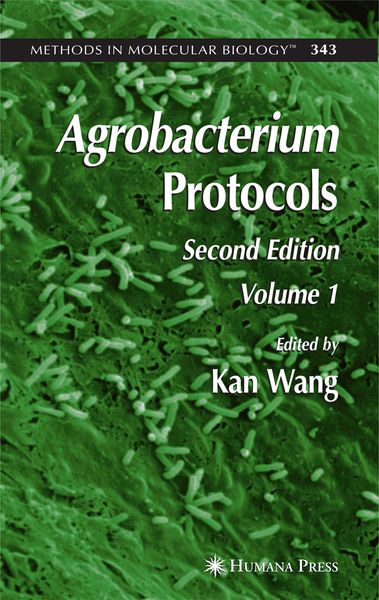
  • Produktbild: Agrobacterium Protocols
  • Produktbild: Agrobacterium Protocols
Band 343 - 12%

Agrobacterium Protocols Volume I

12% sparen

192,99 € UVP 219,99 €

inkl. gesetzl. MwSt., Versandkostenfrei


Beschreibung

Produktdetails

Einband

Gebundene Ausgabe

Erscheinungsdatum

01.06.2006

Abbildungen

XXII, 484 p. 89 illus., 6 illus. in color.

Herausgeber

Kan Wang

Verlag

Humana Press

Seitenzahl

484

Maße (L/B/H)

24,1/16/3,6 cm

Gewicht

963 g

Auflage

2nd ed. 2006

Sprache

Englisch

ISBN

978-1-58829-536-1

Beschreibung

Rezension

From the reviews of the second edition:


"This book is intended as a laboratory manual for researchers using Agrobacterium tumefaciens for plant transformation. It covers the basics of culturing and transforming Agrobacterium … . You don’t expect a lab manual to be ideal … reading, but I found this to be surprisingly readable. … The book would be especially useful for someone just starting plant transformation work or changing to new plant species and … it would also be useful reading for Masters students." (Heather Macdonald, Microbiology Today, November, 2006)


"Methods in Molecular Biology opens … a field concerning Agrobacterium-mediated transformation of plants. … Each chapter is written by the leader in the field … and offers a detailed manual of the transformation protocol. … All users of this book will certainly appreciate the notes sections that bring additional information on potential difficulties in the protocols and alternative materials or methods. The book is the fountainhead of recent practical knowledge concerning Agrobacterium-mediated transformation and … it will become the core manual … ." (J. BRlZA, Biologia Plantarum, Vol. 51 (2), 2007)


"The book’s chapters are organized in a highly detailed fashion, providing readers not only with step-by-step protocols … but also with a comprehensive list of equipment and materials. … With such a rich source of information, organized to be easy to read and very simple to implement, the book should be considered a must for every plant biology laboratory. … It will also be an excellent tool for training students, doctorates, technicians, and other laboratory personnel in the art of plant genetic transformation." (Tzvi Tzfira, Quarterly Review of Biology, Vol. 82, March, 2007)

Produktdetails

Einband

Gebundene Ausgabe

Erscheinungsdatum

01.06.2006

Abbildungen

XXII, 484 p. 89 illus., 6 illus. in color.

Herausgeber

Kan Wang

Verlag

Humana Press

Seitenzahl

484

Maße (L/B/H)

24,1/16/3,6 cm

Gewicht

963 g

Auflage

2nd ed. 2006

Sprache

Englisch

ISBN

978-1-58829-536-1

Herstelleradresse

Springer-Verlag GmbH
Europaplatz 3
69115 Heidelberg
DE

Email: ProductSafety@springernature.com

Noch keine Bewertungen vorhanden

Verfassen Sie die erste Bewertung zu diesem Artikel

Helfen Sie anderen Kundinnen und Kunden durch Ihre Meinung.

Kundinnen und Kunden meinen

Bewertungen (0)

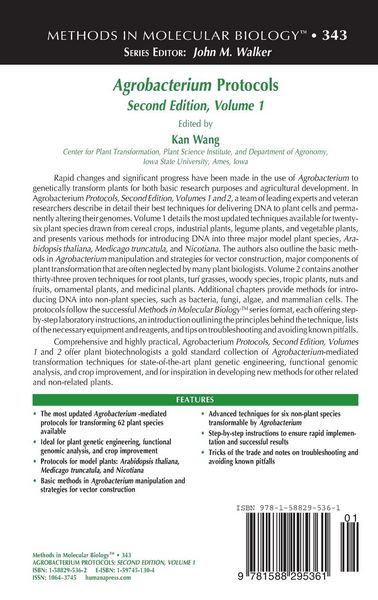
  • Produktbild: Agrobacterium Protocols
  • Produktbild: Agrobacterium Protocols
  • AGROBACTERIUM HANDLING.- Culture and Maintenance of Agrobacterium Strains.- Binary Vectors and Super-binary Vectors.- Three Methods for the Introduction of Foreign DNA into Agrobacterium.- Integration of Genes into the Chromosome of Agrobacterium tumefaciens C58.- Nucleic Acid Extraction from Agrobacterium Strains.- Agrobacterium Virulence Gene Induction.- Model Plants.- Arabidopsis thaliana Floral Dip Transformation Method.- Agrobacterium Transformation of Arabidopsis thaliana Roots.- Medicago truncatula Transformation Using Leaf Explants.- Medicago truncatula Transformation Using Cotyledon Explants.- Medicago truncatula Transformation Using Root Explants.- Nicotiana (Nicotiana tobaccum, Nicotiana benthamiana).- Generation of Composite Plants Using Agrobacterium rhizogenes.- Cereal Crops.- Barley (Hordeum vulgare L.).- Maize (Zea mays L.).- Indica Rice (Oryza sativa, BR29 and IR64).- Japonica Rice Varieties (Oryza sativa, Nipponbare, and Others).- Rye (Secale cereale L.).- Sorghum (Sorghum bicolor L.).- Wheat (Triticum aestivum L.).- Industrial Plants.- Canola (Brassica napus L.).- Cotton (Gossypium hirsutum L.).- Indian Mustard [Brassica juncea (L.) Czern.].- Sunflower (Helianthus annuus L.).- Legume Plants.- Alfalfa (Medicago sativa L.).- Chickpea (Cicer arietinum L.).- Clovers (Trifolium spp.).- Peas (Pisum sativum L.).- Peanut (Arachis hypogaea L.).- Pigeonpea (Cajanus cajn (L.) Millsp.).- Red Clover (Trifolium pratense).- Soybean (Glycine max) Transformation Using Mature Cotyledonary Node Explants.- Soybean (Glycine max) Transformation Using Immature Cotyledon Explants.- Tepary Bean (Phaseolus acutifolius).- Vegetable Plants.- Brassica oleracea.- Cucumber (Cucumis sativus L.).- Eggplant (Solanum melongena L.).- Lettuce (Lactuca sativa L.).- Tomato (Lycopersicum esculentum).