KI-Beratung Beta

Gutscheinbedingungen

**Gültig bis 30.11.2026 auf Spielzeug, Schreibwaren, Filme, Geschenke & Trends, Musik, tolino eReader & Zubehör, Hörbücher und Hörbuch-Downloads, nicht preisgebundene Bücher und Kalender online auf thalia.at und in der Thalia App. Einzelne Artikel können ausgeschlossen sein. Aufgrund der Buchpreisbindung sind deutschsprachige Bücher und eBooks ausgenommen. Zusätzlich ausgenommen sind Abos & Flatrates, Games, Geschenkkarten/-boxen, Shelfies, Software, Zeitschriften sowie einzelne Artikel von tonies®. Pro Einkauf einmal einlösbar. Nur gültig mit im Onlineshop hinterlegter Bonuscard. Click & Collect nur bei Onlinevorabzahlung möglich. Keine Barauszahlung. Nicht kombinierbar mit anderen Aktionen und Gutscheinen. Gutschein wird auf max. 500€ Bestellwert angerechnet. Nicht gültig für Versandkosten und Services.

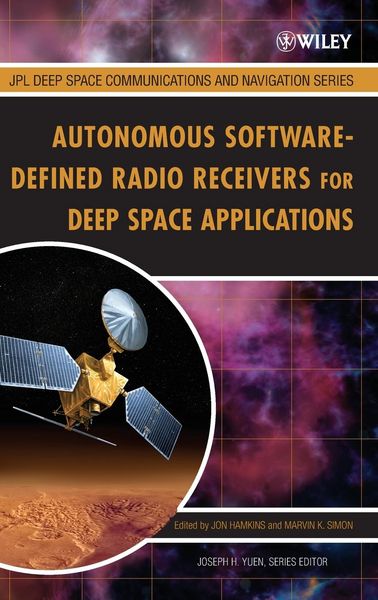
Produktbild: Autonomous Software-Defined Radio Receivers for Deep Space Applications
Band 1

Autonomous Software-Defined Radio Receivers for Deep Space Applications

286,99 €

inkl. gesetzl. MwSt., Versandkostenfrei


Beschreibung

Full coverage of the techniques needed to implement an autonomous software-defined radio system   This book introduces the reader to the concept of an autonomous software-defined radio (SDR) receiver, which automatically recognizes attributes of an incoming signal and reconfigures itself to receive it....

Beschreibung

Full coverage of the techniques needed to implement an autonomous software-defined radio system
 
This book introduces the reader to the concept of an autonomous software-defined radio (SDR) receiver, which automatically recognizes attributes of an incoming signal and reconfigures itself to receive it. This is in contrast to conventional software-defined radios, which are reconfigurable but not autonomous.
 
The book explores the challenges of such automatic reconfiguration, and explains the design and development of algorithms that permit its successful operation. Among the topics covered are automatic identification of the carrier frequency, modulation index, data rate, modulation type, and pulse shape, based on observations of the received signal.
 
Each distinct aspect of the design of the receiver is treated in a separate chapter written by one or more leading innovators in the field. Chapters begin with a problem statement and then offer a full mathematical derivation of an appropriate solution, a decision metric or loop-structure as appropriate, and performance results.
 
Two of the chapters serve specifically to pull all the individual elements together and help readers see how a successful autonomous SDR receiver works:
* Chapter 2, The Electra Radio, provides a detailed review of NASA's Electra radio, which was developed for deep space applications
* Chapter 11, Implementation and Interaction of Estimators and Classifiers, the final chapter, demonstrates the performance of an actual software implementation of the various algorithms working in concert with each other
 
In summary, all the materials and techniques that an engineer needs to implement an autonomous SDR are included. Although the technology is intended for deep space applications, the theoretical development and algorithms presented in this text can be applied to any terrestrial radio with the capability of processing more than one type of signal.

Produktdetails

Einband

Gebundene Ausgabe

Erscheinungsdatum

01.10.2006

Herausgeber Jon Hamkins + weitere
Verlag John Wiley & Sons Inc

Produktdetails

Einband

Gebundene Ausgabe

Erscheinungsdatum

01.10.2006

Herausgeber
Verlag John Wiley & Sons Inc
Seitenzahl

464

Maße (L/B/H)

24/16,1/2,9 cm

Gewicht

853 g

Auflage

1. Auflage

Sprache

Englisch

ISBN

978-0-470-08212-6

Herstelleradresse

Libri GmbH
Europaallee 1
36244 Bad Hersfeld
DE

Email: gpsr@libri.de

Noch keine Bewertungen vorhanden

Verfassen Sie die erste Bewertung zu diesem Artikel

Helfen Sie anderen Kundinnen und Kunden durch Ihre Meinung.

Kundinnen und Kunden meinen

Bewertungen (0)

Die Leseprobe wird geladen.
  • Produktbild: Autonomous Software-Defined Radio Receivers for Deep Space Applications
  • Foreword.
     
    Preface.
     
    Acknowledgments.
     
    Contributors.
     
    Chapter 1 : Introduction and Overview (Jon Harnkins and Marvin K . Simon).
     
    Chapter 2: The Electra Radio (Edgar Satorius. Tom Jedrey. David Bell. Ann Devereaux. Todd Ely. Edwin Grigorian. Igor Kuperman. and Alan Lee).
     
    Chapter 3: Modulation Index Estimation (Marvin K. Simon and Jon Hamkins).
     
    Chapter 4: Frequency Correction (Dariush Divsalar).
     
    Chapter 5: Data Format and Pulse Shape Classification (Marvin K . Simon and Dariush Divsalar).
     
    Chapter 6: Signal-to-Noise Ratio Estimation (Marvin K . Simon and Samuel Dolinar).
     
    Appendix 6-A Derivation of Asymptotic Mean and Variance of SSME.
     
    Chapter 7: Data Rate Estimation (by Andre Tkacenko and Marvin K . Simon).
     
    Chapter 8: Carrier Synchronization (by Marvin K . Simon and Jon Harnkins).
     
    Appendix 8-A Cramer-Rao Bound on the Variance of the Error in Estimating the Carrier Phase of a BPSK Signal.
     
    Chapter 9: Modulation Classification (Jon Hamkins and Marvin K . Simon).
     
    Appendix 9-A Parameter Estimation for the GLRT.
     
    Appendix 9-6 ML Estimation of Carrier Phase for al4-QPSK Modulation.
     
    Chapter 10: Symbol Synchronization (Marvin K . Simon).
     
    Chapter 11 : Implementation and lnteraction of Estimators and Classifiers (Jon Harnkins and Hooman Shirani-Mehr)
     
    Reference.
     
    Acronyms and Abbreviations.
     
    Index.