Gutscheinbedingungen

**Gültig bis 25.08.2026 ab einem Mindestbestellwert von 30€ auf Spielzeug, Schreibwaren, Filme, Geschenke & Trends, Musik, tolino eReader & Zubehör, Hörbücher und Hörbuch-Downloads (außer Abo), nicht preisgebundene Bücher und Kalender online auf thalia.at und in der Thalia App. Einzelne Artikel können ausgeschlossen sein. Aufgrund der Buchpreisbindung sind deutschsprachige Bücher und eBooks ausgenommen. Zusätzlich ausgenommen sind preisgebundene Artikel, Abos & Flatrates, eBooks, Games, Geschenkkarten/-boxen, Shelfies, Software, Zeitschriften sowie einzelne Artikel von tonies®. Pro Einkauf einmal einlösbar. Click & Collect nur bei Onlinevorabzahlung möglich. Keine Barauszahlung. Nicht kombinierbar mit anderen Aktionen und Gutscheinen. Gutschein wird auf max. 500€ Bestellwert angerechnet. Nicht gültig für Versandkosten und Services. Preisgebundene Artikel sind vom Mindestbestellwert ausgeschlossen.

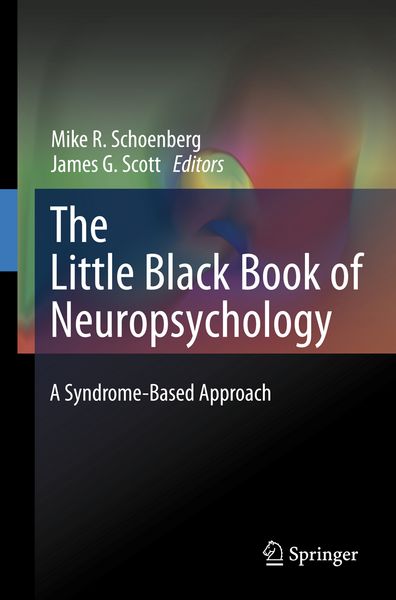
  • Produktbild: The Little Black Book of Neuropsychology
  • Produktbild: The Little Black Book of Neuropsychology
- 18%

The Little Black Book of Neuropsychology A Syndrome-Based Approach

18% sparen

125,99 € UVP 153,99 €

inkl. gesetzl. MwSt., Versandkostenfrei


Beschreibung

Produktdetails

Einband

Gebundene Ausgabe

Erscheinungsdatum

13.01.2011

Abbildungen

XVIII, 968 p.

Herausgeber

Mike R. Schoenberg + weitere

Verlag

Springer Us

Seitenzahl

968

Maße (L/B/H)

24,1/16/5,8 cm

Gewicht

1625 g

Auflage

2011

Sprache

Englisch

ISBN

978-0-387-70703-7

Beschreibung

Rezension

From the book reviews:

“This text has allowed me to get a really good comprehensive source reference when preparing for assessments and during the write up. It was also a very good refresher for main neuropsychological concepts. … This is another great quick reference guide to have on my bookshelf at work … .

Portrait

Mike R. Schoenberg, Ph.D., is an Assistant Professor of Neurology at University Hospitals of Cleveland and Case Western Reserve University School of Medicine. He completed a two year post-doctoral fellowship in clinical neuropsychology at the University of Oklahoma Health Sciences Center and an internship at the University of Kansas School of Medicine, Wichita. He provides academic instruction and supervision in clinical neuropsychology to medical students and psychology trainees, and conducts research in clinical neuropsychology. James G. Scott, Ph.D., ABPP-Cn is a Professor of Psychiatry at the University of Oklahoma Health Sciences Center. He completed two years of postdoctoral training in clinical neuropsychology at the University of Oklahoma Health Sciences Center and an internship at Tulane University Medical School. He is board certified by the American Board of Professional Psychology in clinical neuropsychology and provides academic instruction and supervision to medical students and psychology trainees in clinical neuropsychology and conducts research in clinical neuropsychology.

Produktdetails

Einband

Gebundene Ausgabe

Erscheinungsdatum

13.01.2011

Abbildungen

XVIII, 968 p.

Herausgeber

Verlag

Springer Us

Seitenzahl

968

Maße (L/B/H)

24,1/16/5,8 cm

Gewicht

1625 g

Auflage

2011

Sprache

Englisch

ISBN

978-0-387-70703-7

Herstelleradresse

Springer-Verlag KG
Sachsenplatz 4-6
1201 Wien
AT

Email: GPSR Kontakt

Noch keine Bewertungen vorhanden

Verfassen Sie die erste Bewertung zu diesem Artikel

Helfen Sie anderen Kundinnen und Kunden durch Ihre Meinung.

Kundinnen und Kunden meinen

Bewertungen (0)

  • Produktbild: The Little Black Book of Neuropsychology
  • Produktbild: The Little Black Book of Neuropsychology

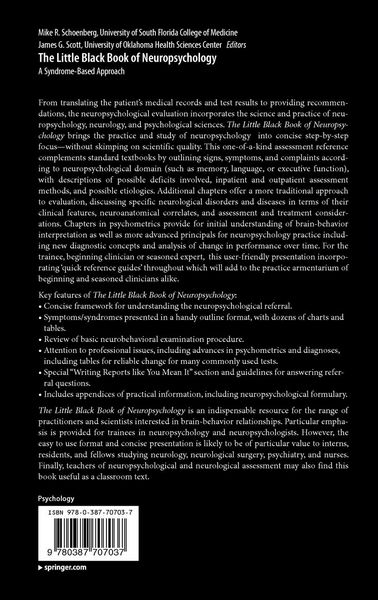
  • Part I: Neuropsychology – General Issues: The Neuropsychological Referral.- Medical Records.- Basic Neuroanatomy.- Basic components of a Neuropsychological Evaluation.- Part II: Neuropsychological Domains: Arousal: The drowsy, lethargic, or stuporous patient.- Attention/Concentration Problems: The distractible patient.- Inattention/Neglect Syndromes.- Language Problems.- Learning and Memory: The Forgetful Patient.- Visuospatial/Visuoconstructional Problems.- Apraxias.- Agnosias.- Executive Functions (problem solving, abstraction, sequencing, inhibition, self-monitoring, planning, and initiation).- Emotional/Mood.- Episodic Neurological Dysfunction.- Part III: Specific Neurological Diseases: Aphasia.- Cerebrovascular Disease and Stroke.- Dementia.- Seizures/Epilepsy.- Somatization Disorders, blackout spells, fits/convulsions.- Parkinson’s Disease and other movement disorders.- Multiple Sclerosis and Other Demyelinating Disorders.- Traumatic Brain Injury and Concussion.- Infections.- Neoplasms/Neoplastic Syndromes .- Psychiatric – depression and anxiety.- Part IV: Special Considerations: Medicolegal exposure.- Reporting Test performance/scores.- Limitations.- Answering Referral Questions.- Placement issues.