Gutscheinbedingungen

**Gültig bis 06.07.2026 auf fremdsprachige Bücher online auf thalia.at, in der Thalia App ab einem Mindestbestellwert von 30€ und in allen Thalia Buchhandlungen in Österreich. In den Buchhandlungen nur gültig auf lagernde Ware. Einzelne Artikel können ausgeschlossen sein. Ausgenommen sind preisgebundene Artikel & eBooks. Pro Einkauf einmal einlösbar. Nur gültig gegen Vorlage oder im Onlineshop hinterlegter Bonuscard. Infos zur Einlösung in der Buchhandlung sind auf der Bonuscard-Vorteilspreisseite zu finden. Click & Collect nur bei Onlinevorabzahlung möglich. Keine Einlösung bei Scan & Go-Bezahlung. Keine Barauszahlung. Nicht kombinierbar mit anderen Aktionen und Gutscheinen. Gutschein wird auf max. 500€ Bestellwert angerechnet. Nicht gültig für Versandkosten und Services.

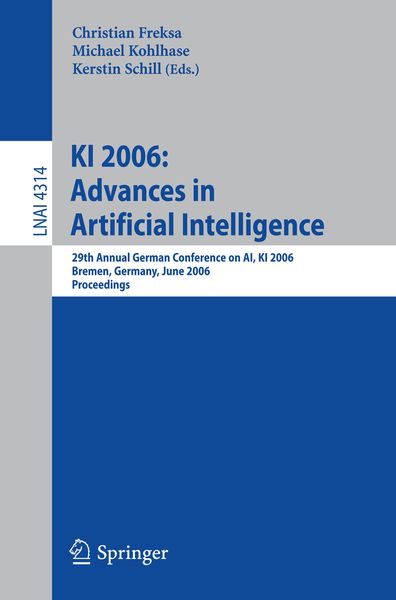
  • Produktbild: KI 2006
  • Produktbild: KI 2006

KI 2006 29th Annual German Conference on AI, KI 2006, Bremen, Germany, June 14-17, 2006, Proceedings

51,99 €

inkl. gesetzl. MwSt., Versandkostenfrei


Beschreibung

Produktdetails

Einband

Taschenbuch

Erscheinungsdatum

18.01.2007

Herausgeber

Christian Freksa + weitere

Verlag

Springer Berlin

Seitenzahl

464

Maße (L/B/H)

23,5/15,5/2,6 cm

Gewicht

730 g

Auflage

2007

Sprache

Englisch

ISBN

978-3-540-69911-8

Beschreibung

Produktdetails

Einband

Taschenbuch

Erscheinungsdatum

18.01.2007

Herausgeber

Verlag

Springer Berlin

Seitenzahl

464

Maße (L/B/H)

23,5/15,5/2,6 cm

Gewicht

730 g

Auflage

2007

Sprache

Englisch

ISBN

978-3-540-69911-8

Herstelleradresse

Springer-Verlag KG
Sachsenplatz 4-6
1201 Wien
AT

Email: GPSR Kontakt

Noch keine Bewertungen vorhanden

Verfassen Sie die erste Bewertung zu diesem Artikel

Helfen Sie anderen Kundinnen und Kunden durch Ihre Meinung.

Kundinnen und Kunden meinen

Bewertungen (0)

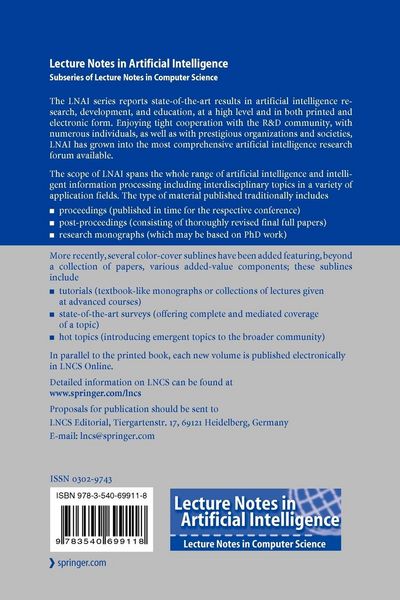
  • Produktbild: KI 2006
  • Produktbild: KI 2006
  • Session 1. Invited Talk.- Expressivity-Preserving Tempo Transformation for Music – A Case-Based Approach.- Session 2. Cognition and Emotion.- MicroPsi: Contributions to a Broad Architecture of Cognition.- Affective Cognitive Modeling for Autonomous Agents Based on Scherer’s Emotion Theory.- Session 3A. Semantic Web.- OWL and Qualitative Reasoning Models.- Techniques for Fast Query Relaxation in Content-Based Recommender Systems.- Session 3B. Analogy.- Solving Proportional Analogies by E–Generalization.- Building Robots with Analogy-Based Anticipation.- Session 4A. Natural Language.- Classification of Skewed and Homogenous Document Corpora with Class-Based and Corpus-Based Keywords.- Learning an Ensemble of Semantic Parsers for Building Dialog-Based Natural Language Interfaces.- Session 4B. Reasoning.- Game-Theoretic Agent Programming in Golog Under Partial Observability.- Finding Models for Blocked 3-SAT Problems in Linear Time by Systematical Refinement of a Sub-model.- Towards the Computation of Stable Probabilistic Model Semantics.- DiaWOz-II – A Tool for Wizard-of-Oz Experiments in Mathematics.- Session 5. Invited Talk.- Applications of Automated Reasoning.- Session 6A. Ontologies.- On the Scalability of Description Logic Instance Retrieval.- Relation Instantiation for Ontology Population Using the Web.- Session 6B. Spatio-temporal Reasoning.- GeTS – A Specification Language for Geo-Temporal Notions.- Active Monte Carlo Recognition.- Session 7A. Machine Learning.- Cross System Personalization and Collaborative Filtering by Learning Manifold Alignments.- A Partitioning Method for Mixed Feature-Type Symbolic Data Using a Squared Euclidean Distance.- Session 7B. Spatial Reasoning.- On Generalizing Orientation Information in .- Towards the Visualisation of Shape Features The Scope Histogram.- Session 8A. Robot Learning.- A Robot Learns to Know People—First Contacts of a Robot.- Recombinant Rule Selection in Evolutionary Algorithm for Fuzzy Path Planner of Robot Soccer.- Session 8B. Classical AI Problems.- A Framework for Quasi-exact Optimization Using Relaxed Best-First Search.- Gray Box Robustness Testing of Rule Systems.- A Unifying Framework for Hybrid Planning and Scheduling.- Session 9. Agents.- A Hybrid Time Management Approach to Agent-Based Simulation.- Adaptive Multi-agent Programming in GTGolog.- Agent Logics as Program Logics: Grounding KARO.- On the Relationship Between Playing Rationally and Knowing How to Play: A Logical Account.- Special Event. 50 Years Artificial Intelligence.- 1956-1966 How Did It All Begin? - Issues Then and Now.- Fundamental Questions.- Towards the AI Summer.- History of AI in Germany and The Third Industrial Revolution.- Three Decades of Human Language Technology in Germany.- 1996-2006 Autonomous Robots.- Projects and Vision in Robotics.- What Will Happen in Algorithm Country?.