KI-Beratung Beta

  • Produktbild: Verification of Object-Oriented Software. The KeY Approach
  • Produktbild: Verification of Object-Oriented Software. The KeY Approach
Band 4334

Verification of Object-Oriented Software. The KeY Approach Foreword by K. Rustan M. Leino

109,99 €

inkl. gesetzl. MwSt., Versandkostenfrei


Beschreibung

Long gone are the days when program veri?cation was a task carried out merely by hand with paper and pen. For one, we are increasingly interested in proving actual program artifacts, not just abstractions thereof or core algorithms. The programs we want to verify today are thus longer, including whole...

Beschreibung

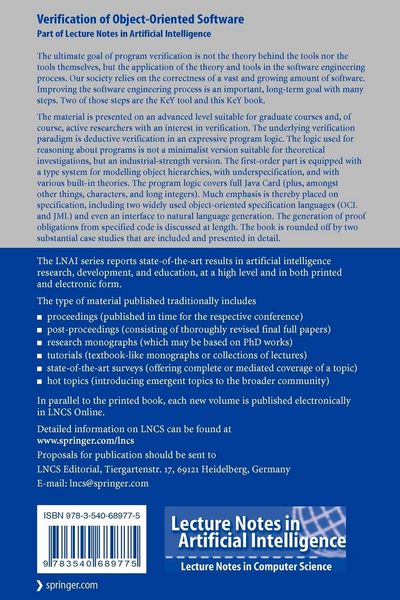
Long gone are the days when program veri?cation was a task carried out merely by hand with paper and pen. For one, we are increasingly interested in proving actual program artifacts, not just abstractions thereof or core algorithms. The programs we want to verify today are thus longer, including whole classes and modules. As we consider larger programs, the number of cases to be considered in a proof increases. The creative and insightful parts of a proof can easily be lost in scores of mundane cases. Another problem with paper-and-pen proofs is that the features of the programming languages we employ in these programs are plentiful, including object-oriented organizations of data, facilities for specifying di?erent c- trol ?ow for rare situations, constructs for iterating over the elements of a collection, and the grouping together of operations into atomic transactions. These language features were designed to facilitate simpler and more natural encodings of programs, and ideally they are accompanied by simpler proof rules. But the variety and increased number of these features make it harder to remember all that needs to be proved about their uses. As a third problem, we have come to expect a higher degree of rigor from our proofs. A proof carried out or replayed by a machine somehow gets more credibility than one that requires human intellect to understand.

Rezension

From the reviews:


"This book is a collection of work by different authors on software verification. The context of the book is the key project, which aims to build a verification of the systems based on model checking. The book features the widely used specification languages: object constraint language (OCL) and Java modeling language (JML). … this book is a good resource for graduate students and researchers … ." (S. Balaraman, Computing Reviews, December, 2007)

Produktdetails

Einband

Taschenbuch

Erscheinungsdatum

03.01.2007

Abbildungen

XXIX, 658 p.

Herausgeber Bernhard Beckert + weitere

Produktdetails

Einband

Taschenbuch

Erscheinungsdatum

03.01.2007

Abbildungen

XXIX, 658 p.

Herausgeber
Verlag Springer Berlin
Seitenzahl

658

Maße (L/B/H)

23,5/15,5/3,7 cm

Gewicht

1031 g

Auflage

2007

Sprache

Englisch

ISBN

978-3-540-68977-5

Herstelleradresse

Springer-Verlag KG
Sachsenplatz 4-6
1201 Wien
AT

Email: ProductSafety@springernature.com

Noch keine Bewertungen vorhanden

Verfassen Sie die erste Bewertung zu diesem Artikel

Helfen Sie anderen Kundinnen und Kunden durch Ihre Meinung.

Kundinnen und Kunden meinen

Bewertungen (0)

  • Produktbild: Verification of Object-Oriented Software. The KeY Approach
  • Produktbild: Verification of Object-Oriented Software. The KeY Approach
  • A New Look at Formal Methods for Software Construction.- A New Look at Formal Methods for Software Construction.- I: Foundations.- First-Order Logic.- Dynamic Logic.- Construction of Proofs.- II: Expressing and Formalising Requirements.- Formal Specification.- Pattern-Driven Formal Specification.- Natural Language Specifications.- Proof Obligations.- From Sequential Java to Java Card.- III: Using the KeY System.- Using KeY.- Proving by Induction.- Java Integers.- Proof Reuse.- IV: Case Studies.- The Demoney Case Study.- The Schorr-Waite-Algorithm.- Appendices.- Predefined Operators in Java Card DL.- The KeY Syntax.