• Produktbild: Rigid Flexibility
  • Produktbild: Rigid Flexibility
Band 34 - 13%

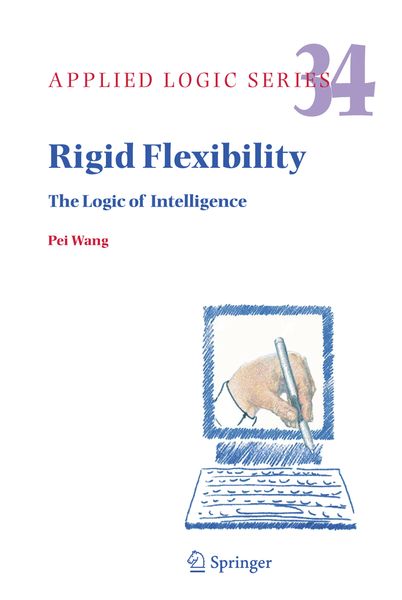
Rigid Flexibility The Logic of Intelligence

Aus der Reihe Applied Logic Series
13% sparen

189,99 € UVP 219,99 €

inkl. gesetzl. MwSt., Versandkostenfrei


Beschreibung

Produktdetails

Einband

Gebundene Ausgabe

Erscheinungsdatum

23.08.2006

Verlag

Springer Netherland

Seitenzahl

402

Maße (L/B/H)

24,8/16,9/2,7 cm

Gewicht

801 g

Auflage

2006 edition

Sprache

Englisch

ISBN

978-1-4020-5044-2

Beschreibung

Rezension

From the reviews:


"Rigid Flexibility presents a new theory of cognition. As such it is devoted to the general research for Artificial Intelligence (AI), in contrast to a focus of other AI research that is focusing on solving specific reasoning problems such as planning or learning for example. … The review of the principles and assumptions underlying the various streams of AI research make this book very interesting to read and enable the reader to easily compare the presented theory with other existing approaches." (Jana Koehler, Zentralblatt MATH, Vol. 1122 (24), 2007)

Produktdetails

Einband

Gebundene Ausgabe

Erscheinungsdatum

23.08.2006

Verlag

Springer Netherland

Seitenzahl

402

Maße (L/B/H)

24,8/16,9/2,7 cm

Gewicht

801 g

Auflage

2006 edition

Sprache

Englisch

ISBN

978-1-4020-5044-2

Herstelleradresse

Libri GmbH
Europaallee 1
36244 Bad Hersfeld
DE

Email: gpsr@libri.de

Noch keine Bewertungen vorhanden

Verfassen Sie die erste Bewertung zu diesem Artikel

Helfen Sie anderen Kundinnen und Kunden durch Ihre Meinung.

Kundinnen und Kunden meinen

Bewertungen (0)

  • Produktbild: Rigid Flexibility
  • Produktbild: Rigid Flexibility
  • Preface Acknowledgment PART I. Theoretical Foundation Chapter 1. The Goal of Artificial Intelligence 1.1 To define intelligence 1.2 Various schools in AI research 1.3 AI as a whole Chapter 2. A New Approach Toward AI 2.1 To define AI 2.2 Intelligent reasoning systems 2.3 Major design issues of NARS PART II. Non-Axiomatic Reasoning System Chapter 3. The Core Logic 3.1 NAL-0: binary inheritance 3.2 The language of NAL-1 3.3 The inference rules of NAL-1 Chapter 4. First-Order Inference 4.1 Compound terms 4.2 NAL-2: sets and variants of inheritance 4.3 NAL-3: intersections and differences 4.4 NAL-4: products, images, and ordinary relations Chapter 5. Higher-Order Inference 5.1 NAL-5: statements as terms 5.2 NAL-6: statements with variables 5.3 NAL-7: temporal statements 5.4 NAL-8: procedural statements Chapter 6. Inference Control 6.1 Task management 6.2 Memory structure 6.3 Inference processes 6.4 Budget assessment . PART III. Comparison and Discussion Chapter 7. Semantics 7.1 Experience vs. model 7.2 Extension and intension 7.3 Meaning of term 7.4 Truth of statement Chapter 8. Uncertainty 8.1 The non-numerical approaches 8.2 The fuzzy approach 8.3 The Bayesian approach 8.4 Other probabilistic approaches 8.5 Unified representation of uncertainty Chapter 9. Inference Rules 9.1 Deduction 9.2 Induction 9.3 Abduction 9.4 Implication Chapter 10. NAL as a Logic 10.1 NAL as a term logic 10.2 NAL vs. predicate logic 10.3 Logic and AI Chapter 11. Categorization and Learning 11.1 Concept and categorization 11.2 Learning in NARS Chapter 12. Control and Computation 12.1 NARS and theoretical computer science 12.2 Various assumptions about resources 12.3 Dynamic natures of NARS PART IV. Conclusions Chapter 13. Current Results 13.1 Theoretical foundation 13.2 Formal model 13.3 Computer implementation Chapter 14. NARS in the Future 14.1 Next steps of the project 14.2 What NARS is not 14.3 General implications Bibliography Index