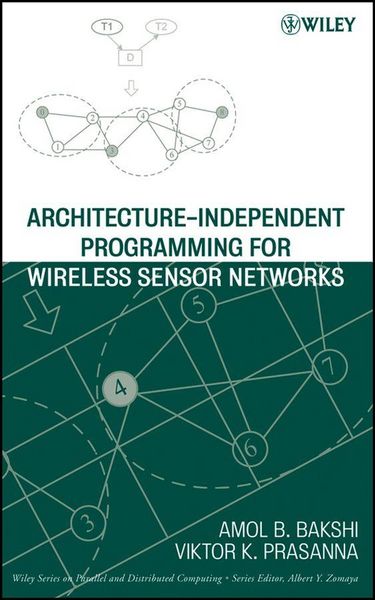
Architecture-Independent Programming for Wireless Sensor Networks
-
- Englisch ausgewählt
136,99 €
inkl. gesetzl. MwSt.,
Beschreibung
Produktdetails
Einband
Gebundene Ausgabe
Erscheinungsdatum
01.04.2008
Abbildungen
Drawings: 92 B&W, 0 Color; Screen captures: 10 B&W, 0 Color; Tables: 0 B&W, 0 Color
Verlag
John Wiley & Sons IncSeitenzahl
208
Maße (L/B/H)
24,3/16/1,8 cm
Gewicht
476 g
Auflage
1. Auflage
Sprache
Englisch
ISBN
978-0-471-77889-9
Following this book's clear explanations, examples, and illustrations, domain experts can design and deploy nontrivial networked sensing applications without much knowledge of the low-level networking aspects of deployment. This new approach is based on the Abstract Task Graph (ATaG), a data-driven programming model and an innovative methodology forarchitecture-independent programming and automatic software synthesis for sensor networks. ATaG programs are concise, understandable, and network-independent descriptions of global application functionality that can be automatically compiled onto any target deployment.
The book begins with an overview chapter that addresses the important issues of programming methodologies and compares various programming models for sensor networks. Next, the authors set forth everything you need for designing and deploying sensor networks using ATaG, including:
*
Detailed description of the ATaG model's features
*
System-level support for architecture-independent programming
*
Examination of the graphical programming and software synthesis environment for ATaG
*
Case study illustrating the process of end-to-end application development and software synthesis using ATaG
Throughout the book, the authors provide code excerpts and figures to help clarify key concepts and explain each step.
For programmers, the graphical formalism of the ATaG program, coupled with the fact it uses an existing language (Java), means that no special training is needed to start developing and deploying applications in ATaG. Everything you need to know is clearly set forth in this book.
Noch keine Bewertungen vorhanden
Verfassen Sie die erste Bewertung zu diesem Artikel
Helfen Sie anderen Kundinnen und Kunden durch Ihre Meinung.
Kurze Frage zu unserer Seite
Vielen Dank für Ihr Feedback
Wir nutzen Ihr Feedback, um unsere Produktseiten zu verbessern. Bitte haben Sie Verständnis, dass wir Ihnen keine Rückmeldung geben können. Falls Sie Kontakt mit uns aufnehmen möchten, können Sie sich aber gerne an unseren Kund*innenservice wenden.
zum Kundenservice