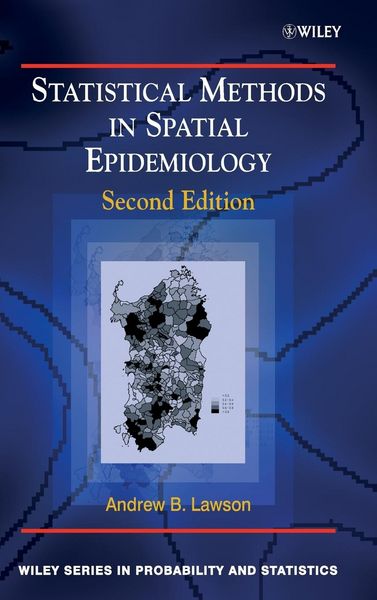
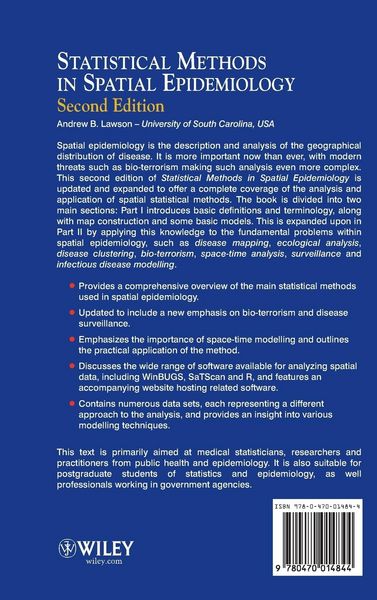
• Produktbild: Statistical Methods in Spatial Epidemiology
  • Produktbild: Statistical Methods in Spatial Epidemiology

Statistical Methods in Spatial Epidemiology

204,99 €

inkl. gesetzl. MwSt., Versandkostenfrei


Beschreibung

Produktdetails

Einband

Gebundene Ausgabe

Erscheinungsdatum

01.07.2006

Verlag

John Wiley & Sons Inc

Seitenzahl

424

Maße (L/B/H)

23,5/15,7/2,7 cm

Gewicht

766 g

Auflage

2nd edition

Sprache

Englisch

ISBN

978-0-470-01484-4

Beschreibung

Produktdetails

Einband

Gebundene Ausgabe

Erscheinungsdatum

01.07.2006

Verlag

John Wiley & Sons Inc

Seitenzahl

424

Maße (L/B/H)

23,5/15,7/2,7 cm

Gewicht

766 g

Auflage

2nd edition

Sprache

Englisch

ISBN

978-0-470-01484-4

Herstelleradresse

Libri GmbH
Europaallee 1
36244 Bad Hersfeld
DE

Email: GPSR Kontakt

Noch keine Bewertungen vorhanden

Verfassen Sie die erste Bewertung zu diesem Artikel

Helfen Sie anderen Kundinnen und Kunden durch Ihre Meinung.

Kundinnen und Kunden meinen

Bewertungen (0)

Die Leseprobe wird geladen.
  • Produktbild: Statistical Methods in Spatial Epidemiology
  • Produktbild: Statistical Methods in Spatial Epidemiology
  • Preface and Acknowldegements to Second Edition.

    Preface and Acknowldegements.

    I: The Nature of Spatial Epidemiology.

    1. Definitions, Terminolgy and Data Sets.

    1.1 Map Hypotheses and Modelling Approaches.

    1.2 Definitions and Data Examples.

    1.3 Further definitions.

    1.4 Some Data Examples.

    2.Scales of Measurement and Data Availability.

    2.1 Small Scale.

    2.2 Large Scale.

    2.3 Rate Dependence.

    2.4 DataQuality and the Ecological Fallacy.

    2.5 Edge E.ects.

    3.Geographical Representation and Mapping.

    3.1 Introduction and Definitions.

    3.2 Maps and Mapping.

    3.3 Statistical Accuracy.

    3.4 Aggregation.

    3.5 Mapping Issues related toAggregated Data.

    3.6 Conclusions.

    4.Basic Models.

    4.1 Sampling Considerations.

    4.2 Likelihood-based and Bayesian Approaches.

    4.3 Point EventModels.

    4.4 CountModels.

    5.Exploratory Approaches, Parametric Estimation and Inference.

    5.1 ExploratoryMethods.

    5.2 Parameter Estimation.

    5.3 Residual Diagnostics.

    5.4 Hypothesis Testing.

    5.5 Edge E.ects.

    II:Important Problems in Spatial Epidemiology.

    6.Small Scale: Disease Clustering.

    6.1 Definition of Clusters and Clustering.

    6.2 Modelling Issues.

    6.3 Hypothesis Tests for Clustering.

    6.4 Space-Time Clustering.

    6.5 Clustering Examples.

    6.6 OtherMethods related to clustering.

    7.Small Scale: Putative Sources of Hazard.

    7.1 Introduction.

    7.2 StudyDesign.

    7.3 Problems of Inference.

    7.4 Modelling the Hazard Exposure Risk.

    7.5 Models for Case Event Data.

    7.6 ACase Event Example.

    7.7 Models for CountData.

    7.8 ACountData Example.

    7.9 OtherDirections.

    8. Large Scale: Disease Mapping.

    8.1 Introduction.

    8.2 Simple Statistical Representation.

    8.3 BasicModels.

    8.4 AdvancedMethods.

    8.5 Model Variants and Extensions.

    8.6 ApproximateMethods.

    8.7 MultivariateMethods.

    8.8 Evaluation ofModel Performance.

    8.9 Hypothesis Testing in DiseaseMapping.

    8.10 Space-Time DiseaseMapping.

    8.11 Spatial Survival and longitudinal data.

    8.12 DiseaseMapping: Case Studies.

    9.Ecological Analysis and Scale Change.

    9.1 Ecological Analysis: Introduction.

    9.2 Small-ScaleModelling Issues.

    9.3 Changes of Scale andMAUP.

    9.4 A Simple Example: Sudden Infant Death in North Carolina.

    9.5 ACase Study: Malaria and IDDM.

    10.Infectious Disease Modelling.

    10.1 Introduction.

    10.2 GeneralModelDevelopment.

    10.3 SpatialModelDevelopment.

    10.4 Modelling Special Cases for Individual Level Data.

    10.5 Survival Analysis with spatial dependence.

    10.6 Individual level data example.

    10.7 Underascertainment and Censoring.

    10.8 Conclusions.

    11.Large Scale: Surveillance.

    11.1 Process ControlMethodology.

    11.2 Spatio-Temporal Modelling.

    11.3 Spatio-TemporalMonitoring.

    11.4 Syndromic Surveillance.

    11.5 Multivariate-Mulitfocus Surveillance.

    11.6 Bayesian Approaches.

    11.7 Computational Considerations.

    11.8 Infectious Diseases.

    11.9 Conclusions.

    Appendix A:Monte Carlo Testing, Parametric Bootstrap and Simulation Envelopes.

    A.1 Nuisance parameters and test statistics.

    A.2 Monte Carlo Tests.

    A.3 Null Hypothesis Simulation.

    A.4 Parametric Bootstrap.

    A.5 Simulation Envelopes.

    Appendix B:Markov ChainMonte Carlo Methods.

    B.1 Definitions.

    B.2 Metropolis and Metropolis--Hastings

    Algorithms.

    Appendix C:Algorithms and Software.

    C.1 Data Exploration.

    C.2 Likelihood and BayesianModels.

    C.3 LikelihoodModels.

    C.4 Bayesian HierarchicalModels.

    C.5 Space-Time Analysis.

    Appendix D: Glossary of Estimators.

    D.1 Case Event Estimators.

    D.2 Tract Count Estimators.

    Appendix E:Software.

    E.1 Software.

    E.1.2 Geographical Information Systems.

    Bibliography.

    Index.