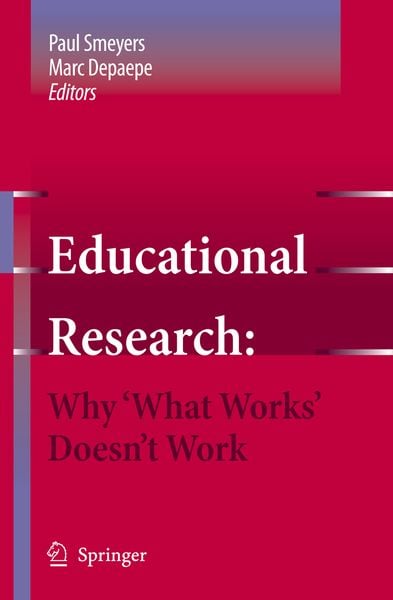
Educational Research: Why 'What Works' Doesn't Work
-
- Hardcover ausgewählt
- Taschenbuch
- eBook
-
Sprache:Englisch
96,99 €
UVP
109,99 €
inkl. gesetzl. MwSt.,
Beschreibung
Produktdetails
Einband
Gebundene Ausgabe
Erscheinungsdatum
10.11.2006
Abbildungen
VI, 196 p.
Herausgeber
Paul Smeyers + weitereVerlag
Springer NetherlandSeitenzahl
196
Maße (L/B/H)
24,1/16/1,7 cm
Gewicht
477 g
Sprache
Englisch
ISBN
978-1-4020-5307-8
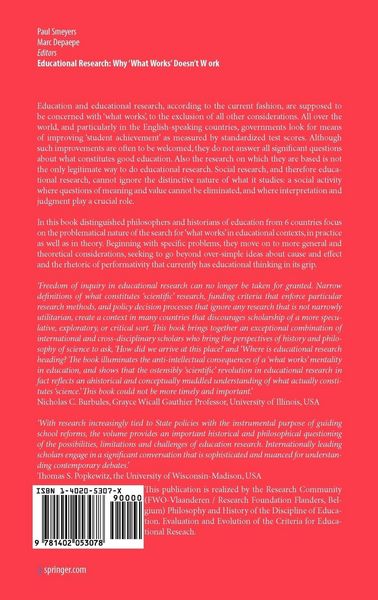
Education and educational research, according to the current fashion, are supposed to be concerned with ‘what works’, to the exclusion of all other considerations. All over the world, and particularly in the English-speaking countries, governments look for means of improving ‘student achievement’ as measured by standardized test scores. Although such improvements are often to be welcomed, they do not answer all significant questions about what constitutes good education. Also the research on which they are based is not the only legitimate way to do educational research. Social research, and therefore educational research, cannot ignore the distinctive nature of what it studies: a social activity where questions of meaning and value cannot be eliminated, and where interpretation and judgment play a crucial role.
In this book distinguished philosophers and historians of education from 6 countries focus on the problematical nature of the search for ‘what works’ in educational contexts, in practice as well as in theory. Beginning with specific problems, they move on to more general and theoretical considerations, seeking to go beyond over-simple ideas about cause and effect and the rhetoric of performativity that currently has educational thinking in its grip.
‘ Freedom of inquiry in educational research can no longer be taken for granted. Narrow definitions of what constitutes ‘scientific’ research, funding criteria that enforce particular research methods, and policy decision processes that ignore any research that is not narrowly utilitarian, create a context in many countries that discourages scholarship of a more speculative, exploratory, or critical sort.
This book brings together an exceptional combination of international and cross-disciplinary scholars who bring the perspectives of history and philosophy of science to ask, ‘How did we arrive at this place? and ‘Where is educational research heading? Thebook illuminates the anti-intellectual consequences of a ‘what works’ mentality in education, and shows that the ostensibly ‘scientific’ revolution in educational research in fact reflects an ahistorical and conceptually muddled understanding of what actually constitutes ‘science.’ This book could not be more timely and important.’
Nicholas C. Burbules, Grayce Wicall Gauthier Professor, University of Illinois
‘ With research increasingly tied to State policies with the instrumental purpose of guiding school reforms, the volume provides an important historical and philosophical questioning of the possibilities, limitations and challenges of education research. Internationally leading scholars engage in a significant conversation that is sophisticated and nuanced for understanding contemporary debates.’
Thomas S. Popkewitz, the University of Wisconsin-Madison, USA
This publication is realized by the Research Community (FWO-Vlaanderen / Research Foundation Flanders, Belgium) Philosophy and History of the Discipline of Education. Evaluation and Evolution of the Criteria for Educational Reseach.
Noch keine Bewertungen vorhanden
Verfassen Sie die erste Bewertung zu diesem Artikel
Helfen Sie anderen Kundinnen und Kunden durch Ihre Meinung.
Kurze Frage zu unserer Seite
Vielen Dank für Ihr Feedback
Wir nutzen Ihr Feedback, um unsere Produktseiten zu verbessern. Bitte haben Sie Verständnis, dass wir Ihnen keine Rückmeldung geben können. Falls Sie Kontakt mit uns aufnehmen möchten, können Sie sich aber gerne an unseren Kund*innenservice wenden.
zum Kundenservice