Gutscheinbedingungen

**Gültig bis 06.07.2026 auf fremdsprachige Bücher online auf thalia.at, in der Thalia App ab einem Mindestbestellwert von 30€ und in allen Thalia Buchhandlungen in Österreich. In den Buchhandlungen nur gültig auf lagernde Ware. Einzelne Artikel können ausgeschlossen sein. Ausgenommen sind preisgebundene Artikel & eBooks. Pro Einkauf einmal einlösbar. Nur gültig gegen Vorlage oder im Onlineshop hinterlegter Bonuscard. Infos zur Einlösung in der Buchhandlung sind auf der Bonuscard-Vorteilspreisseite zu finden. Click & Collect nur bei Onlinevorabzahlung möglich. Keine Einlösung bei Scan & Go-Bezahlung. Keine Barauszahlung. Nicht kombinierbar mit anderen Aktionen und Gutscheinen. Gutschein wird auf max. 500€ Bestellwert angerechnet. Nicht gültig für Versandkosten und Services.

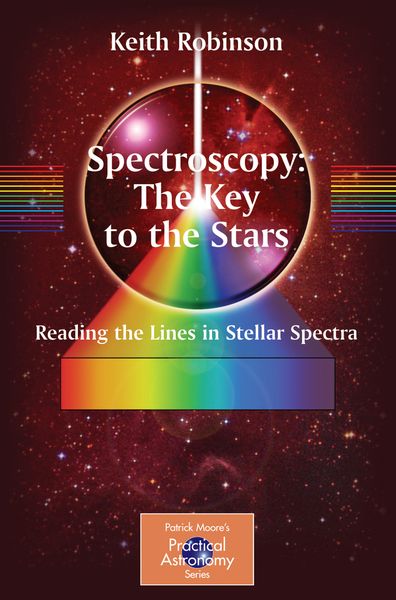
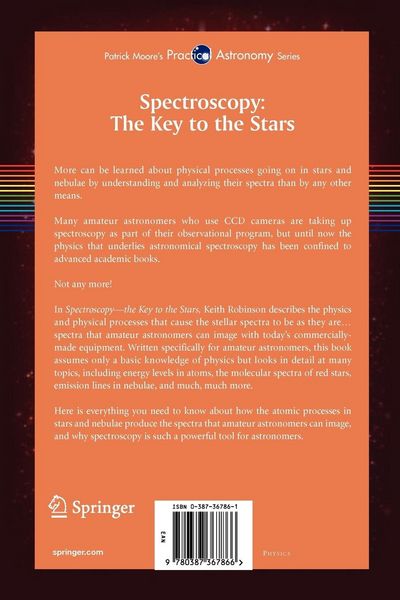
  • Produktbild: Spectroscopy: The Key to the Stars
  • Produktbild: Spectroscopy: The Key to the Stars
- 19%

Spectroscopy: The Key to the Stars Reading the Lines in Stellar Spectra

19% sparen

39,99 € UVP 49,49 €

inkl. gesetzl. MwSt., Versandkostenfrei


Beschreibung

Produktdetails

Einband

Taschenbuch

Erscheinungsdatum

16.01.2007

Abbildungen

XII, 87 illus., schwarz-weiss Illustrationen

Verlag

Springer Us

Seitenzahl

160

Maße (L/B/H)

23,3/15,7/1,5 cm

Gewicht

220 g

Auflage

2007

Sprache

Englisch

ISBN

978-0-387-36786-6

Beschreibung

Rezension

From the reviews:


"If you ever wondered what the big deal is about spectroscopy or wished you understood it a little better, this book’s for you. Robinson takes a step-by-step approach to spectroscopy, each chapter building on the ones before it. … The book is a worthy addition to any advanced amateur astronomer’s library." (Michael Bakich, Astronomy, February, 2007)


"In this informative monograph, Robinson (Royal Astronomical Society) explains the basic concepts in terms that a general reader can master. Topics such as the characteristic radiation expected to be emitted by atoms, by ionized gas, and by molecules are addressed using illustrations and word descriptions of the physical processes. … the interested reader will find this book a stimulating introduction. Summing Up: Recommended. General readers; lower-division undergraduates." (D. E. Hogg, CHOICE, Vol. 44 (11), July, 2007)


"In Spectroscopy: The Key to the Stars, Keith Robinson makes spectroscopy approachable for those who are interested in expanding their observational repertoire. … Not only is this a good read for any observer thinking of taking up spectroscopy, but it’s also suitable for high school or first-year college students in astronomy and physics." (Carolyn Collins Petersen, Sky & Telescope, Vol. 115 (1), January, 2008)


"This is a small book (160 pages) written for amateur astronomers who use CCD cameras and include spectroscopy as part of their observational program. The main purpose of the book is to describe the physics and the physical processes behind the stellar spectra. … the topics considered are clearly and concisely described. The amateur astronomers, who are not familiar with physics or who have forgotten the essentials of this science, will read it … with interest and pleasure." (Emile Biemont, Physicalia Magazine, Vol. 29 (4), 2007)

Produktdetails

Einband

Taschenbuch

Erscheinungsdatum

16.01.2007

Abbildungen

XII, 87 illus., schwarz-weiss Illustrationen

Verlag

Springer Us

Seitenzahl

160

Maße (L/B/H)

23,3/15,7/1,5 cm

Gewicht

220 g

Auflage

2007

Sprache

Englisch

ISBN

978-0-387-36786-6

Herstelleradresse

Libri GmbH
Europaallee 1
36244 Bad Hersfeld
DE

Email: gpsr@libri.de

Noch keine Bewertungen vorhanden

Verfassen Sie die erste Bewertung zu diesem Artikel

Helfen Sie anderen Kundinnen und Kunden durch Ihre Meinung.

Kundinnen und Kunden meinen

Bewertungen (0)

  • Produktbild: Spectroscopy: The Key to the Stars
  • Produktbild: Spectroscopy: The Key to the Stars
  • Spectroscopy—A New Golden Age for Amateur Astronomy.- The Basic Stuff—Light Radiation and Atoms.- Behind the Lines—The Magnificent Energy Level Structure of an Atom.- Our Old Friend the Doppler Effect.- When Is a Spectral Line Not a Spectral Line?.- Stellar Spectra and That Famous Mnemonic.- Cool but not Smooth—The Molecular Spectra of Red Stars.- Glows in the Dark—Emission Lines and Nebulae.- Glowing Vortices—Accretion Disks.- The P Cygni Profile and Friends.- Spectral Magnetism—The Zeeman Effect.- ‘How Much Gold in Them There Stars?’—The Curve of Growth.