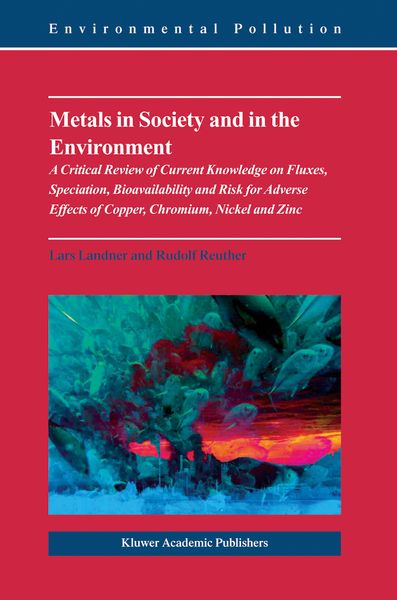
Metals in Society and in the Environment A Critical Review of Current Knowledge on Fluxes, Speciation, Bioavailability and Risk for Adverse Effects of Copper, Chromium, Nickel and Zinc
-
- Englisch ausgewählt
144,99 €
UVP
164,99 €
inkl. gesetzl. MwSt.,
Beschreibung
Produktdetails
Einband
Gebundene Ausgabe
Erscheinungsdatum
01.09.2004
Verlag
Springer NetherlandSeitenzahl
407
Maße (L/B/H)
24,1/16/2,8 cm
Gewicht
805 g
Auflage
2004
Sprache
Englisch
ISBN
978-1-4020-2740-6
In 2002, the Swedish Metal Information Task Force (MITF) engaged the Environmental Research Group (MFG) to update previous monographs on copper, zinc and major alloying metals (such as chromium, nickel and molybdenum) in society and in the environment. This book presents new results on metal fluxes from society to the environment, on metal speciation in water, soil and sediment, and its interpretation in terms of mobility, biological uptake and toxicity. The scientific fundamentals of new approaches, like the Acid Volatile Sulphide (AVS) concept to predict metal bioavailability in sediments, and the Biotic Ligand Model (BLM) to calculate the toxicity of metals to aquatic organisms, are critically evaluated, with a focus on copper, nickel, zinc, and, in part, chromium.
Recent scientific advances now offer an improved understanding of the mechanisms and factors controlling the intricate behaviour of trace metals, their interactions, uptake and effect in natural systems. Traditional risk assessment methods usually built on quite crude toxicity tests done in unrealistic "laboratory waters", and did not consider natural conditions. In contrast, modern approaches now increasingly involve the full utilisation of site-specific factors, which are decisive for the formation of bioavailable and toxic metal forms.
Audience: This book provides excellent guidance not only to scientists focusing on the assessment of the ecological risk of metals, but also to authorities, decision makers in industry, educational staff and the interested public concerned with the occurrence and fate of trace metals.
Kundinnen und Kunden meinen
Verfassen Sie die erste Bewertung zu diesem Artikel
Helfen Sie anderen Kund*innen durch Ihre Meinung
Kurze Frage zu unserer Seite
Vielen Dank für Ihr Feedback
Wir nutzen Ihr Feedback, um unsere Produktseiten zu verbessern. Bitte haben Sie Verständnis, dass wir Ihnen keine Rückmeldung geben können. Falls Sie Kontakt mit uns aufnehmen möchten, können Sie sich aber gerne an unseren Kund*innenservice wenden.
zum Kundenservice