KI-Beratung Beta

Gutscheinbedingungen

**Gültig bis 18.11.2026 auf englischsprachige Klassiker (klassiker-32728) online auf thalia.at und in der Thalia App. Einzelne Artikel können ausgeschlossen sein. Ausgenommen sind preisgebundene Artikel & eBooks. Pro Einkauf einmal einlösbar. Click & Collect nur bei Onlinevorabzahlung möglich. Keine Barauszahlung. Nicht kombinierbar mit anderen Aktionen und Gutscheinen. Gutschein wird auf max. 500€ Bestellwert angerechnet. Nicht gültig für Geschenkkarten, Versandkosten und Services.

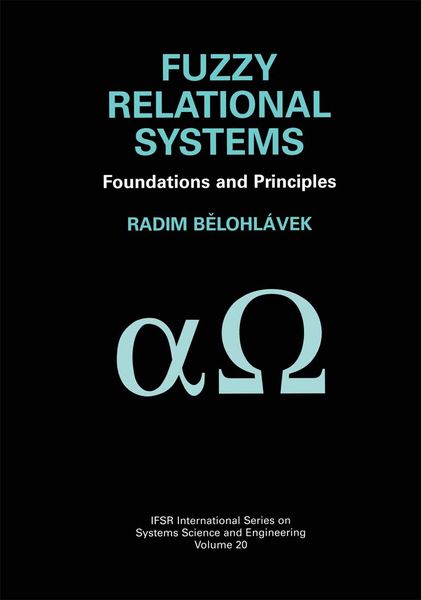
Produktbild: Fuzzy Relational Systems
Band 20

Fuzzy Relational Systems Foundations and Principles

164,99 €

inkl. gesetzl. MwSt., Versandkostenfrei


Beschreibung

Since their inception, fuzzy sets and fuzzy logic became popular. The reason is that the very idea of fuzzy sets and fuzzy logic attacks an old tradition in science, namely bivalent (black-or-white, all-or-none) judg ment and reasoning and the thus resulting approach to formation of scientific theories...

Beschreibung

Since their inception, fuzzy sets and fuzzy logic became popular. The reason is that the very idea of fuzzy sets and fuzzy logic attacks an old tradition in science, namely bivalent (black-or-white, all-or-none) judg ment and reasoning and the thus resulting approach to formation of scientific theories and models of reality. The idea of fuzzy logic, briefly speaking, is just the opposite of this tradition: instead of full truth and falsity, our judgment and reasoning also involve intermediate truth values. Application of this idea to various fields has become known under the term fuzzy approach (or graded truth approach). Both prac tice (many successful engineering applications) and theory (interesting nontrivial contributions and broad interest of mathematicians, logicians, and engineers) have proven the usefulness of fuzzy approach. One of the most successful areas of fuzzy methods is the application of fuzzy relational modeling. Fuzzy relations represent formal means for modeling of rather nontrivial phenomena (reasoning, decision, control, knowledge extraction, systems analysis and design, etc. ) in the pres ence of a particular kind of indeterminacy called vagueness. Models and methods based on fuzzy relations are often described by logical formulas (or by natural language statements that can be translated into logical formulas). Therefore, in order to approach these models and methods in an appropriate formal way, it is desirable to have a general theory of fuzzy relational systems with basic connections to (formal) language which enables us to describe relationships in these systems.

Produktdetails

Einband

Gebundene Ausgabe

Erscheinungsdatum

30.06.2002

Abbildungen

XII, 369 p.

Verlag Springer Us

Produktdetails

Einband

Gebundene Ausgabe

Erscheinungsdatum

30.06.2002

Abbildungen

XII, 369 p.

Verlag Springer Us
Seitenzahl

369

Maße (L/B/H)

26/18,3/2,6 cm

Gewicht

854 g

Sprache

Englisch

ISBN

978-0-306-46777-6

Herstelleradresse

Springer-Verlag GmbH
Europaplatz 3
69115 Heidelberg
DE

Email: ProductSafety@springernature.com

Noch keine Bewertungen vorhanden

Verfassen Sie die erste Bewertung zu diesem Artikel

Helfen Sie anderen Kundinnen und Kunden durch Ihre Meinung.

Kundinnen und Kunden meinen

Bewertungen (0)

  • Produktbild: Fuzzy Relational Systems
  • 1. Preliminaries.- 1.1 Sets, relations, mappings.- 1.2 Ordered sets, lattices.- 1.3 Tolerances, equivalences.- 1.4 Algebras.- 2. Fuzzy Approach, Graded Truth, and Structures of Truth Values.- 2.1 Fuzzy approach: from resolving paradoxes to engineering applications.- 2.2 Graded truth and structures of truth values.- 2.3 Residuated lattices.- 2.4 Residuated lattices and t-norms.- 2.5 Bibliographical remarks.- 3. Fuzzy Structures.- 3.1 Fuzzy sets and fuzzy relations.- 3.2 Fuzzy logic: syntax and semantics.- 3.3 Similarity issues.- 3.4 Morphisms, products, substructures.- 3.5 Representation by crisp structures: cutlike semantics.- 3.6 Algebras with fuzzy equalities.- 3.7 Many-sorted case.- 3.8 Bibliographical remarks.- 4. Binary Fuzzy Relations.- 4.1 Operations and properties of binary fuzzy relations.- 4.2 Similarity: fuzzy equivalences.- 4.3 Hierarchy: fuzzy order.- 4.4 Bibliographical remarks.- 5. Object-Attribute Fuzzy Relations and Fuzzy Concept Lattices.- 5.1 Conceptual granulation: fuzzy context, fuzzy concepts, and fuzzy concept lattice.- 5.2 Similarity and logical precision.- 5.3 Fuzzy Galois connections.- 5.4 Main theorem of fuzzy concept lattices.- 5.5 Bibliographical remarks.- 6. Composition and Decomposition of Fuzzy Relations.- 6.1 Composition of fuzzy relations.- 6.2 Decomposition: fuzzy relational equations.- 6.3 Bibliographical remarks.- 7. Miscellanea.- 7.1 Fuzzy closure operators and similarity spaces.- 7.2 Applications of selected results to some problems and models.- 7.3 Fuzzy logic with truth degrees in residuated lattices.- 7.4 Bibliographical remarks.- References.