KI-Beratung Beta

Gutscheinbedingungen

**Gültig am 27.11.2026 auf Spielzeug, Schreibwaren, Filme, Geschenke & Trends, Musik, tolino eReader & Zubehör, Hörbücher und Hörbuch-Downloads, nicht preisgebundene Bücher und Kalender online auf thalia.at und in der Thalia App. Einzelne Artikel können ausgeschlossen sein. Aufgrund der Buchpreisbindung sind deutschsprachige Bücher und eBooks ausgenommen. Zusätzlich ausgenommen sind Abos & Flatrates, Games, Geschenkkarten/-boxen, Shelfies, Software, Zeitschriften sowie einzelne Artikel von tonies®. Pro Einkauf einmal einlösbar. Click & Collect nur bei Onlinevorabzahlung möglich. Keine Barauszahlung. Nicht kombinierbar mit anderen Aktionen und Gutscheinen. Gutschein wird auf max. 500€ Bestellwert angerechnet. Nicht gültig für Versandkosten und Services.

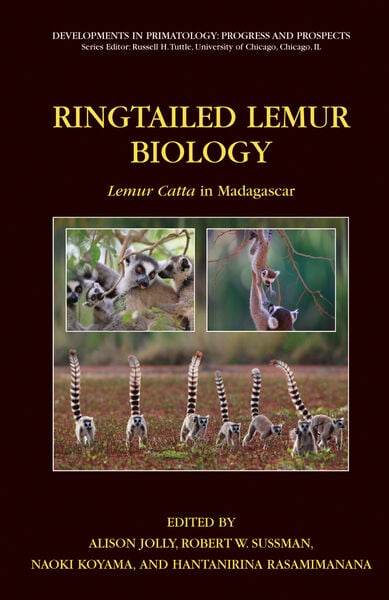
Produktbild: Ringtailed Lemur Biology
- 12%

Ringtailed Lemur Biology Lemur catta in Madagascar

12% sparen

144,99 € UVP 164,99 €

inkl. gesetzl. MwSt., Versandkostenfrei


Beschreibung

This book is a truly international collaboration, with editors based on four con- nents and first authors from Canada, France, Japan, Madagascar, the United Kingdom, and the United States. Clearly, there is something attractive about studying Lemur catta, the ringtailed lemur. Perhaps it is the lemurs...

Beschreibung

This book is a truly international collaboration, with editors based on four con- nents and first authors from Canada, France, Japan, Madagascar, the United Kingdom, and the United States. Clearly, there is something attractive about studying Lemur catta, the ringtailed lemur. Perhaps it is the lemurs themselves! Why study ringtailed lemurs? Because lemurs are a separate radiation of p- mates from the monkeys, apes, and humans. Because ringtails live in the largest social groups of any known lemur and therefore offer the closest comparison with other social primates, including ourselves. And also because ringtails have become the flagship species of Madagascar. Some 70 species or subspecies of lemurs inhabit Madagascar. Each kind has its own fascinating story, but ringtails are the ones that everyone thinks they know. That black-and-white tail adorns tourist brochures and school notebooks and banknotes. All the same, after 40 years of field study, we don’t know nearly enough. In this book, we make a first estimate on how many might be alive today, but we do not know how many ri- tailed lemurs and how many southern forests will survive. This book explores part of what we do know. Its four sections are (I) Distribution: Ringtailed Lemurs in Madagascar, (II) Ringtails and Their Forests: Feeding and Ranging Behavior, (III) Social Behavior Within and Between Troops, and finally (IV) Health and Disease. Of course, all these issues are int- related.

Rezension

From the reviews:


"I can point … this book as the perfect place to get ‘cool stuff’ on ringtailed lemurs. … this book is a must-have and instant classic for any existing or budding researchers with an interest in ringtailed lemurs. The data will be of interest to anyone conducting meta-analysis studies of primate diets. … the book will find its way onto the bookshelves of many professional primatologists and mammologists. I also think that the book will be of interest to amateur naturalists and students … ." (Shawn M. Lehman, Journal of Mammalian Evolution, Vol. 15, 2008)

Produktdetails

Einband

Gebundene Ausgabe

Erscheinungsdatum

30.08.2006

Abbildungen

XVI, 378 p. 120 illus., 2 illus. in color.

Herausgeber Alison Jolly + weitere

Produktdetails

Einband

Gebundene Ausgabe

Erscheinungsdatum

30.08.2006

Abbildungen

XVI, 378 p. 120 illus., 2 illus. in color.

Herausgeber
Verlag Springer Us
Seitenzahl

378

Maße (L/B/H)

24,1/16/2,9 cm

Gewicht

779 g

Sprache

Englisch

ISBN

978-0-387-32669-6

Herstelleradresse

Springer-Verlag GmbH
Europaplatz 3
69115 Heidelberg
DE

Email: ProductSafety@springernature.com

Noch keine Bewertungen vorhanden

Verfassen Sie die erste Bewertung zu diesem Artikel

Helfen Sie anderen Kundinnen und Kunden durch Ihre Meinung.

Kundinnen und Kunden meinen

Bewertungen (0)

  • Produktbild: Ringtailed Lemur Biology
  • Distribution: Ringtailed Lemurs in Madagascar.- The Distribution and Biogeography of the Ringtailed Lemur (Lemur catta) in Madagascar.- A Preliminary Estimate of Lemur catta Population Density Using Satellite Imagery.- Berenty Reserve: A Research Site in Southern Madagascar.- Beza Mahafaly Special Reserve: A Research Site in Southwestern Madagascar.- Ringtails and Their Forests: Feeding and Ranging.- Plant Species Fed on by Lemur catta in Gallery Forests of the Southern Domain of Madagascar.- Tamarind Recruitment and Long-Term Stability in the Gallery Forest at Berenty, Madagascar.- Home Ranges of Ringtailed Lemur Troops.- The Influence of Tamarind Tree Quality and Quantity on Lemur catta Behavior.- Feeding Competition Between Introduced Eulemur fulvus and Native Lemur catta During the Birth Season at Berenty Reserve, Southern Madagascar.- Tradition and Novelty: Lemur catta Feeding Strategy on Introduced Tree Species at Berenty Reserve.- Diet Quality and Taste Perception of Plant Secondary Metabolites by Lemur catta.- Social Behavior within and Between Troops.- Territory as Bet-hedging: Lemur catta in a Rich Forest and an Erratic Climate.- Resource Defense in Lemur catta: The Importance of Group Size.- Social Changes in a Wild Population of Ringtailed Lemurs (Lemur catta) at Berenty, Madagascar.- Obsession with Agonistic Power.- Male and Female Ringtailed Lemurs' Energetic Strategy Does Not Explain Female Dominance.- Male Sociality and Integration During the Dispersal Process in Lemur catta: A Case Study.- Health and Disease.- Patterns of Health, Disease, and Behavior Among Wild Ringtailed Lemurs, Lemur catta: Effects of Habitat and Sex.- Bald Lemur Syndrome and the Miracle Tree: Alopecia Associated with Leucaena leucocephala at Berenty Reserve, Madagascar.- Temporal Change in Tooth Size Among Ringtailed Lemurs (Lemur catta) at the Beza Mahafaly Special Reserve, Madagascar: Effects of an Environmental Fluctuation.