KI-Beratung Beta

Gutscheinbedingungen

**Gültig am 20.11.2026 ab einem Mindestbestellwert von 30€ auf Spielzeug, Schreibwaren, Filme, Geschenke & Trends, Musik, tolino eReader & Zubehör, Hörbücher und Hörbuch-Downloads, nicht preisgebundene Bücher und Kalender online auf thalia.at und in der Thalia App. Einzelne Artikel können ausgeschlossen sein. Aufgrund der Buchpreisbindung sind deutschsprachige Bücher und eBooks ausgenommen. Zusätzlich ausgenommen sind Abos & Flatrates, Games, Geschenkkarten/-boxen, Shelfies, Software, Zeitschriften sowie einzelne Artikel von tonies®. Pro Einkauf einmal einlösbar. Click & Collect nur bei Onlinevorabzahlung möglich. Keine Barauszahlung. Nicht kombinierbar mit anderen Aktionen und Gutscheinen. Gutschein wird auf max. 500€ Bestellwert angerechnet. Nicht gültig für Versandkosten und Services. Preisgebundene Artikel sind vom Mindestbestellwert ausgeschlossen.

  • Produktbild: Neuroacanthocytosis Syndromes
  • Produktbild: Neuroacanthocytosis Syndromes
- 12%

Neuroacanthocytosis Syndromes

12% sparen

144,99 € UVP 164,99 €

inkl. gesetzl. MwSt., Versandkostenfrei


Beschreibung

Neuroacanthocytosis Syndromes is the first comprehensive review of a field that has not yet received the attention it deserves. Affecting the brain as well as the circulating red cells, these multi-system disorders in the past had often been mistaken for Huntington's disease. Recent breakthroughs have...

Beschreibung

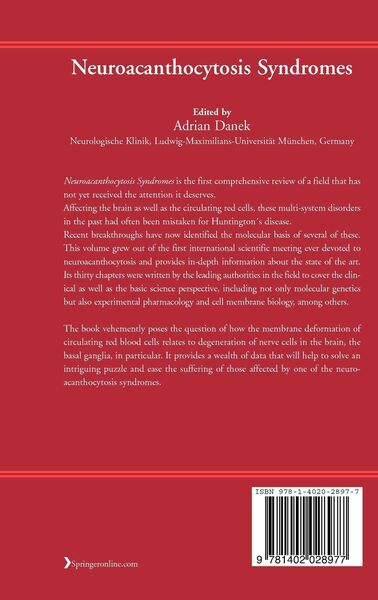
Neuroacanthocytosis Syndromes is the first comprehensive review of a field that has not yet received the attention it deserves. Affecting the brain as well as the circulating red cells, these multi-system disorders in the past had often been mistaken for Huntington's disease. Recent breakthroughs have now identified the molecular basis of several of these. This volume grew out of the first international scientific meeting ever devoted to neuroacanthocytosis and provides in-depth information about the state of the art. Its thirty chapters were written by the leading authorities in the field to cover the clinical as well as the basic science perspective, including not only molecular genetics but also experimental pharmacology and cell membrane biology, among others. The book vehemently poses the question of how the membrane deformation of circulating red blood cells relates to degeneration of nerve cells in the brain, the basal ganglia, in particular. It provides a wealth of data that will help to solve an intriguing puzzle and ease the suffering of those affected by one of the neuroacanthocytosis syndromes.

Produktdetails

Einband

Gebundene Ausgabe

Erscheinungsdatum

19.11.2004

Herausgeber Adrian Danek
Verlag Springer Netherland

Produktdetails

Einband

Gebundene Ausgabe

Erscheinungsdatum

19.11.2004

Herausgeber Adrian Danek
Verlag Springer Netherland
Seitenzahl

288

Maße (L/B/H)

24,7/16,7/2,2 cm

Gewicht

573 g

Auflage

2005 edition

Sprache

Englisch

ISBN

978-1-4020-2897-7

Herstelleradresse

Springer Nature Customer Service Center GmbH
Europaplatz 3
69115 Heidelberg
DE
ProductSafety@springernature.com

Noch keine Bewertungen vorhanden

Verfassen Sie die erste Bewertung zu diesem Artikel

Helfen Sie anderen Kundinnen und Kunden durch Ihre Meinung.

Kundinnen und Kunden meinen

Bewertungen (0)

  • Produktbild: Neuroacanthocytosis Syndromes
  • Produktbild: Neuroacanthocytosis Syndromes
  • Introduction.- 1. Neuroacanthocytosis syndromes: What links red blood cells and neurons; A. Danek. Clinical Context.- 2. The differential diagnosis of neuroacanthocytosis: An overview; F. Tison. 3. Acanthocytes and disorders of lipoprotein metabolism; K. Al-Shali and R.A. Hegele. 4. Levine-Critchley syndrome of neuroacanthocytosis: A clinical review; R.J. Hardie. 5. Chorea-acanthocytosis with the Ehime-deletion mutation; S.-I. Ueno et al. 6. McLeod syndrome: A clinical review; H.H. Jung. 7. Autosomal-dominant chorea-acanthocytosis: Report of a family and neuropathology; R.H. Walker et al. 8. Acanthocytes in pantothenate kinase associated neurodegeneration; T. Klopstock et al. 9. Diagnostic test for neuroacanthocytosis: Quantitative measurement of red blood cell morphology; A. Storch and J. Schwarz. 10. Differential diagnosis of serum creatine kinase elevation; B.G.H. Schoser and T.N. Witt. Organ Involvement.- 11. Pathology of neuroacanthosytosis and of Huntington's disease; A. Martínez et al. 12. Cognitive and neuropsychiatric findings in the McLeod syndrome and in chorea-acanthocytosis; A. Danek et al. 13. Epilepsy in neuroacanthocytosis; H. Meierkord. 14. Sleep features in chorea-acanthocytosis; L. Dolenc-Groselj et al. 15. Neuromuscular findings in eight Italian families with neuroacanthocytosis; M.T. Dotti et al. 16. Cardiac involvement in the neuroacanthocytosis syndromes; S.A. Mohiddin and L. Fananapazir. Basic Science.- 17. Erythrocyte membrane abnormalities in neuroacanthocytosis: Evidence for a neuron-erythrocyte axis?; G.J.C.G.M. Bosman et al. 18. Erythrocyte membrane anion exchange abnormalities in chorea-acanthocytosis: The band 3 network; L. de Franceschi and R. Corrocher. 19. The spectrum of mutations and possible function ofthe CHAC gene; C. Dobson-Stone et al. 20. Immunohematology of the Kell and Kx blood group systems; G. Daniels. 21. C.elegans as a disease model for neuroacanthocytosis; K. Wong and M. Hengartner. 22. The Kell blood group protein, its relation to XK and its function as an endothelin-3-converting enzyme; C.M. Redman et al. 23. Endothelins as basal ganglia transmitters; M. van den Buuse. 24. Substrates for transglutaminase-catalyzed cross-linking: Relevance to pathogenesis of Huntington's disease and chorea-acanthocytosis; M.A.B. Melone and G. Peluso. 25. Huntingon's disease animal models: What lesson can be learned for research on neuroacanthocytosis syndromes?; C.M. Kosinski. 26. Motor deficits as biomarkers in Huntington's disease: Perspectives for neuroacanthocytosis syndromes; R. Reilman. Treatment.- 27. Treatment options in Huntington's disease; M. Dose. 28. Is surgical treatment an option for chorea-acanthocytosis? J. Volkmann. 29. The potential for gene therapy of neurodenerative disorders; A. Andreu and A.D. Miller. Summary.- 30. Research agenda in neuracanthocytosis; A. Danek. Appendix.- A1. Individual sponsors. A2. Abbreviations. A3. Index. A4. Index of contributors.