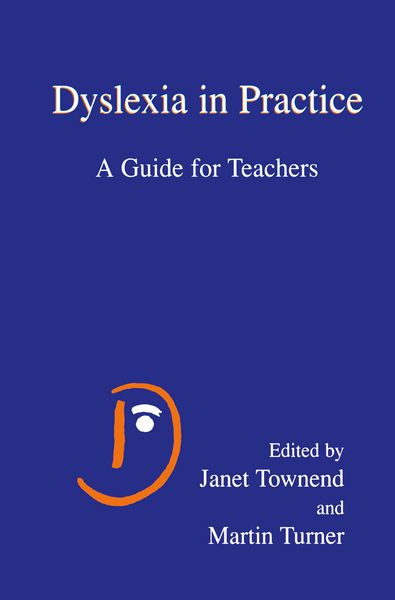
Dyslexia in Practice A Guide for Teachers
-
- Hardcover ausgewählt
- Taschenbuch
- eBook
-
Sprache:Englisch
164,99 €
inkl. gesetzl. MwSt.,
Beschreibung
Produktdetails
Einband
Gebundene Ausgabe
Erscheinungsdatum
30.09.2000
Abbildungen
XXI, 349 p.
Herausgeber
Janet Townend + weitereVerlag
Springer UsSeitenzahl
349
Maße (L/B/H)
24,1/16/2,4 cm
Gewicht
683 g
Auflage
2000
Sprache
Englisch
ISBN
978-0-306-46251-1
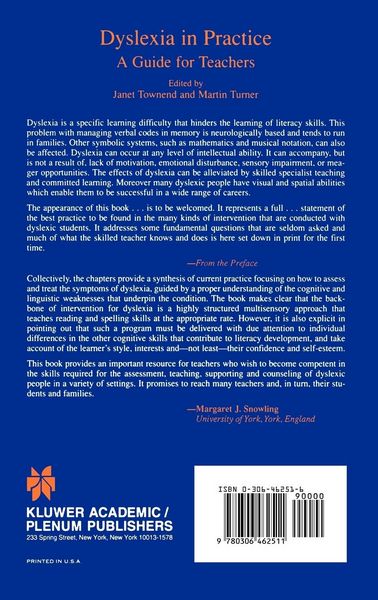
Dyslexia is a specific learning difficulty that hinders the learning of literacy skills. This problem with managing verbal codes in memory is neurologically based and tends to run in families. Other symbolic systems, such as mathematics and musical notation, can also be affected. Dyslexia can occur at any level of intellectual ability. It can accompany, but is not a result of, lack of motivation, emotional disturbance, sensory impairment or meagre opportunities. The effects of dyslexia can be alleviated by skilled specialist teaching and committed learning. Moreover many dyslexic people have visual and spatial abilities which enable them to be successful in a wide range of careers.
The appearance of this book .. is to be welcomed. It represents a full statement of the best practice to be found in the many kinds of intervention that are conducted with dyslexic students. It addresses some fundamental questions that are seldom asked and much of what the skilled teacher knows and does is set down here in print for the first time.
From the Preface:
`Collectively, the chapters provide a synthesis of current practice focusing on how to assess and treat the symptoms of dyslexia, guided by a proper understanding of the cognitive and linguistic weaknesses that underpin the condition. The book makes clear that the backbone of intervention for dyslexia is a highly structured multisensory approach that teaches reading and spelling skills at the appropriate rate. However, it is also explicit in pointing out that such a programme must be delivered with due attention to individual differences in the other cognitive skills that contribute to literacy development, and take account of the learner's style, interests and not least their confidence and self-esteem.
This book provides an important resource for teachers who wish to become competent in the skills required for the assessment, teaching, supporting and counselling of dyslexic people in a variety of settings. It promises to reach many teachers and in turn, their students and families'.
Margaret J. Snowling, University of York, UK
Noch keine Bewertungen vorhanden
Verfassen Sie die erste Bewertung zu diesem Artikel
Helfen Sie anderen Kundinnen und Kunden durch Ihre Meinung.
Kurze Frage zu unserer Seite
Vielen Dank für Ihr Feedback
Wir nutzen Ihr Feedback, um unsere Produktseiten zu verbessern. Bitte haben Sie Verständnis, dass wir Ihnen keine Rückmeldung geben können. Falls Sie Kontakt mit uns aufnehmen möchten, können Sie sich aber gerne an unseren Kund*innenservice wenden.
zum Kundenservice