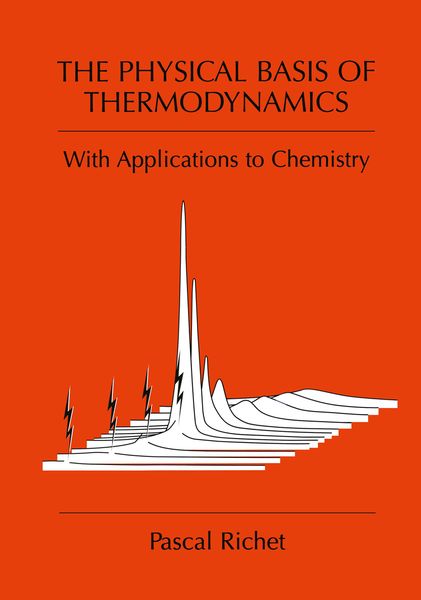

The Physical Basis of Thermodynamics With Applications to Chemistry
-
- Hardcover ausgewählt
- Taschenbuch
-
Sprache:Englisch
144,99 €
UVP
164,99 €
inkl. gesetzl. MwSt.,
Beschreibung
Produktdetails
Einband
Gebundene Ausgabe
Erscheinungsdatum
31.08.2001
Abbildungen
XXIX, 442 p.
Verlag
Springer UsSeitenzahl
442
Maße (L/B/H)
26/18,3/3,1 cm
Gewicht
1035 g
Auflage
2001
Sprache
Englisch
ISBN
978-0-306-46584-0
Given that thermodynamics books are not a rarity on the market, why would an additional one be useful? The answer is simple: at any level, thermodynamics is usually taught as a somewhat abstruse discipline where many students get lost in a maze of difficult concepts. However, thermodynamics is not as intricate a subject as most people feel. This book fills a niche between elementary textbooks and mathematically oriented treatises, and provides readers with a distinct approach to the subject. As indicated by the title, this book explains thermodynamic phenomena and concepts in physical terms before proceeding to focus on the requisite mathematical aspects. It focuses on the effects of pressure, temperature and chemical composition on thermodynamic properties and places emphasis on rapidly evolving fields such as amorphous materials, metastable phases, numerical simulations of microsystems and high-pressure thermodynamics. Topics like redox reactions are dealt with in less depth, due to the fact that there is already much literature available. Without requiring a background in quantum mechanics, this book also illustrates the main practical applications of statistical thermodynamics and gives a microscopic interpretation of temperature, pressure and entropy.
This book is perfect for undergraduate and graduate students who already have a basic knowledge of thermodynamics and who wish to truly
understand
the subject and put it in a broader physical perspective. The book is aimed not at theoretical physicists, but rather at practitioners with a variety of backgrounds from physics to biochemistry for whom thermodynamics is a tool which would be better used if better understood.
Noch keine Bewertungen vorhanden
Verfassen Sie die erste Bewertung zu diesem Artikel
Helfen Sie anderen Kundinnen und Kunden durch Ihre Meinung.
Kurze Frage zu unserer Seite
Vielen Dank für Ihr Feedback
Wir nutzen Ihr Feedback, um unsere Produktseiten zu verbessern. Bitte haben Sie Verständnis, dass wir Ihnen keine Rückmeldung geben können. Falls Sie Kontakt mit uns aufnehmen möchten, können Sie sich aber gerne an unseren Kund*innenservice wenden.
zum Kundenservice