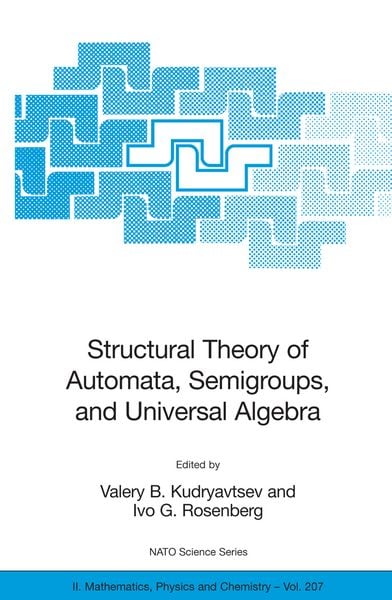
Structural Theory of Automata, Semigroups, and Universal Algebra Proceedings of the NATO Advanced Study Institute on Structural Theory of Automata, Semigroups and Universal Algebra, Montreal, Quebec, Canada, 7-18 July 2003
-
- Hardcover
- Taschenbuch ausgewählt
-
Sprache:Englisch
96,99 €
inkl. gesetzl. MwSt.,
Beschreibung
Produktdetails
Einband
Taschenbuch
Erscheinungsdatum
09.11.2005
Abbildungen
XXII, 434 p.
Herausgeber
Valery B. Kudryavtsev + weitereVerlag
Springer NetherlandSeitenzahl
434
Maße (L/B/H)
23,5/15,5/2,5 cm
Gewicht
692 g
Auflage
2005 edition
Sprache
Englisch
ISBN
978-1-4020-3816-7
Noch keine Bewertungen vorhanden
Verfassen Sie die erste Bewertung zu diesem Artikel
Helfen Sie anderen Kundinnen und Kunden durch Ihre Meinung.
Kurze Frage zu unserer Seite
Vielen Dank für Ihr Feedback
Wir nutzen Ihr Feedback, um unsere Produktseiten zu verbessern. Bitte haben Sie Verständnis, dass wir Ihnen keine Rückmeldung geben können. Falls Sie Kontakt mit uns aufnehmen möchten, können Sie sich aber gerne an unseren Kund*innenservice wenden.
zum Kundenservice