Produktbild: Aiding Decisions with Multiple Criteria
Band 44

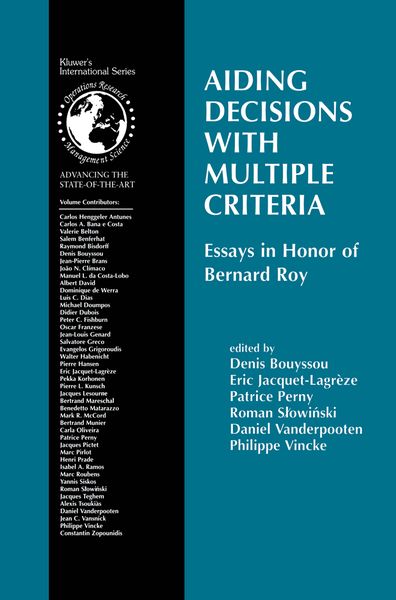
Aiding Decisions with Multiple Criteria Essays in Honor of Bernard Roy

239,99 €

inkl. gesetzl. MwSt., Versandkostenfrei


Beschreibung

Produktdetails

Einband

Gebundene Ausgabe

Erscheinungsdatum

30.11.2001

Verlag

Springer Us

Seitenzahl

558

Maße (L/B/H)

24,1/16/3,6 cm

Gewicht

1027 g

Auflage

Repr. d. Ausg. v. 2001

Sprache

Englisch

ISBN

978-0-7923-7611-8

Beschreibung

Produktdetails

Einband

Gebundene Ausgabe

Erscheinungsdatum

30.11.2001

Verlag

Springer Us

Seitenzahl

558

Maße (L/B/H)

24,1/16/3,6 cm

Gewicht

1027 g

Auflage

Repr. d. Ausg. v. 2001

Sprache

Englisch

ISBN

978-0-7923-7611-8

Herstelleradresse

Libri GmbH
Europaallee 1
36244 Bad Hersfeld
DE

Email: gpsr@libri.de

Kundinnen und Kunden meinen

0 Bewertungen

Informationen zu Bewertungen

Zur Abgabe einer Bewertung ist eine Anmeldung im Konto notwendig. Die Authentizität der Bewertungen wird von uns nicht überprüft. Wir behalten uns vor, Bewertungstexte, die unseren Richtlinien widersprechen, entsprechend zu kürzen oder zu löschen.

Die Bewertungen sind nach Format, Anzahl Sterne und Datum sortiert.

Verfassen Sie die erste Bewertung zu diesem Artikel

Helfen Sie anderen Kund*innen durch Ihre Meinung

Kundinnen und Kunden meinen

0 Bewertungen filtern

  • Produktbild: Aiding Decisions with Multiple Criteria
  • Preface. Selected Publications of Bernard Roy. Part I: Memories of Early Career and Impact of Early Works of Bernard Roy. Bernard Roy, Forty Years of Esteem and Friendship; J. Lesourne. Connectivity, Transitivity and Chromaticity: The Pioneering Work of Bernard Roy in Graph Theory; P. Hansen, D. de Werra. Part II: Philosophy and Epistemology of Decision-Aiding. Decision-Aid Between Tools and Organisations; A. David. Talking About the Practice of MCDA; V. Belton, J. Pictet. Multi-Criteria Decision-Aid in a Philosophical Perspective; J.L. Genard, M. Pirlot. Part III: Theory and Methodology of Multi-Criteria Decision-Aiding. A Characterization of Strict Concordance Relations; D. Bouyssou, M. Pirlot. From Concordance / Discordance to the Modelling of Positive and Negative Reasons in Decision Aiding; A. Tsoukiàs, et al. Exploring the Consequences of Imprecise Information in Choice Problems Using ELECTRE; L.C. Dias, J. Clímaco. Modelling in Decision Aiding; D. Vanderpooten. On the Use of Multicriteria Classification Methods: a Simulation Study; M. Doumpos, C. Zopounidis. Ordinal Multiattribute Sorting and Ordering in the Presence of Interacting Points of View; M. Roubens. Part IV: Preference Modeling. Multiattribute Interval Orders; P.C. Fishburn. Preference Representation by Means of Conjoint Measurement and Decision Rule Model; S. Greco, et al. Towards a Possibilistic Logic Handling of Preferences; S. Benferhat, et al. Empirical Comparison of Lottery- and Rating-Based Preference Assessment; O. Franzese, M.R. McCord. Risk Attitudes Appraisal and Cognitive Coordination in Decentralized Decision Systems; B. Munier. Logical Foundation ofMulticriteria Preference Aggregation; R. Bisdorff. Part V: Applications of Multi-Criteria Decision-Aiding. A Study of the Interactions Between the Energy System and the Economy Using TRIMAP; C.H. Antunes, et al. Multicriteria Approach for Strategic Town Planning; C.A. Bana e Costa, et al. Measuring Customer Satisfaction for Various Services Using Multicriteria Analysis; Y. Siskos, E. Grigoroudis. Management of the Future; J.P. Brans, et al. Part VI: Multi-Objective Mathematical Programming. Methodologies for Solving Multi-Objective Combinatorial Optimization Problems; J. Teghem. Outcome-Based Neighborhood Search (ONS); W. Habenicht. Searching the Efficient Frontier in Data Envelopment Analysis; P. Korhonen.