Gutscheinbedingungen

**Gültig von 22.06.2026 ab 19 Uhr bis 23.06.2026 24 Uhr auf Spielzeug, Schreibwaren, Filme, Geschenke & Trends, Musik, tolino eReader & Zubehör, Hörbücher und Hörbuch-Downloads (außer Abo), nicht preisgebundene Bücher und Kalender online auf thalia.at und in der Thalia App. Einzelne Artikel können ausgeschlossen sein. Aufgrund der Buchpreisbindung sind deutschsprachige Bücher und eBooks ausgenommen. Zusätzlich ausgenommen sind preisgebundene Artikel, Abos & Flatrates, eBooks, Games, Geschenkkarten/-boxen, Shelfies, Software, Zeitschriften sowie einzelne Artikel von tonies®. Pro Einkauf einmal einlösbar. Click & Collect nur bei Onlinevorabzahlung möglich. Keine Barauszahlung. Nicht kombinierbar mit anderen Aktionen und Gutscheinen. Gutschein wird auf max. 500€ Bestellwert angerechnet. Nicht gültig für Versandkosten und Services.

  • Produktbild: Programming Concepts and Methods PROCOMET ’98
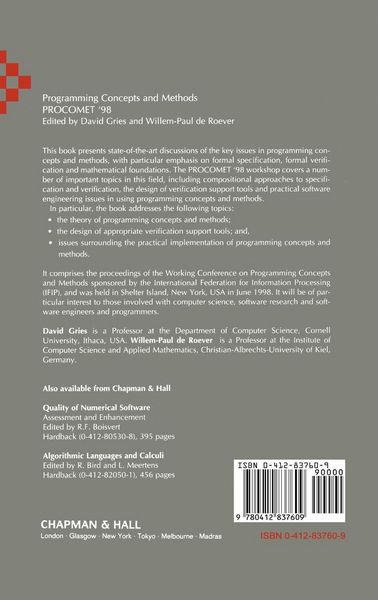
  • Produktbild: Programming Concepts and Methods PROCOMET ’98
  • Produktbild: Programming Concepts and Methods PROCOMET ’98
- 12%

Programming Concepts and Methods PROCOMET ’98 IFIP TC2 / WG2.2, 2.3 International Conference on Programming Concepts and Methods (PROCOMET ’98) 8–12 June 1998, Shelter Island, New York, USA

12% sparen

192,99 € UVP 219,99 €

inkl. gesetzl. MwSt., Versandkostenfrei


Beschreibung

Produktdetails

Einband

Gebundene Ausgabe

Erscheinungsdatum

31.05.1998

Herausgeber

David Gries + weitere

Verlag

Springer Us

Seitenzahl

486

Maße (L/B/H)

24,1/16/3,2 cm

Gewicht

906 g

Auflage

1998

Sprache

Englisch

ISBN

978-0-412-83760-9

Beschreibung

Produktdetails

Einband

Gebundene Ausgabe

Erscheinungsdatum

31.05.1998

Herausgeber

Verlag

Springer Us

Seitenzahl

486

Maße (L/B/H)

24,1/16/3,2 cm

Gewicht

906 g

Auflage

1998

Sprache

Englisch

ISBN

978-0-412-83760-9

Herstelleradresse

Springer-Verlag GmbH
Tiergartenstr. 17
69121 Heidelberg
DE

Email: ProductSafety@springernature.com

Kundinnen und Kunden meinen

0 Bewertungen

Informationen zu Bewertungen

Zur Abgabe einer Bewertung ist eine Anmeldung im Konto notwendig. Die Authentizität der Bewertungen wird von uns nicht überprüft. Wir behalten uns vor, Bewertungstexte, die unseren Richtlinien widersprechen, entsprechend zu kürzen oder zu löschen.

Die Bewertungen sind nach Format, Anzahl Sterne und Datum sortiert.

Verfassen Sie die erste Bewertung zu diesem Artikel

Helfen Sie anderen Kund*innen durch Ihre Meinung

Kundinnen und Kunden meinen

0 Bewertungen filtern

  • Produktbild: Programming Concepts and Methods PROCOMET ’98
  • Produktbild: Programming Concepts and Methods PROCOMET ’98
  • Produktbild: Programming Concepts and Methods PROCOMET ’98
  • 1 Invited lecture Extended static checking.- 2 Invited lecture From lattices to practical formal hardware verification.- 3 Invited lecture Programming with tabling in XSB.- 4 Invited lecture Verifying electronic control units: today and tomorrow.- 5 Educational session Teaching calculational logic.- 6 Types for trees.- 7 Structures for lazy semantics.- 8 A proof theory of asynchronously communicating sequential processes.- 9 Bisimulations in the join-calculus.- 10 Using state space exploration and a natural deduction style message derivation engine to verify security protocols.- 11 Programming language semantics in foundational type theory.- 12 An algebraic approach to the specification of stochastic systems.- 13 Refinement types for specification.- 14 An extension of the program derivation format.- 15 Deadlines are termination.- 16 The design of a linearization of a concurrent data object.- 17 Final semantics for the pi-calculus.- 18 Comparing CTL and PCTL on labeled Markov chains.- 19 Reactive functional programming.- 20 Imperative objects and mobile processes.- 21 Relating linear and branching model checking.- 22 Verifying duration properties of timed transition systems.- 23 Towards squiggly refinement algebra.- 24 Towards a theory of sequential hybrid programs.- 25 Test selection for object-oriented software based on formal specifications.- 26 Logical foundations for typed object-oriented languages.- 27 Verifying a self-stabilizing mutual exclusion algorithm.- 28 A combination of interval logic and linear temporal logic.- 29 A model of real-time distributed systems.- Index of contributors.- Keyword index.