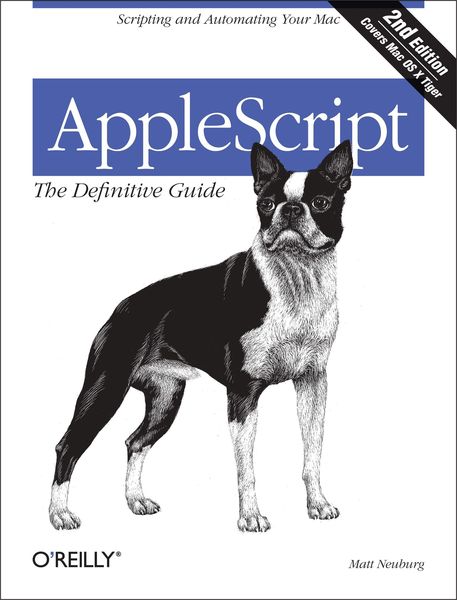
Produktbild: Applescript: The Definitive Guide

Applescript: The Definitive Guide The Definitve Guide. Covers Mac OS X Panther

35,99 €

inkl. gesetzl. MwSt., Versandkostenfrei


Beschreibung

Produktdetails

Einband

Taschenbuch

Erscheinungsdatum

07.02.2006

Verlag

O'Reilly Media

Seitenzahl

504

Maße (L/B/H)

23,3/18,1/3 cm

Gewicht

853 g

Auflage

2nd edition

Sprache

Englisch

ISBN

978-0-596-10211-1

Beschreibung

Produktdetails

Einband

Taschenbuch

Erscheinungsdatum

07.02.2006

Verlag

O'Reilly Media

Seitenzahl

504

Maße (L/B/H)

23,3/18,1/3 cm

Gewicht

853 g

Auflage

2nd edition

Sprache

Englisch

ISBN

978-0-596-10211-1

Herstelleradresse

Libri GmbH
Europaallee 1
36244 Bad Hersfeld
DE

Email: GPSR Kontakt

Noch keine Bewertungen vorhanden

Verfassen Sie die erste Bewertung zu diesem Artikel

Helfen Sie anderen Kundinnen und Kunden durch Ihre Meinung.

Kundinnen und Kunden meinen

Bewertungen (0)

Die Leseprobe wird geladen.
  • Produktbild: Applescript: The Definitive Guide
  • Preface; The Scope of This Book; Versions; How This Book Is Organized; Conventions Used in This Book; How to Contact Us; Safari® Enabled; Acknowledgments (First Edition); Acknowledgments (Second Edition); Part I: AppleScript Overview; Chapter 1: Why to Use AppleScript; 1.1 The Nature and Purpose of AppleScript; 1.2 Is This Application Scriptable?; 1.3 Calculation and Repetition; 1.4 Reduction; 1.5 Customization; 1.6 Combining Specialties; Chapter 2: Where to Use AppleScript; 2.1 Script Editor; 2.2 Internally Scriptable Application; 2.3 Script Runner; 2.4 Automatic Location; 2.5 Application; 2.6 Unix; 2.7 Hyperlinks; 2.8 AutomatorworkflowAutomator Automator AppleScriptplaces for usingAutomator; Chapter 3: Basic Concepts; 3.1 Apple Events; 3.2 The Open Scripting Architecture; 3.3 Script; 3.4 Compiling and Decompiling; 3.5 Compiled Script Files; 3.6 Script Text File; 3.7 Applet and Droplet; 3.8 Scripting Addition; 3.9 Dictionary; 3.10 Missing External Referents; 3.11 Modes of Scriptability; Part II: The AppleScript Language; Chapter 4: Introducing the Language; 4.1 A Little Language; 4.2 Extensibility and Its Perils; 4.3 The "English-likeness" Monster; 4.4 Object-likeness; 4.5 LISP-likeness; 4.6 The Learning Curve; Chapter 5: Syntactic Ground of Being; 5.1 Lines; 5.2 Result; 5.3 Comments; 5.4 Abbreviations and Synonyms; 5.5 Blocks; 5.6 The; Chapter 6: A Map of the World; 6.1 Scope Blocks; 6.2 Levels and Nesting; 6.3 The Top Level; 6.4 Code and the Run Handler; 6.5 Variables; Chapter 7: Variables; 7.2 Assignment and Retrieval; 7.3 Declaration and Definition of Variables; 7.4 Variable Names; Chapter 8: Script Objects; 8.1 Script Object Definition; 8.2 Run Handler; 8.3 Script Properties; 8.4 Script Objects as Values; 8.5 Top-Level Entities; 8.6 Compiled Script Files as Script Objects; 8.7 Inheritance; Chapter 9: Handlers; 9.1 Handler Definition; 9.2 Returned Value; 9.3 Handlers as Values; 9.4 Parameters; 9.5 Pass by Reference; 9.6 Syntax of Defining and Calling a Handler; 9.7 Event Handlers; 9.8 The Run Handler; 9.9 Recursion; 9.10 Power Handler Tricks; Chapter 10: Scope; 10.1 Regions of Scope; 10.2 Kinds of Variable; 10.3 Scope of Top-Level Entities; 10.4 Scope of Locals; 10.5 Scope of Globals; 10.6 Scope of Undeclared Variables; 10.7 Declare Your Variables; 10.8 Free Variables; 10.9 Redeclaration of Variables; 10.10 Closures; Chapter 11: Objects; 11.1 Messages; 11.2 Attributes; 11.3 Class; 11.4 Target; 11.5 Get; 11.6 It; 11.7 Me; 11.8 Properties and Elements; 11.9 Element Specifiers; 11.10 Operations on Multiple References; 11.11 Assignment of Multiple Attributes; 11.12 Object String Specifier; Chapter 12: References; 12.1 Reference as Target; 12.2 Reference as Incantation; 12.3 Creating a Reference; 12.4 Identifying References; 12.5 Dereferencing a Reference; 12.6 Trouble with Contents; 12.7 Creating References to Variables; 12.8 Reference as Parameter; Chapter 13: Datatypes; 13.1 Application; 13.2 Machine; 13.3 Data; 13.4 Boolean; 13.5 Integer, Real, and Number; 13.6 Date; 13.7 String; 13.8 Unicode Text; 13.9 File and Alias; 13.10 List; 13.11 Record; Chapter 14: Coercions; 14.1 Implicit Coercion; 14.2 Explicit Coercion; 14.3 Boolean Coercions; 14.4 Number, String, and Date Coercions; 14.5 File Coercions; 14.6 List Coercions; 14.7 Unit Conversions; Chapter 15: Operators; 15.1 Implicit Coercion; 15.2 Arithmetic Operators; 15.3 Boolean Operators; 15.4 Comparison Operators; 15.5 Containment Operators; 15.6 Concatenation Operator; 15.7 Parentheses; 15.8 Who Performs an Operation; Chapter 16: Global Properties; 16.1 Strings; 16.2 Numbers; 16.3 Miscellaneous; Chapter 17: Constants; Chapter 18: Commands; 18.1 Application Commands; 18.2 Standard Commands; 18.3 Logging Commands; Chapter 19: Control; 19.1 Branching; 19.2 Looping; 19.3 Tell; 19.4 Using Terms From; 19.5 With; 19.6 Considering/Ignoring; 19.7 Errors; 19.8 Second-Level Evaluation; Part III: AppleScript In Action; Chapter 20: Dictionaries; 20.1 Resolution of Terminology; 20.2 Terminology Clash; 20.3 Nonsensical Apple Events; 20.4 Raw Four-Letter Codes; 20.5 Multiple-Word Terms; 20.6 What's in a Dictionary; 20.7 The 'aeutaeut ' Resource; 20.8 Inadequacies of the Dictionary; Chapter 21: Scripting Additions; 21.1 Pros and Cons of Scripting Additions; 21.2 Classic Scripting Additions; 21.3 Loading Scripting Additions; 21.4 Standard Scripting Addition Commands; Chapter 22: Speed; 22.1 Tools of the Trade; 22.2 Apple Events; 22.3 List Access; 22.4 Scripting Additions; 22.5 Context; Chapter 23: Scriptable Applications; 23.1 Targeting Scriptable Applications; 23.2 Some Scriptable Applications; Chapter 24: Unscriptable Applications; 24.1 Historical Perspective; 24.2 Getting Started with Accessibility; 24.3 GUI Scripting Examples; Chapter 25: Unix; 25.1 Do Shell Script; 25.2 Osascript; Chapter 26: Triggering Scripts Automatically; 26.1 Digital Hub Scripting; 26.2 Folder Actions; 26.3 CGI Application; 26.4 Timers, Hooks, Attachability, Observability; Chapter 27: Writing Applications; 27.1 Applets; 27.2 AppleScript Studio; 27.3 Cocoa Scripting; 27.4 AppleScript Studio Scriptability; Part IV: Appendixes; Appendix A: The AppleScript Experience; A.1 The Problem; A.2 A Day in the Life; A.3 Conclusions, Lessons, and Advice; Appendix B: Apple Events Without AppleScript; B.1 Pure Raw Apple Events; B.2 JavaScript; B.3 UserTalk; B.4 Perl; B.5 Python; Appendix C: Tools and Resources; C.1 Scripting Software and Tools; C.2 Scriptable Software; C.3 AppleScript Documentation; C.4 Writing a Scripting Addition; C.5 Writing a Scriptable Application; C.6 Portals, Instruction, and Repositories; C.7 Mailing Lists; C.8 Books; C.9 Unix Scripting; Colophon;