KI-Beratung Beta

  • Produktbild: Time for Science Education
  • Produktbild: Time for Science Education
Band 8 - 13%

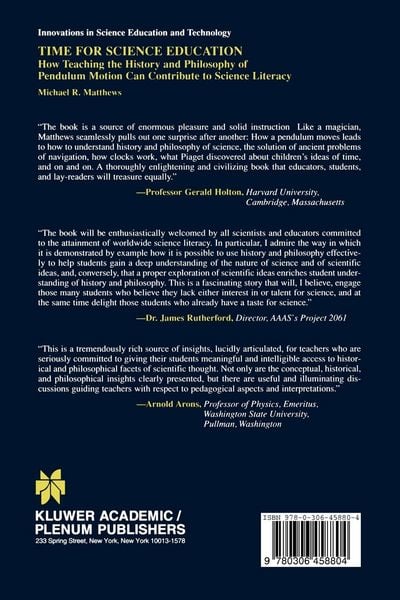
Time for Science Education How Teaching the History and Philosophy of Pendulum Motion can Contribute to Science Literacy

13% sparen

142,99 € UVP 164,99 €

inkl. gesetzl. MwSt., Versandkostenfrei


Beschreibung

The book's argument depends, as do most proposals in education, upon cer tain positions in the philosophy of education. I believe that education should be primarily concerned with developing understanding, with initiation into worth while traditions of intellectual achievement, and with developing capacities...

Beschreibung

The book's argument depends, as do most proposals in education, upon cer tain positions in the philosophy of education. I believe that education should be primarily concerned with developing understanding, with initiation into worth while traditions of intellectual achievement, and with developing capacities for clear, analytic and critical thought. These have been the long-accepted goals of liberal education. In a liberal education, students should come to know and appre ciate a variety of disciplines, know them at an appropriate depth, see the interconnectedness of the disciplines, or the modes of thought, and finally have some critical disposition toward what is being learned, to be genuinely open minded about intellectual things. These liberal goals are contrasted with goals such as professional training, job preparation, promotion of self-esteem, social engineering, entertainment, or countless other putative purposes of schooling that are enunciated by politicians, administrators, and educators. The book's argument might be consistent with other views of education especially ones about the training of specialists (sometimes called a professional view of education)-but the argument fits best with a liberal view of education. The liberal hope has always been that if education is done well, then other per sonal and social goods will follow. The development of informed, critical, and moral capacities is the cornerstone for personal and social achievements.

Rezension

`
Michael Matthews ... has just published a book that should be read by all serious physics educationists. ... Given the lamentable lack of books on physics education that try to show how the history and philosophy of science can be incorporated into real physics, Matthew's book is highly recommended.
'
Ivan Slade
in
Physics World, February 2001
`
I recommend this wide-ranging and fascinating book to all science educators, and I hope that Matthew will publish a shortened version of it for science (physics) educators and classroom teachers. The story of the pendulum, as told here, would enliven the physics classroom and make it reach beyond the textbook.
'
CJSMTE/RCESMT, 1:4 (2001)
`
Mathew's book is a true work of scholarship and I have no hesitation in urging anyone interested in informing debates about science education to read it from cover to cover.
'
Studies in Science Education

Produktdetails

Einband

Taschenbuch

Erscheinungsdatum

31.10.2000

Abbildungen

XXVIII, 440 p. 27 illus.

Verlag Springer Netherland

Produktdetails

Einband

Taschenbuch

Erscheinungsdatum

31.10.2000

Abbildungen

XXVIII, 440 p. 27 illus.

Verlag Springer Netherland
Seitenzahl

440

Maße (L/B/H)

23,5/15,5/2,6 cm

Gewicht

703 g

Auflage

Softcover reprint of the original 1st edition 2000

Sprache

Englisch

ISBN

978-0-306-45880-4

Herstelleradresse

Springer-Verlag KG
Sachsenplatz 4-6
1201 Wien
AT

Email: ProductSafety@springernature.com

Noch keine Bewertungen vorhanden

Verfassen Sie die erste Bewertung zu diesem Artikel

Helfen Sie anderen Kundinnen und Kunden durch Ihre Meinung.

Kundinnen und Kunden meinen

Bewertungen (0)

  • Produktbild: Time for Science Education
  • Produktbild: Time for Science Education
  • Acknowledgements. Preface. 1. Learning about the Pendulum and Improving Science Education. 2. Navigation and the Longitude Problem. 3. Ancient and Medieval Timekeeping. 4. Galileo and the Pendulum Clock. 5. Galileo's Analysis of Pendulum Motion. 6. Christiaan Huygens and the Pendulum Clock. 7. Perfecting Mechanical Timekeeping and Solving the Longitude Problem. 8. The Pendulum in Newton's Physics. 9. Clocks and Culture: The Clock Analogy in Philosophy and Theology. 10. Science and Philosophy: Some Lessons from the History of Pendulum Motion. 11. Teaching and Learning about Time and Pendulum Motion: Some Theoretical Considerations. 12. Teaching and Learning about Time and Pendulum Motion: Some Pedagogical Considerations. 13. Science Education and Culture. Endnotes. References. Credits.